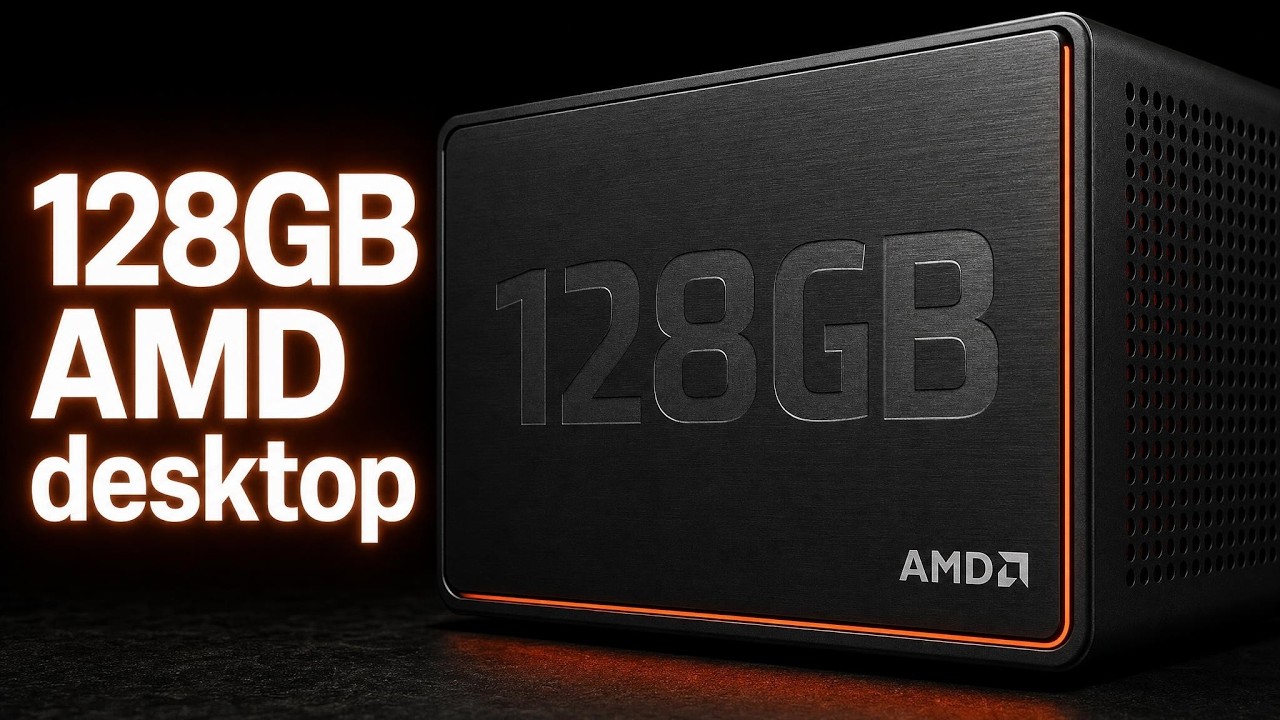
The AMD Ryzen AI Halo developer box uses a massive 128GB shared memory pool to run extremely large AI models locally, excelling in memory-intensive tasks like conversational inference but struggling with compute-heavy workloads such as video generation due to limited software support and driver stability. While ideal for researchers needing large memory capacity for AI model training and inference, its early-stage software ecosystem and performance limitations make traditional discrete GPUs a better choice for high-speed, stable compute tasks.
The AMD Ryzen AI Halo developer box is a $4,000 mini PC designed to handle massive AI models locally without a dedicated graphics card. Instead, it leverages a shared memory pool of 128GB LPDDR5x RAM, allowing the processor to allocate up to 96GB as VRAM. This approach eliminates the strict VRAM limits typical of discrete GPUs, enabling the system to run enormous models like 200 billion parameter AI models that would otherwise crash on standard consumer graphics cards. While the system boasts 126 TOPS of throughput, its primary strength lies in capacity rather than raw speed, making it ideal for workloads that require large memory rather than fast computation.
In practical tests, the Ryzen AI excels at conversational inference with large quantized models. Independent benchmarks show it can stream tokens at competitive speeds for models ranging from 7 billion to 120 billion parameters, outperforming CPU-only setups and demonstrating the hardware’s capability to handle large-scale inference tasks effectively. This confirms that for applications where fitting the model into memory is the main challenge, the AMD system delivers solid performance and fulfills its design goals.
However, when it comes to fine-tuning large language models, the hardware’s potential is hampered by a lack of official software support from AMD. Users currently rely on community-developed tools like the “amd strix halo fine tuning toolboxes” on GitHub, which, while functional, highlight the early-stage nature of the platform’s software ecosystem. This means that while the hardware can physically support training workloads due to its large memory pool, the user experience depends heavily on third-party solutions and ongoing software development.
The system struggles more with compute-intensive tasks such as image and video generation. Although image generation works with some performance limitations, video generation pushes the hardware to its limits, often causing system crashes and reboots. These issues stem from both raw compute constraints and immature software drivers, making the platform less suitable for workflows that demand high throughput or stability in graphics-heavy AI tasks. Users also face challenges with driver compatibility and software stack stability, which fluctuate frequently and require technical troubleshooting.
Ultimately, the Ryzen AI Halo developer box is best suited for users whose primary bottleneck is memory capacity rather than speed. It offers a unique solution for running and fine-tuning extremely large AI models that cannot fit into the VRAM of typical GPUs, making it valuable for researchers and developers working with massive models. However, those needing fast, stable performance for compute-heavy tasks or who rely on CUDA-based pipelines should consider traditional discrete GPUs instead. The platform’s value lies in its ability to handle large-scale AI workloads locally, but it remains an early-stage product with significant software and performance caveats.