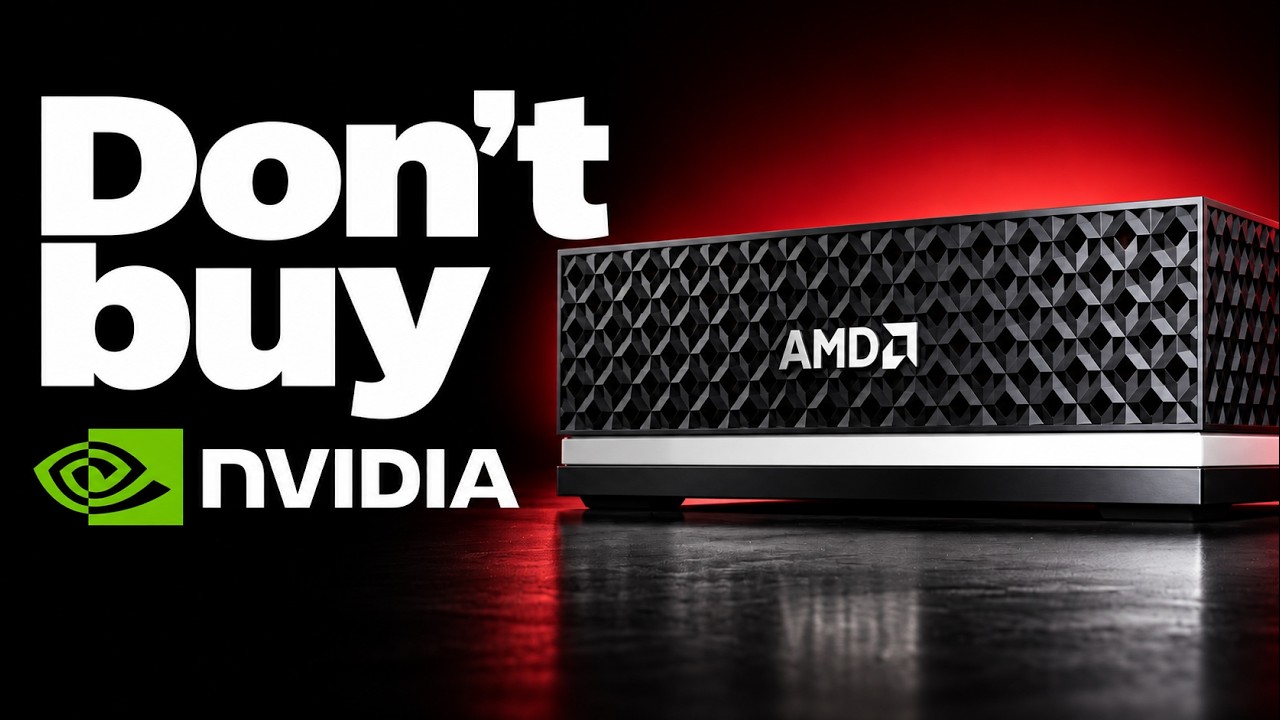
AMD offers a desktop AI workstation priced at $3,999, positioned as a competitor to NVIDIA’s $4,699 DGX Spark. While AMD’s latest chip supports a larger unified memory pool of 192GB compared to NVIDIA’s 128GB, the real-world performance depends on more than just memory size. AMD’s system uses a unified memory architecture where the CPU and integrated graphics share the same memory pool, eliminating the need for multiple GPUs and enabling large AI models to run on a compact desktop without complex setups.
The current AMD hardware available, such as the Minisforum MS S1 Max, supports up to 128GB of unified memory using the Ryzen AI Max+ 395 chip, while the newer Ryzen AI Max+ 495 chip, which supports 192GB, is not yet widely available and is expected to cost around $8,000. Despite the larger memory capacity, AMD’s system faces a significant bottleneck in memory bandwidth, capped at 256 GB/s, which is comparable to NVIDIA’s DGX Spark bandwidth of 273 GB/s. This parity means that both systems have similar limitations in how fast they can process data during AI model inference.
Performance comparisons reveal that both AMD and NVIDIA machines generate text at roughly the same speed for large models, such as the 235 billion parameter Qwen 3, with AMD achieving about 11 tokens per second and NVIDIA slightly faster with clustered DGX Sparks. However, AMD’s system struggles significantly during the prompt reading phase, where it processes input up to twelve times slower than NVIDIA. This slowdown grows exponentially with longer input contexts, attributed mainly to software and kernel inefficiencies rather than hardware limitations, undermining the advantage of AMD’s larger memory pool for handling long-context AI tasks.
The choice between these two systems ultimately depends on the user’s workload. For tasks involving short prompts or quick question-answering, AMD’s more affordable workstation offers comparable performance to NVIDIA’s much pricier setup, making it a cost-effective option. Conversely, for workloads requiring the processing of large documents, codebases, or long transcripts, NVIDIA’s superior prompt reading speed and clustering capabilities justify the higher price, as AMD’s system becomes increasingly inefficient with longer inputs.
In summary, AMD’s AI desktop presents a compelling value proposition for local AI inference with large models, especially for users with shorter input contexts. However, its software limitations in prompt processing and the higher cost of the 192GB memory variant temper its appeal for heavy-duty, long-context applications. NVIDIA’s DGX Spark remains the preferred choice for users needing fast, scalable performance with extensive input processing, despite its higher price tag. Ultimately, the decision hinges on the specific nature of the AI tasks and the importance of prompt reading speed versus memory capacity.
Useful Links