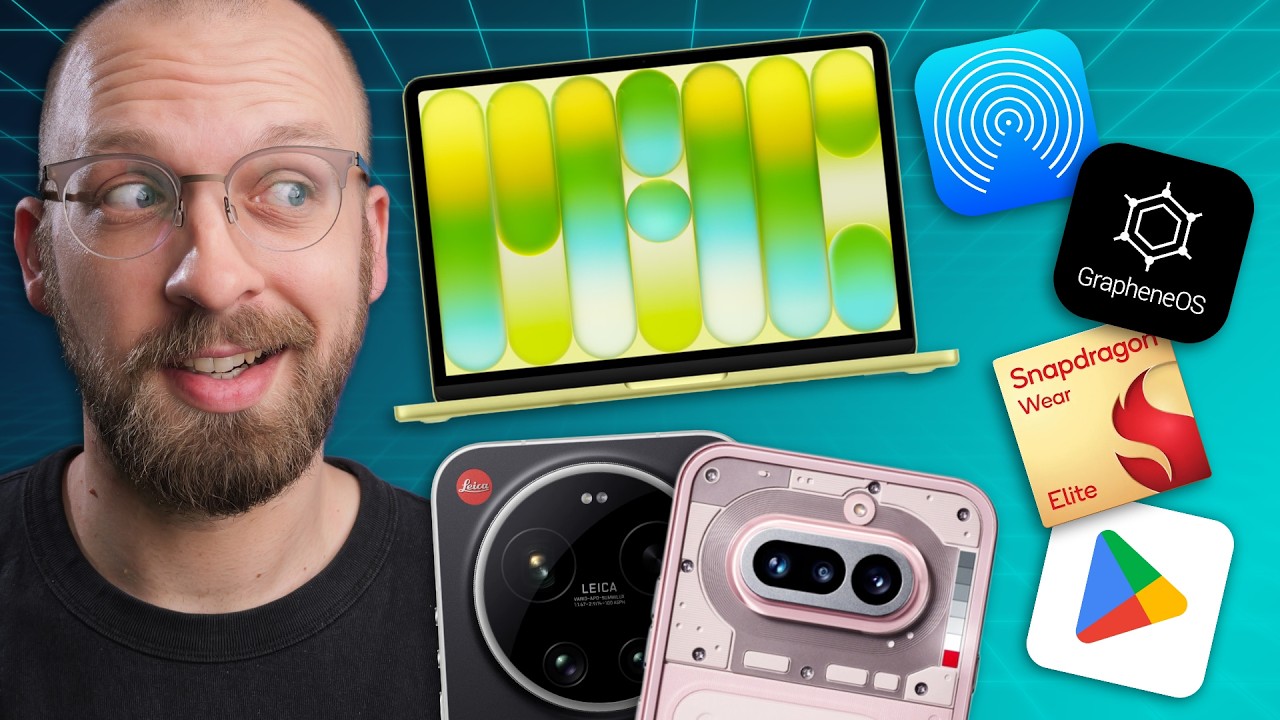
This week was unusually positive for the tech industry, with several exciting announcements from major brands. The video opens with a focus on Nothing, a company that had previously disappointed with the Phone 3 but has now launched three impressive products. The standout is the Phone 4a, which offers a stylish design, vibrant colors, a solid Snapdragon 7s Gen 4 processor, and even a periscope camera—all starting at €349. While it may not be available in the US yet, it’s considered a great value for those who don’t need wireless charging or advanced water resistance. The Nothing Phone 4 Pro, which will be available in the US for $499, features an aluminum unibody and upgraded specs, while the new Headphone A promises 135 hours of battery life at $199.
Apple also surprised many by introducing competitively priced products that challenge the perception of the brand as overpriced. The new MacBook Neo, starting at $599 ($499 with an education discount), features an A18 Pro chip and is more powerful than the older M1 MacBook Air, though it’s limited to 8GB of RAM. Despite some downgrades like the lack of a backlit keyboard, it’s seen as an excellent option for basic computing needs. Apple also refreshed its budget iPhone line with the iPhone 17e, which now offers double the storage and a new chip for $599. Other updates include new iPads with M4 chips, MacBook Air and Pro models with M5 chips, and a more affordable 27-inch Studio XDR display.
At Mobile World Congress (MWC) in Barcelona, several other brands made notable announcements. Xiaomi and Leica introduced the Leica Lights phone, an international version of the Xiaomi 17 Ultra with Leica’s design and camera software tweaks. Vivo launched the X300 Ultra, focusing on professional video features and supporting Samsung’s new APV video codec, which could become a standard for Android filmmaking. Honor unveiled the Magic V6, the world’s first foldable phone with both IP68 and IP69 certifications, and teased a collaboration with German cinema camera brand ARRI.
Lenovo showcased the Legion Go Fold concept, a foldable device that could represent a practical use for foldable screens, and the company has a track record of bringing concept devices to market. Other concepts, such as modular phones and laptops, were also mentioned, with links provided for further exploration. In the brief news section, Motorola announced a partnership with GrapheneOS for privacy-focused Android devices, Qualcomm introduced its first 3nm Snapdragon Elite chip for wearables, and Google rolled out desktop mode for Pixel phones and expanded AirDrop-like file sharing to more Android devices.
Finally, Google settled its lawsuit with Epic Games, resulting in more freedom for app developers regarding billing systems and third-party app stores. Samsung and Aqara quickly adopted a new open standard for smart door locks, enabling NFC unlocking via Samsung Wallet. The video concludes with a recommendation for the new Nebula-exclusive series “Day Pass,” which explores public transit in various cities, and a promotion for Nebula subscriptions, highlighting the platform’s quality content and special offers for viewers.