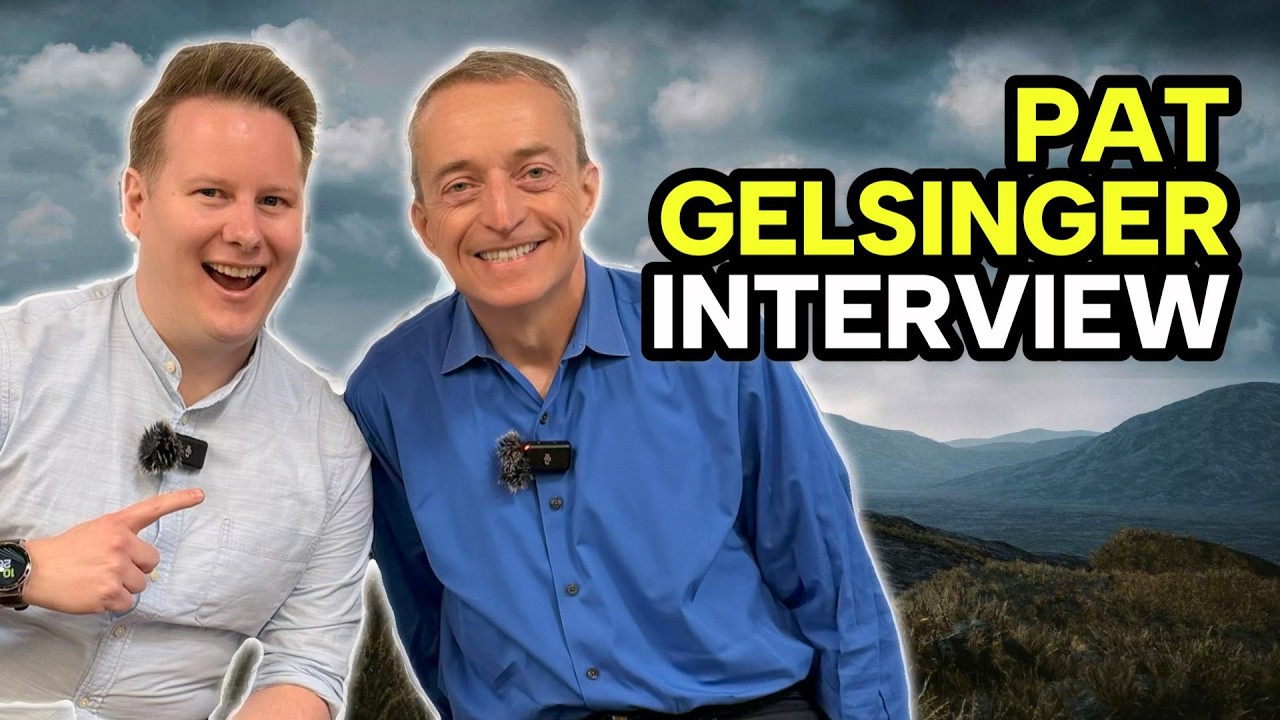
In this in-depth interview, Pat Gelsinger, recently turned 65 and now a venture capitalist at Playground Global, shares insights into his transition from leading major tech companies like Intel to investing in and mentoring deep tech startups. He reflects on his 45-year career, emphasizing his passion for making a meaningful impact by supporting innovative companies with strong leadership teams. Gelsinger discusses the challenges and excitement of learning new technologies such as quantum computing, superconducting logic, and nuclear energy, highlighting the importance of continuous learning and adaptability in the rapidly evolving tech landscape.
Gelsinger elaborates on his investment philosophy, focusing on three critical questions when evaluating startups: whether the technology works, how it can be brought to market at scale, and if the leadership team is capable of executing the vision. He stresses the value of his extensive industry network in accelerating business development and shaping CEOs into effective leaders. The conversation also touches on the current venture capital environment, noting how lead term sheets can catalyze funding rounds and the impact of Nvidia’s acquisition of Groq on the AI hardware investment landscape.
A significant portion of the discussion centers on the future of computing architectures, where Gelsinger introduces the concept of the “trinity of computing”—classical, AI-driven, and quantum computing—each suited to different workloads. He advocates for heterogeneous computing systems tailored to specific tasks rather than a one-size-fits-all approach. The interview also addresses the challenges of software development for such diverse architectures, emphasizing the need for efficient, hardware-aware programming and benchmarking to maximize performance and energy efficiency.
On the manufacturing front, Gelsinger is optimistic about advancements in semiconductor lithography, particularly through the use of free electron lasers to push beyond current EUV limits and revive Moore’s Law. He discusses the economic and technical challenges of next-generation wafer sizes and packaging technologies, advocating for innovative business models like “photons as a service” to improve capital efficiency. He also highlights the importance of government support and international collaboration in sustaining semiconductor innovation and supply chain resilience, especially in the context of geopolitical risks.
Finally, Gelsinger reflects on the broader ecosystem, including the need to nurture talent and invest in people to sustain the semiconductor industry’s future. He acknowledges the challenges faced by Europe in scaling startups and retaining talent but remains hopeful about a resurgence in hardware enthusiasm globally. Looking ahead to 2026, Gelsinger aims for multiple successful exits, foundational investments, and scaling of his faith technology platform, all while enjoying family life and philanthropic endeavors. The interview concludes on a light note with plans for a push-up contest, underscoring Gelsinger’s energetic approach to life and work.