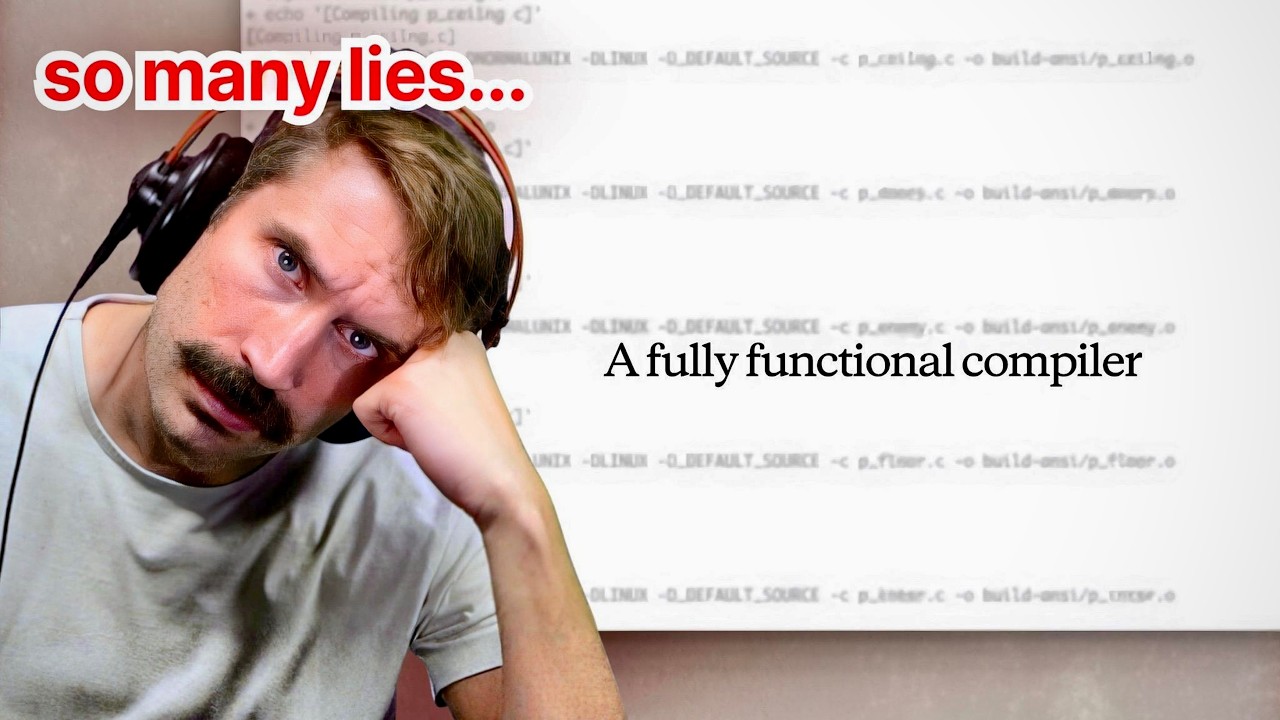
The video discusses Anthropic’s recent marketing campaign, which claims that their AI model, Claude, autonomously built a C compiler from scratch without human intervention. The narrator initially acknowledges the technical achievement and the impressive demonstration, noting that the compiler could supposedly build complex software like Linux, SQLite, Redis, Lua, and even Doom. However, the narrator quickly expresses skepticism about the honesty of Anthropic’s claims, suggesting that the company’s framing of the project is misleading and part of a broader trend of AI hype.
Delving into the details, the narrator explains that Anthropic’s process involved orchestrating 16 AI agents to collaboratively write a Rust-based C compiler over two weeks, incurring significant cloud computing costs. While the end result was a 100,000-line compiler capable of building Linux 6.9 for multiple architectures, the narrator points out that the project was not truly “from scratch.” The AI had access to decades of open-source test suites and the existing GCC compiler as an “online oracle” for validation, which is a significant advantage compared to genuine ground-up development.
The narrator further critiques the claim that the compiler could fully build Linux, clarifying that it could not produce a bootable Linux kernel due to limitations in generating sufficiently small 16-bit x86 code. This technical shortcoming undermines the assertion that the AI-built compiler is fully functional for all intended purposes. The narrator also highlights that the process was not entirely autonomous, as human intervention was required to restart the system when it crashed and to keep the project on track.
Beyond the technical aspects, the video criticizes Anthropic’s marketing language, accusing the company of exaggerating the autonomy and novelty of their achievement. The narrator notes that the real accomplishment was orchestrating multiple AI agents to work together on a large project with minimal human oversight, which is indeed impressive. However, the company’s decision to frame the project as a revolutionary, fully autonomous feat is seen as disingenuous and part of a pattern of overhyping AI capabilities.
In conclusion, the narrator calls for greater honesty in AI marketing, arguing that the technology is already impressive without the need for misleading claims. They suggest that Anthropic’s models have significant potential and that more transparent communication would foster greater excitement and support from the tech community. The video ends with a tongue-in-cheek offer to review Anthropic’s future marketing materials for free, emphasizing the value of honesty over hype in advancing the field of AI.