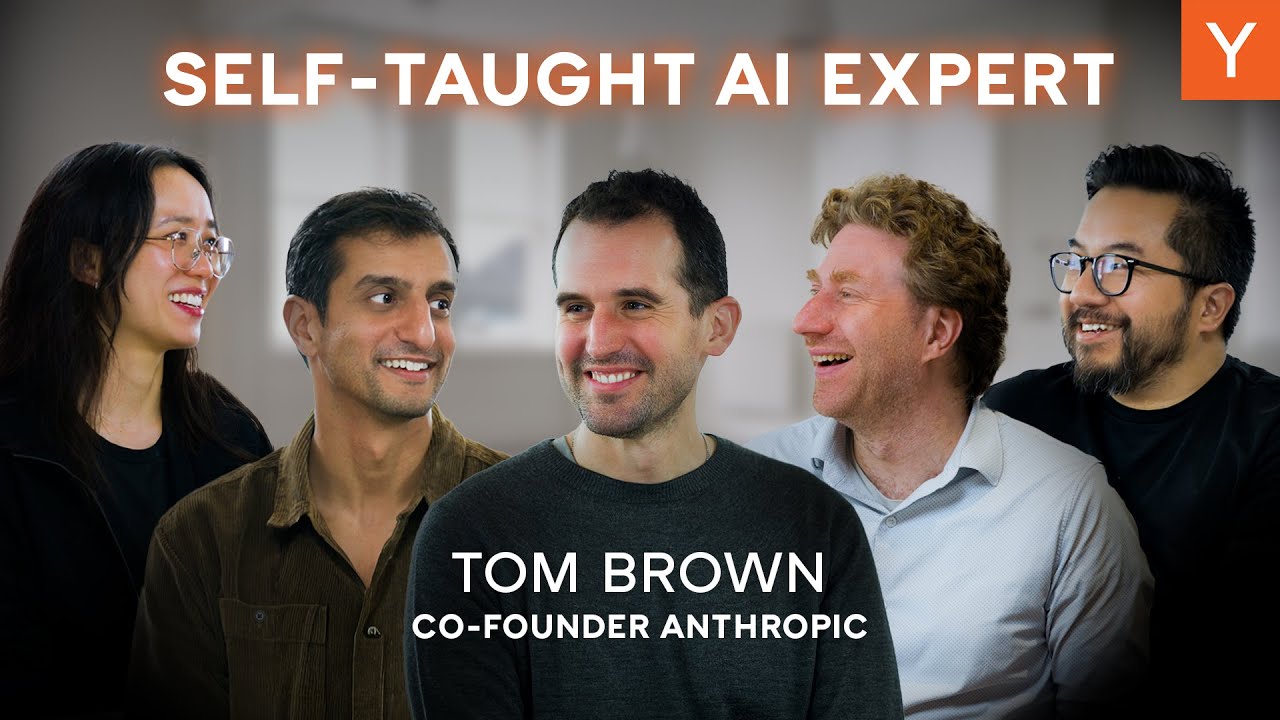
The video features Tom Brown, co-founder of Anthropic, sharing his journey from a fresh MIT graduate to a key figure in AI development. Starting as an early employee at startups, Tom embraced a “wolf” mindset of self-driven problem-solving rather than waiting for tasks, which shaped his approach to building impactful technology. After several startup experiences, including Grouper, a group dating app, he pivoted towards AI research despite initial doubts about his qualifications, undertaking six months of intensive self-study to prepare for roles at leading AI institutions like OpenAI and Google Brain.
Tom joined OpenAI early on, initially contributing to engineering projects such as creating a Starcraft environment, before playing a significant role in the transition from TPU to GPU infrastructure that enabled the scaling of GPT-3. He highlights the importance of the scaling laws discovered by researchers like Dario Amodei, which demonstrated a predictable increase in AI model performance with more compute power, a principle that guided much of the development in large language models (LLMs). Despite skepticism from some quarters about the cost and approach, this scaling strategy proved transformative.
In 2021, Tom and a group of colleagues spun off from OpenAI to form Anthropic, driven by a shared mission to build safe and aligned AI systems. Starting with seven co-founders, they focused initially on building the necessary training infrastructure and securing compute resources. Their first product, Claude, was developed cautiously with an emphasis on safety and alignment, launching publicly after ChatGPT’s debut. The company experienced uncertainty about success until breakthroughs with Claude 3.5 and Claude Code, which excelled particularly in coding tasks, gaining significant traction among developers and startups.
Anthropic’s approach emphasizes building tools and APIs that empower developers and treat the AI model itself as a user, enabling more effective interaction and productivity. Claude Code, an internal tool turned product, exemplifies this philosophy by serving as a powerful coding assistant that can handle complex tasks like decompiling binaries. Tom notes that their success partly stems from focusing on genuine utility rather than optimizing for benchmarks, contrasting with other labs that often “teach to the test.” This developer-centric focus has helped Anthropic carve out a strong position in the competitive AI landscape.
Finally, Tom discusses the massive scale of AI infrastructure buildout underway, comparing it to historic projects like Apollo and Manhattan but on a much larger scale, with compute spending tripling annually. Anthropic uses a diverse hardware strategy, leveraging GPUs, TPUs, and other accelerators to optimize performance and flexibility despite the complexity it adds. Looking ahead, power availability and data center expansion in the US are key bottlenecks. Tom advises young people entering the AI field to take risks and focus on work that excites them intrinsically rather than chasing traditional credentials, emphasizing the unique opportunities in the rapidly evolving AI ecosystem.