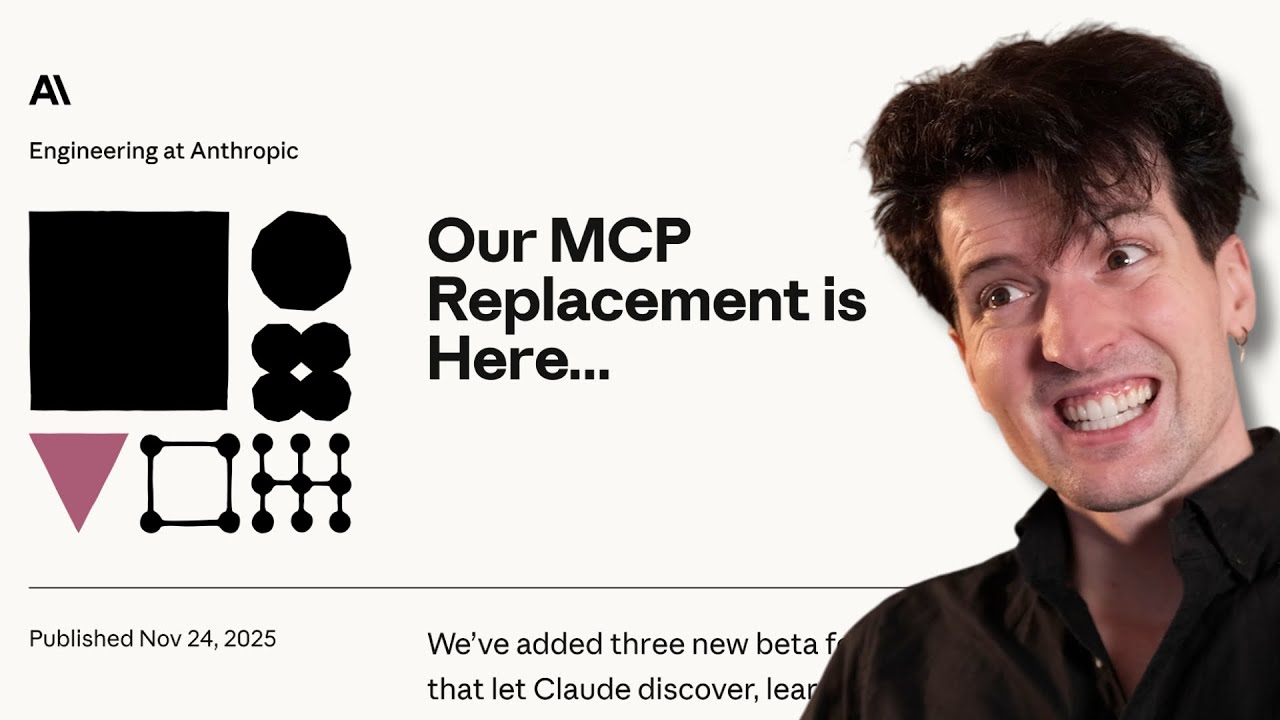
The video discusses the challenges and ongoing efforts by Anthropic to improve the Model Context Protocol (MCP), a standard used for AI agents to interact with various tools. The speaker expresses skepticism about MCP, highlighting its inefficiencies, such as the need to include all tool definitions in the model’s context upfront, which leads to bloated context windows, slower performance, and increased costs. This approach forces the model to process tens of thousands of tokens of irrelevant information during each interaction, making the system less efficient and more error-prone.
Anthropic is addressing these issues by introducing advanced tool use features on their Claude developer platform. These include a tool search tool that allows the model to discover and load only the necessary tools on demand, significantly reducing context bloat and improving accuracy. Additionally, programmatic tool calling enables Claude to write and execute code to orchestrate multiple tools in a single step, rather than making multiple natural language tool calls. This reduces inference overhead, minimizes context pollution from intermediate results, and improves reliability by letting the model filter and process data more effectively.
Another key improvement is the introduction of tool use examples, which provide concrete usage patterns for tools rather than relying solely on JSON schemas. This helps the model understand when and how to use optional parameters and complex nested structures correctly, reducing errors in tool invocation. Together, these three features—tool search, programmatic tool calling, and tool use examples—aim to tackle different bottlenecks in the MCP workflow, making AI agents more scalable, precise, and efficient.
Despite these advancements, the speaker criticizes the complexity and layering of solutions required to make MCP workable. The protocol demands running persistent servers, managing large context windows, and dealing with caching challenges that can break when tool definitions change dynamically. The speaker also points out potential security risks, such as prompt injection attacks, and expresses frustration with the convoluted engineering required to maintain and improve MCP-based systems. They suggest that the industry might benefit from adopting better protocols, like ACP, or learning from teams like Zed, who focus on developer experience and simpler, more effective solutions.
In conclusion, while Anthropic’s new features represent meaningful progress in addressing MCP’s shortcomings, the overall system remains complicated and somewhat fragile. The video emphasizes the need for more streamlined, developer-friendly approaches to tool integration in AI agents. The speaker remains cautiously optimistic but critical, highlighting that the current state of MCP and its fixes feel like patching a fundamentally flawed standard rather than building a robust foundation. The video ends with a call for better design and simpler protocols to truly unlock the potential of AI agents working with vast tool libraries.