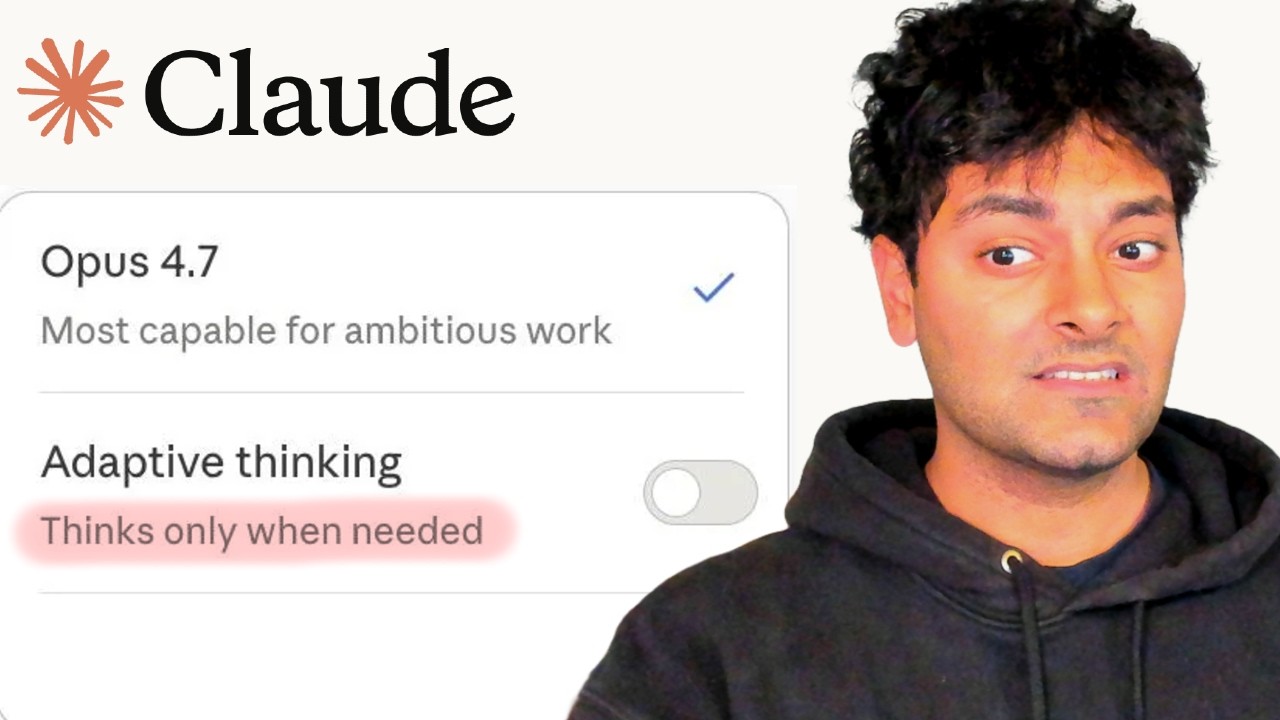
Anthropic recently released Claude Opus 4.7, a new AI model that some have hyped as a breakthrough signaling the arrival of AGI (Artificial General Intelligence). However, the speaker argues that this release is not as significant as some claim. While Opus 4.7 shows improvements over previous versions like 4.6 and 4.5 in benchmarks, the differences are relatively minor in practical use. The truly advanced model, Mythos, remains unreleased to the public due to concerns about its potential to find serious security vulnerabilities, and is only accessible to select government agencies and companies.
Benchmarks for AI models, including Opus 4.7, are often misleading and can be manipulated, making it difficult to gauge true progress. Although Opus 4.7 performs better in most categories compared to its predecessors, it is not drastically superior in real-world applications. The speaker notes that some features, such as adaptive thinking—which allows the model to decide when to engage in deeper reasoning—are controversial and may be attempts by Anthropic to manage computational costs. This adaptive thinking is off by default, meaning the model sometimes chooses not to “think” deeply unless prompted by higher effort settings.
Anthropic has also introduced changes that affect user experience and cost, such as increasing token usage by about 35%, which could raise expenses for users. While the company has raised rate limits to compensate, the changes have caused confusion and frustration among users. Additionally, Anthropic has faced criticism for lack of transparency, sudden changes to default settings, and perceived restrictions on model capabilities, which some interpret as attempts to control usage or limit potential misuse, especially in cybersecurity contexts.
The speaker highlights ongoing tensions in the AI industry, contrasting Anthropic’s cautious, ethics-focused approach with OpenAI’s more open and commercially aggressive stance. Anthropic has resisted certain government uses of its technology, whereas OpenAI has been more willing to collaborate with government agencies. Despite Anthropic’s flaws and PR challenges, the speaker credits the company for its commitment to security and ethical considerations, even if their communication and implementation sometimes fall short.
In conclusion, while Claude Opus 4.7 offers incremental improvements and some new features, it is not a revolutionary leap forward. The speaker remains skeptical about the hype surrounding each new AI release and emphasizes the importance of competition in the AI space. They suggest that users should temper expectations and recognize that meaningful advancements may come more slowly and cautiously, especially given the complex ethical and technical challenges involved. Overall, Opus 4.7 is a step forward but not a game-changer.