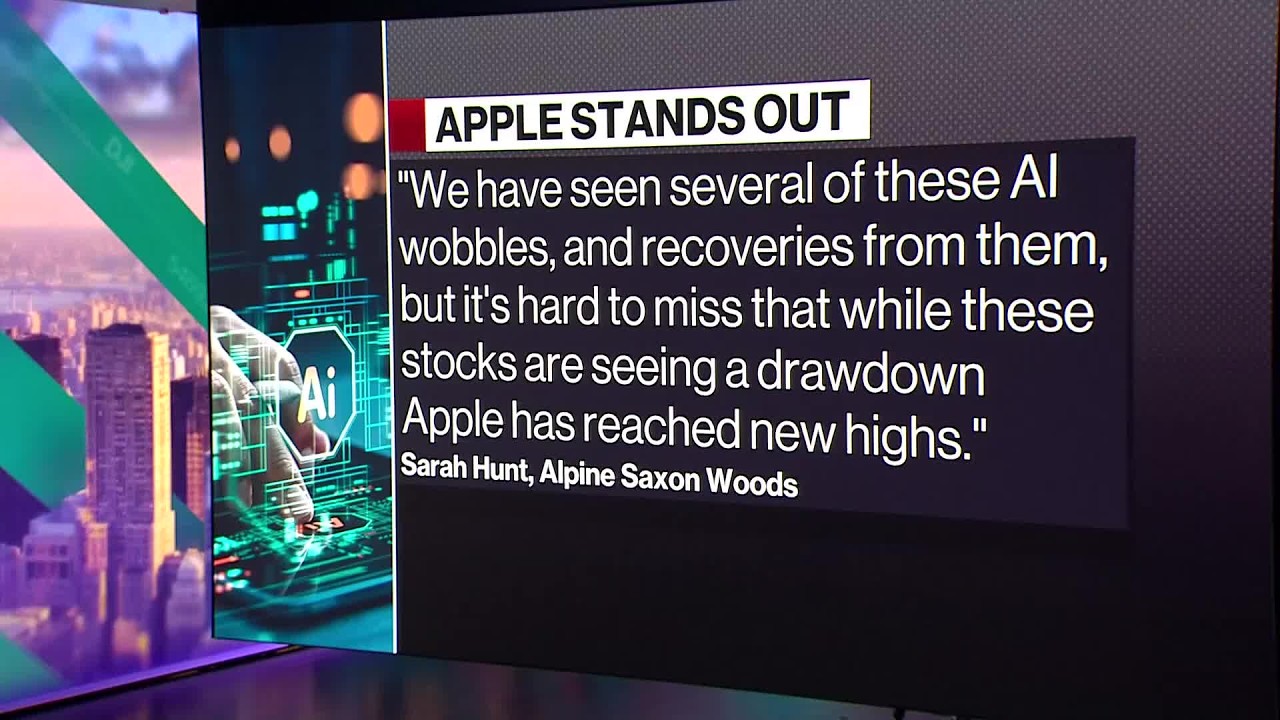
Sarah Hunt, chief market strategist at Jackson Woods, discusses Apple’s recent performance and its position in the market. She notes that Apple experienced a period of underperformance while AI-focused stocks gained excitement. However, with an upcoming hardware cycle and ongoing interest in AI, Apple is poised to regain attention. Unlike some other companies, Apple has not aggressively raised cash for AI investments, which may position it as a more stable player in the AI trade.
Regarding the broader AI trade, Hunt highlights the volatility and uncertainty surrounding these stocks. She compares the current AI enthusiasm to the dot-com bubble, emphasizing that while AI has transformative potential, there are still many unknowns about business models, token pricing, and return on investment. The rapid rise in stock prices has led to some profit-taking, and investors remain cautious about how quickly companies can build infrastructure and monetize AI technologies.
Hunt also points out a shift in investor sentiment towards capital expenditure (CapEx). Previously, heavy spending was rewarded, but now companies are being penalized for aggressive CapEx. This could lead to a more sustainable and repeatable spending cadence, which might be more acceptable to investors. However, the market is still grappling with understanding the long-term viability and profitability of AI investments, contributing to ongoing uncertainty.
Beyond AI, Hunt identifies other promising areas for growth, including healthcare, financials, and biotech sectors. She mentions that early-stage companies in these fields are attracting attention, either through acquisitions or renewed investor interest. Companies with strong cash flow and diversified revenue streams are also gaining favor, as investors look for stability amid the AI-driven market rotation.
Finally, Hunt addresses macroeconomic concerns, particularly inflation and rising oil prices, which have reignited market anxieties. While there was initial relief when oil prices dropped, the recent rebound above $80 per barrel has raised fears about persistent inflation. This complicates the Federal Reserve’s rate hike strategy, with investors uncertain about future monetary policy moves. The market is currently pricing in a July rate hike but remains cautious about potential increases later in the year, contributing to a nervous and volatile investment environment.