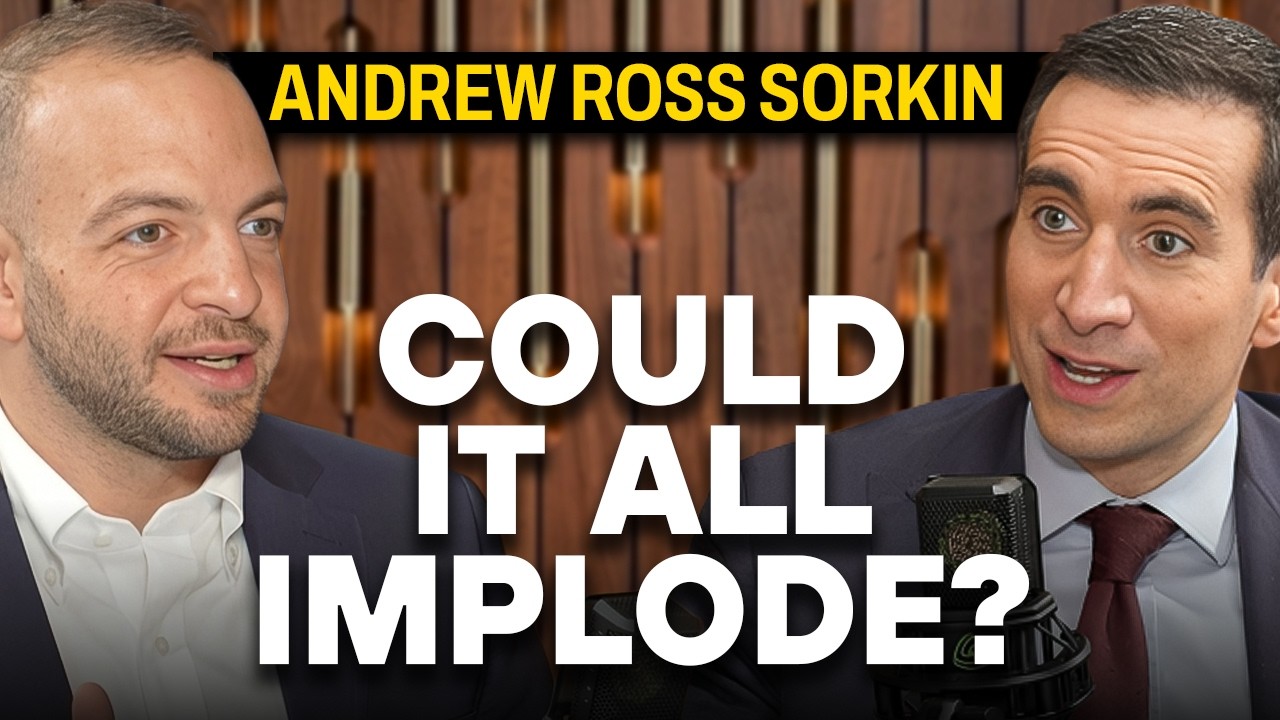
Certainly! Here’s a five-paragraph summary of the conversation between Andrew Ross Sorkin and the host, focusing on the risks and implications of AI for the economy, labor, markets, and broader societal trends:
The discussion opens with the question of whether AI could cause a market crash—not by failing, but by working too well. Sorkin, referencing his book “1929,” notes that massive investments in AI could lead to a new kind of disruption. Rather than a traditional crash, the concern is that AI-driven productivity could lead to widespread job displacement, especially if AI becomes capable of replacing large segments of the workforce. While previous technological revolutions have caused painful transitions, Sorkin suggests that the scale and speed of AI’s impact could be unprecedented, potentially leading to high unemployment and increased inequality.
The conversation explores whether AI will truly cause mass unemployment or if it will instead create new opportunities and economic growth. The host is skeptical that AI will lead to permanent job loss, arguing that increased productivity could expand the economy and generate new types of work. Sorkin counters that while new opportunities may arise, the benefits are likely to be concentrated among those who already have capital or are at the top of the economic hierarchy. He illustrates this with examples from his own experience, where AI tools have replaced the need for certain professional services, suggesting that many traditional roles—especially entry-level or routine jobs—could disappear.
Attention then shifts to the capital side of the equation, particularly the massive investments in AI infrastructure and the role of private credit. Sorkin and the host discuss the risks associated with the current funding model, where much of the AI buildout is financed through opaque private credit markets. They note that if AI fails to deliver on its exponential promise, or if the economics of data centers and chips change rapidly, there could be a financial reckoning reminiscent of past bubbles. The conversation also touches on the potential for a mismatch between the pace of technological progress and the sustainability of current investments, drawing parallels to the dot-com bubble.
The broader societal implications are also examined, particularly the shift in the American dream and the rise of speculative behavior among individuals. Sorkin argues that the post-WWII era of stable, middle-class prosperity was an anomaly, and that today’s environment—marked by inequality and a lack of economic security—drives people toward riskier financial behaviors, such as crypto, sports betting, and prediction markets. This “lottery ticket” mentality is seen as both a symptom and a cause of instability, as people seek agency in a system they feel is stacked against them.
Finally, the conversation addresses the resilience of financial institutions and the role of government intervention. Sorkin notes that while regulations and bailouts have helped prevent crashes on the scale of 1929, the growing national debt and potential erosion of Federal Reserve independence could limit future responses to crises. The discussion concludes with reflections on the importance of Fed independence, the risks of socializing losses, and the challenges of navigating an economy transformed by AI and financial innovation. Sorkin remains cautiously optimistic that a crash on the scale of 1929 is less likely today, but warns that the combination of technological disruption, financial leverage, and political uncertainty could still create significant challenges.