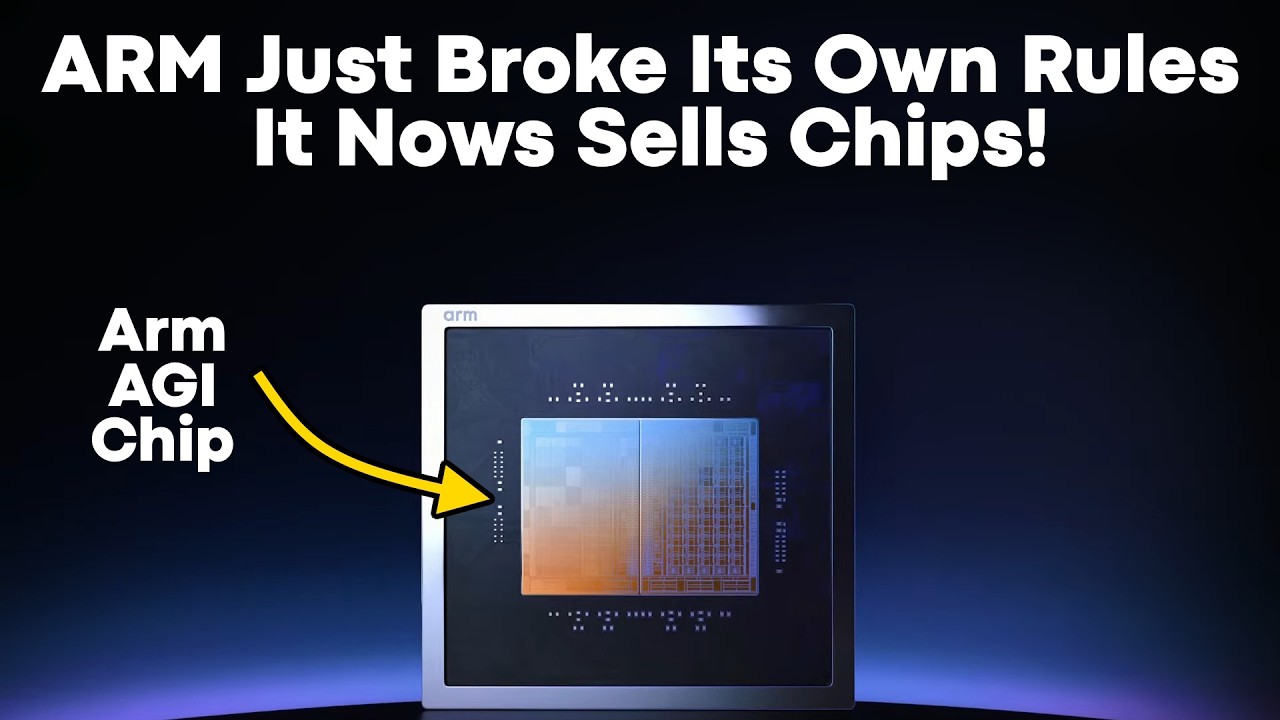
ARM has made a surprising move by producing and selling its own physical silicon chips, breaking away from its long-standing business model of only licensing CPU and GPU designs to other manufacturers. Traditionally, ARM designs the architecture and licenses it to companies like Qualcomm or MediaTek, who then manufacture the chips through foundries such as TSMC. However, ARM has now designed and assembled complete server chips, which are manufactured by TSMC and sold as ready-to-use products, similar to Intel or AMD’s business models. This marks a significant shift for ARM, especially as these chips are targeted at high-performance server applications.
The new ARM AGI CPU is based on the Neoverse V3 architecture, featuring up to 136 high-performance cores with dual 128-bit SVE vector units per core, optimized for AI and machine learning workloads. The chip is built on TSMC’s advanced 3nm process and supports high memory bandwidth and extensive I/O capabilities, including 96 lanes of PCIe Gen 6. The dual chiplet design allows for 68 cores on each chiplet, stitched together to form a powerful processor capable of boosting up to 3.7 GHz. This design is tailored for demanding server environments, emphasizing efficiency and scalability.
ARM’s Neoverse platform has already seen adoption by major players such as Nvidia, Microsoft, and Amazon, with chips like Nvidia’s Grace and Microsoft’s Cobalt series based on Neoverse cores. ARM is also collaborating with server manufacturers like Super Micro, Lenovo, and ASRock to provide reference server designs that can be air-cooled or liquid-cooled, supporting thousands of cores per rack. These servers are designed to handle the increasing computational demands driven by AI workloads, which require more CPUs to manage the growing data and token processing in data centers.
The strategic move into chip manufacturing is primarily focused on the lucrative and expanding server market, where ARM faces competition from Intel, AMD, and Nvidia. ARM’s entry into this space does not threaten most of its existing partners in the mobile and consumer markets, as it is not currently targeting PCs, laptops, or smartphones with its own chips. The company recognizes the significant investment and competitive challenges in those segments and is instead leveraging its strengths in efficient, high-core-count server processors to carve out a new revenue stream.
Looking ahead, while ARM’s direct chip manufacturing is a major development, it is unlikely to disrupt the broader consumer device ecosystem in the near term. ARM will continue licensing its IP and providing compute subsystems to partners, maintaining its traditional business alongside this new venture. The focus remains on addressing the growing needs of data centers and AI workloads, where ARM’s efficient architecture and scalable designs can offer significant advantages. The industry will be watching closely to see how ARM’s new role as a chip seller evolves and impacts the competitive landscape.