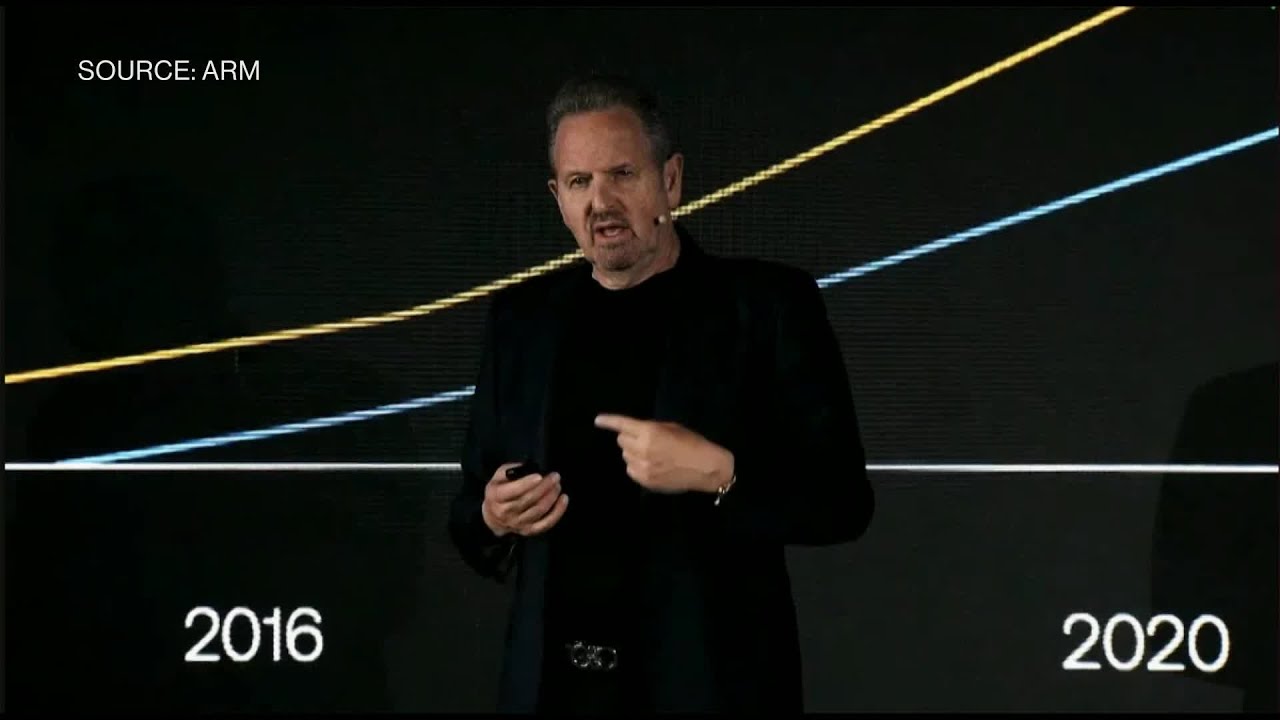
The CEO of Arm emphasizes Taiwan’s vital role in the global AI ecosystem and highlights the rapid growth of agentic AI, particularly driven by platforms like OpenAI, which is significantly increasing demand for CPUs to manage continuous AI agent operations. He predicts that future AI workloads will require substantially more CPU cores—potentially four to ten times current levels—underscoring the need for ongoing innovation in CPU design to support the expanding agentic AI landscape.
The CEO of Arm highlights the critical role Taiwan plays in the global AI ecosystem, emphasizing that the entire Arm ecosystem is built in Taiwan. This includes advanced physical AI technologies such as humanoid robots from companies like Tesla, Figure, and Techman, as well as cloud AI infrastructure like TPU racks from Nvidia and Graviton processors. Without Taiwan’s contributions, Arm’s operations and innovations would not be possible.
Reflecting on an event held on March 24th called ARM Everywhere, the CEO discusses the rapid growth of agentic AI platforms, particularly noting the explosive rise of OpenAI. By comparing GitHub stars, a measure of software popularity, OpenAI’s growth was shown to be nearly parabolic, indicating a surge in demand and interest in agentic AI technologies. This growth signals a significant shift in the AI landscape, driven by the increasing adoption of autonomous agents.
A key insight shared is the evolving demand for CPUs driven by agentic AI. While GPUs excel at generating tokens during AI training and inference, CPUs are essential for managing, orchestrating, and distributing these tokens across systems. Unlike humans, AI agents operate continuously without rest, creating a multiplying effect that increases the workload on CPUs. This dynamic underscores the importance of CPUs in supporting the expanding agentic AI ecosystem.
The CEO predicted that future AI workloads would require up to four times the number of CPU cores within the same power envelope to handle the demands of agentic AI. This projection sparked many questions about the underlying calculations, and subsequent industry discussions have suggested even higher multipliers, ranging from four to ten times. Although exact numbers are challenging to pinpoint, the consensus is clear that CPU requirements will grow substantially as agentic AI continues to expand.
Finally, the CEO notes that since the March event, the growth of agentic AI has only accelerated, reinforcing the initial predictions. The rapid proliferation of AI agents and their increasing complexity are driving unprecedented demand for computing resources, particularly CPUs. This trend highlights the need for continued innovation in CPU design and system architecture to support the future of AI-driven technologies.