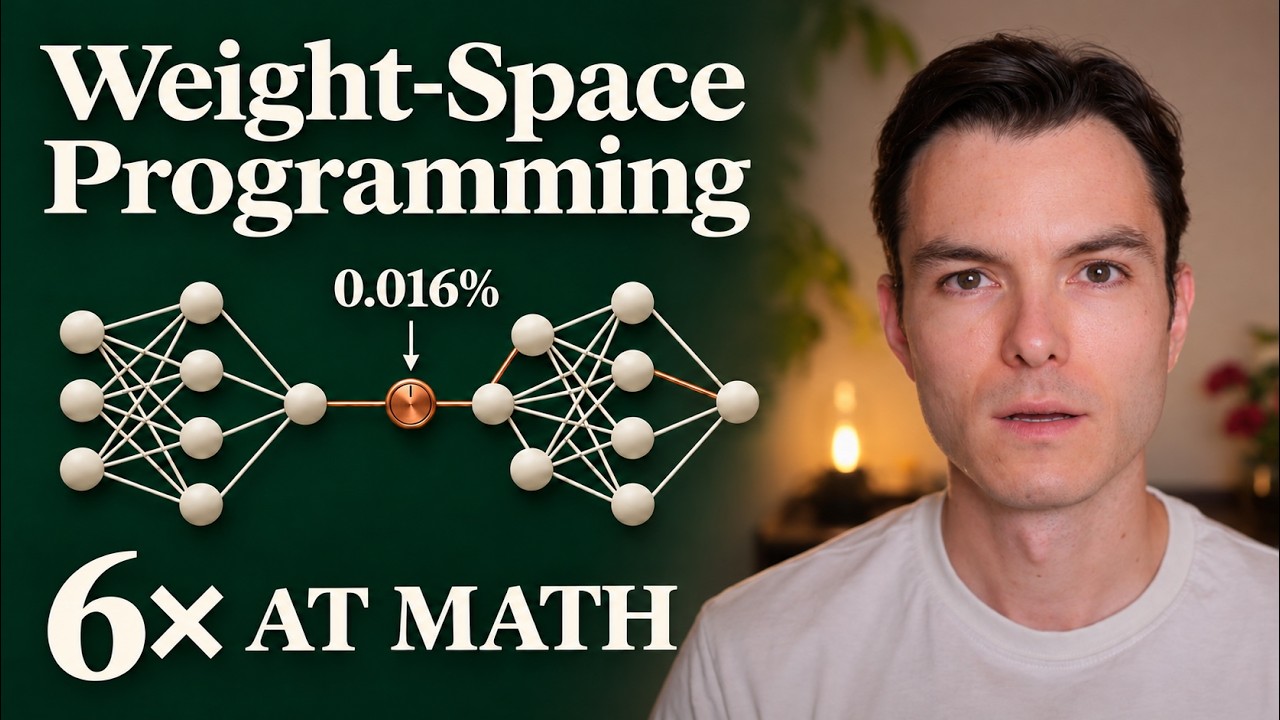
MIT researchers developed an LLM called Astra that can read, interpret, and surgically modify the neural network weights of other models to improve their performance without additional training, demonstrated by enhancing game-playing abilities and boosting the math skills of the Qwen 3.5B model. While the concept of weight space programming is decades old, this work popularizes its application to modern AI, sparking both excitement and skepticism about its potential for efficient model improvement and future recursive self-enhancement.
An article from MIT introduces a concept called “weight space programming,” where a large language model (LLM) named GP6 Astra can read, interpret, and modify the neural network weights of other models to improve their performance. In experiments, Astra was able to identify which game a neural network was trained to play just by analyzing its weights, and even surgically modify weights of smaller models to enhance their abilities, such as improving a car’s performance in a simulation or boosting math skills in the Qwen 3.5B model. Remarkably, these improvements were achieved without additional training, showcasing Astra’s native ability to understand and manipulate neural network weights.
The core idea behind weight space programming is that an LLM can natively read and write neural network weights, effectively allowing it to create or repair other neural networks. While this concept has existed for over 30 years, the innovation from the MIT team lies in applying it to modern frontier AI models and making it accessible to the broader community. This has sparked excitement as well as skepticism, with experts pointing out that the fundamental principles are not new but acknowledging the significance of popularizing and practically demonstrating the concept with current technology.
One of the key experiments involved feeding Astra the weights of neural networks trained to play classic games like Breakout and Pong. Astra could accurately identify the game by analyzing the weight patterns in relation to the game’s layout and inputs, essentially performing complex matrix multiplications internally. This demonstrated that Astra could understand the behavior encoded in the weights without running the network or playing the game, highlighting a new dimension of model interpretability and intelligence.
Community reactions have been mixed, with some experts emphasizing that weight editing and neural network programming have been known for decades. However, many appreciate the MIT team’s work for bringing these ideas into the spotlight and showing practical applications with modern LLMs. The discussion also touches on the potential for future efficiency gains, as models like Astra could improve smaller models without costly retraining, potentially reducing computational resources and accelerating AI development.
The most exciting yet controversial result was Astra’s ability to improve the math reasoning of the Qwen 3.5B model by surgically editing a tiny fraction of its weights, boosting its benchmark performance significantly. However, this success partly relied on Astra being prompted to fix specific issues like repetitive loops in the model’s reasoning, which some see as a strong hint rather than a fully autonomous improvement. While the breakthrough is not as revolutionary as it might seem, it points toward a future where larger models could iteratively enhance themselves or other models, raising profound questions about recursive self-improvement in AI.
Useful Links