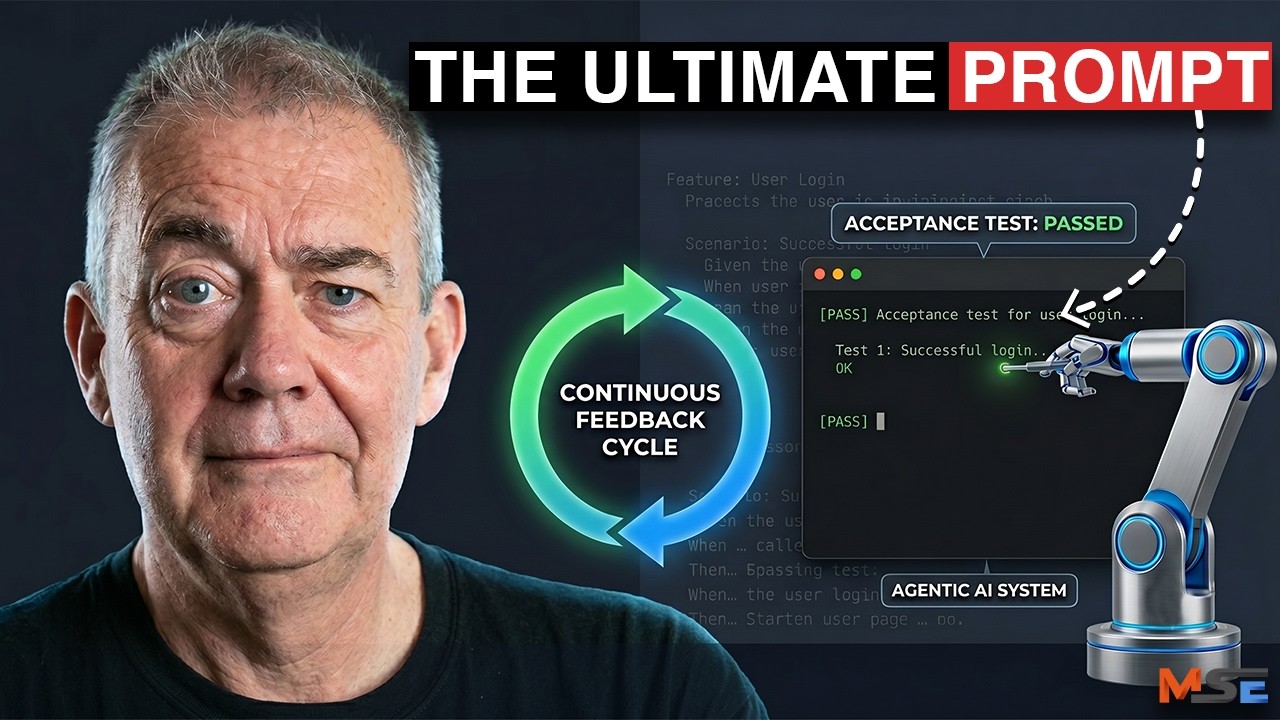
The video emphasizes that combining acceptance test-driven development (ATDD) with agentic AI programming enhances software development by providing clear, executable specifications that ensure consistent, verifiable outcomes and guide AI effectively. This approach elevates programming to focus on behavioral intent rather than implementation details, fostering better human-AI collaboration and improving software quality through disciplined problem understanding and testing practices.
The video discusses the transformative impact of agentic AI programming on software development, emphasizing that while AI changes some day-to-day tasks, the core challenge remains understanding and exploring problems deeply before creating software solutions. Dave Farley introduces the concept of acceptance test-driven development (ATDD) as a crucial methodology that aligns well with AI-assisted programming. He is joined by two guests, Stefan Ellisdorfer and Christian Gassel, who share their experiences using ATDD alongside AI to build real-world systems, highlighting how executable specifications provide stable, verifiable outcomes that guide AI development effectively.
Stefan explains that one of the main challenges with AI-driven development is the lack of determinism, which ATDD helps mitigate by focusing on precise, executable acceptance criteria. These criteria act as a contract for the AI, ensuring that regardless of implementation details, the desired outcomes remain consistent and verifiable. This approach allows developers to trust the AI’s output without needing to scrutinize every line of generated code, much like how programmers trust compilers to produce correct assembly code. Stefan also notes that while AI-generated code is generally good, human oversight remains valuable, especially in crafting high-quality, executable acceptance criteria.
Christian reinforces the importance of clear communication and shared understanding of goals when working with AI. He points out that ATDD trains developers to be specific about what they want, which is essential for instructing AI assistants effectively. He likens a good AI prompt to a well-written specification and suggests that starting with acceptance criteria and enabling AI to self-verify through tests creates a robust workflow. This method raises the abstraction level of programming, focusing on behavioral outcomes rather than low-level implementation details, and aligns well with the evolving capabilities of AI models.
The discussion also touches on the evolving role of test-driven development (TDD) and ATDD in AI-assisted workflows. While some organizations are beginning to adopt these practices, there is still exploration around how to manage the volume of code and tests generated by AI. Dave mentions the “Farley index,” a tool for scoring automated tests to improve their quality, which could serve as a feedback mechanism for AI to produce better tests and code. This reflects a broader trend of using AI not just to generate code but to enhance software engineering practices by embedding good design and testing principles into the development process.
In conclusion, the video highlights that successful AI-assisted software development hinges on human skills in problem understanding and clear specification of desired behaviors. ATDD provides a disciplined framework that complements AI’s strengths by defining precise, testable outcomes that AI can reliably implement. This approach elevates programming to a higher level of abstraction focused on intent and behavior, enabling more effective collaboration between humans and AI. Dave Farley also promotes his training courses on ATDD and related AI skills, aiming to help developers adopt these best practices and leverage AI more effectively in their work.