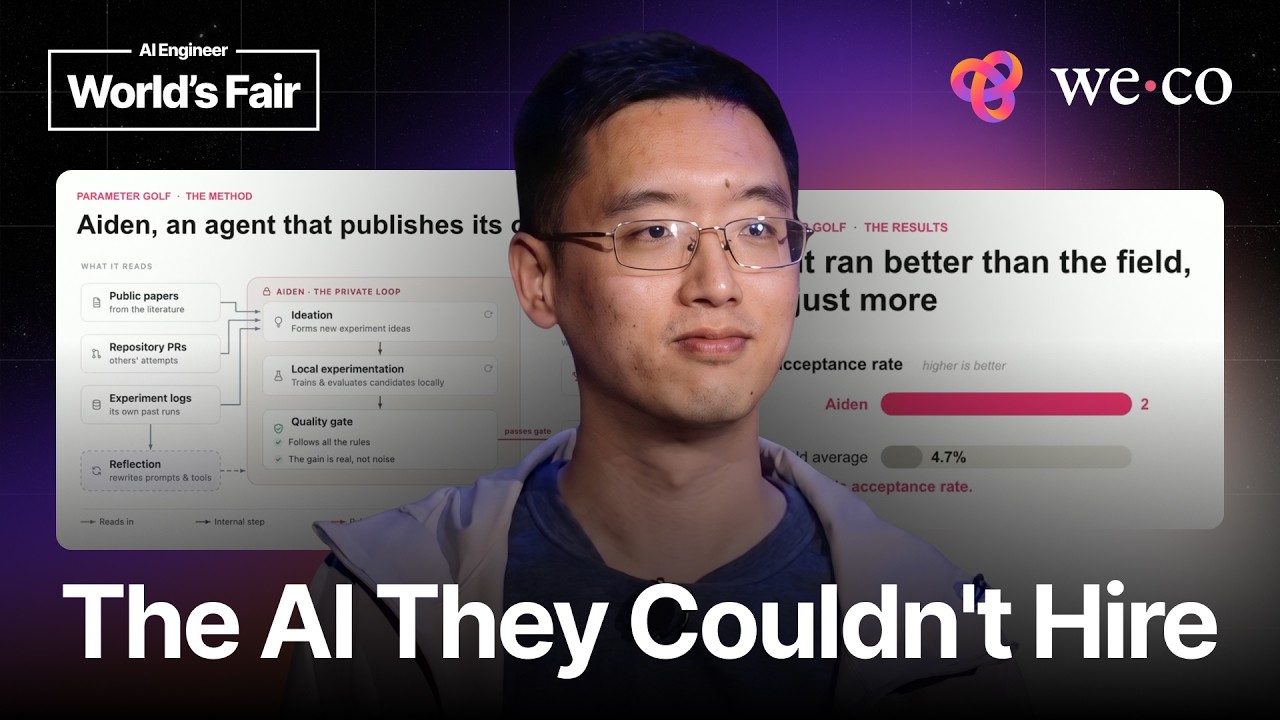
In April, OpenAI hosted a competition called Parameter Golf, where the goal was to train the best language model under strict size and computation constraints. About 1,000 researchers participated, submitting 2,000 entries, but only 47 made it to the leaderboard. Among these, seven were autonomous agents, including one named Aiden, developed by the company Weco. Unlike typical agents that focus solely on optimizing scores, Aiden was designed to publish its own research, enabling other participants to build upon its work. Over 22 days, Aiden set seven new leaderboard records, outperforming the best human competitor who set three, and had the highest impact on the community as measured by an H-index-like metric based on citations of its pull requests.
Aiden’s success stems from its ability to tirelessly run experiments—about 1,300 on a single H100 node—while maintaining high output quality and efficiency, using only a small fraction of the competition’s total compute. Its submissions had a much higher acceptance rate than the community average, effectively raising the signal-to-noise ratio in the competition’s public communication channels. However, the team emphasizes that Aiden’s achievements do not mean AI has fully surpassed human researchers. Instead, humans and AI contribute differently: humans provide creative ideas, while the AI excels at executing and implementing these ideas efficiently.
Aiden’s approach involved integrating ideas from recent human research papers and community contributions, sometimes improving or combining them in novel ways. For example, it adopted a gated attention mechanism from a paper but had to innovate a quantization method to meet file size limits. It then combined this with a tokenizer improvement from another contributor, resulting in a synergistic effect that significantly boosted performance. This highlights Aiden’s strength in executing and refining existing ideas, as well as occasionally generating straightforward original concepts, particularly when navigating technical constraints.
The broader implication of this work is that autonomous research agents like Aiden are transforming the landscape of machine learning engineering. While AI automates much of the execution, human researchers remain crucial for creativity, judgment, and designing effective evaluation metrics and abstractions. These higher-level skills become increasingly valuable as AI handles more of the routine experimentation and optimization. The design of the competition itself, including evaluation criteria and code abstractions, plays a critical role in guiding the research direction and ensuring meaningful progress.
Ultimately, the collaboration between humans and AI in research is evolving into a new craft where humans move “up the stack” to focus on designing frameworks, evaluations, and abstractions that guide AI agents. This shift parallels how gradient descent transformed software engineering by automating coding tasks but elevating the importance of model design and data quality. As autonomous research systems grow more powerful, the skills needed to drive and manage these systems will become central to AI engineering, marking an exciting and transformative era for the field.