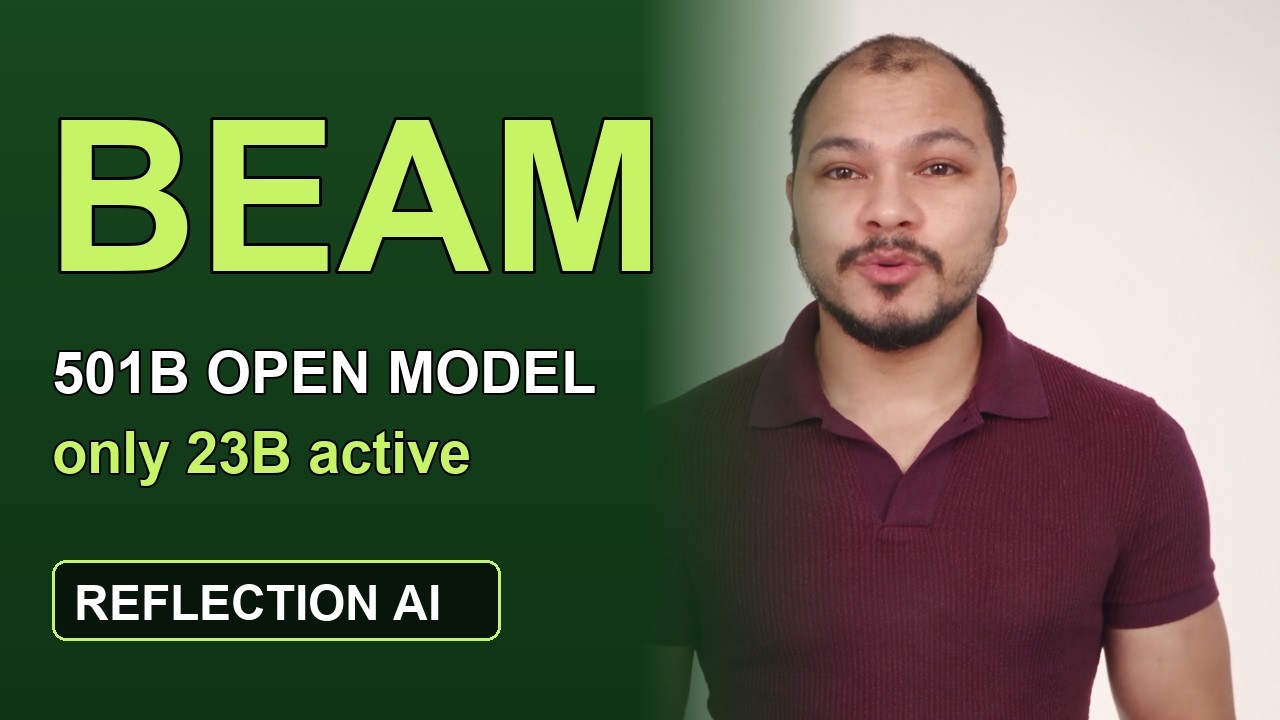
In this video, the presenter introduces Beam, a new open-scale model developed by Reflection AI. Beam is a sparse mixture of expert models with a total of 501 billion parameters, but only 23 billion are active at any given time. It is designed primarily for programming, reasoning, and agent tasks. The model was pre-trained on an enormous dataset of 23.8 trillion tokens from web and licensed sources, and its context window was later expanded to handle up to 1 million tokens. A standout feature of Beam’s training is its extensive use of reinforcement learning, utilizing 10,500 Nvidia GB 300 GPUs over four weeks, generating over 100 million deployments and nearly a million environments for coding and scientific tasks.
Beam’s performance on various benchmarks is impressive, especially considering its relatively low active parameter count. It scores 80.9 on SWE-Bench verified, 77.2 on SWE-Bench Pro version 2 hard, and 80.1 on Terminal Bench 2.1. While it outperforms GLM 5.2 on some tests and nearly matches Qwen 3.8 max, it is not the top performer on the open leaderboard, with models like Kimika 3 and GLM 5.3 scoring higher. Reflection AI acknowledges this but highlights Beam’s efficiency as its main advantage, delivering comparable reasoning results to GLM 5.2 while using three to four times fewer computational resources during inference.
One of Beam’s key strengths is its efficiency and flexibility. Users can adjust the reasoning effort settings to balance between shorter, quicker answers and longer, more complex reasoning processes, allowing alignment with computational budgets. Demonstrations showcased Beam’s capabilities in creative and practical tasks, such as generating a 3D game in P5.js, creating a live map of the New York City subway by autonomously searching for documentation, and improving the accuracy of another model, Gemma 4, on a text-to-SQL task by 66.5%. Beam also performed well on a recent viral puzzle, achieving 95.5% accuracy.
Technically, Beam employs finely routed experts and a combination of local and global attention mechanisms, maintaining a nearly perfect workload balance among experts. The preliminary training phase was completed in under four weeks using 6,144 Nvidia GB 300 GPUs. This efficient design contributes to its strong performance relative to resource consumption. Reflection AI plans to release the model’s scales, technical report, and model card later in the month under the Apache 2.0 license, with early access currently available via a waiting list on their platform.
In conclusion, Beam represents a significant advancement in open-scale models by combining a massive parameter count with sparse activation and efficient reinforcement learning. While it may not top all leaderboards, its efficiency and adaptability make it a compelling option for programming and reasoning tasks. The video encourages viewers to explore Reflection AI’s blog for more details and invites feedback on what aspects of Beam to test once the model becomes publicly available.