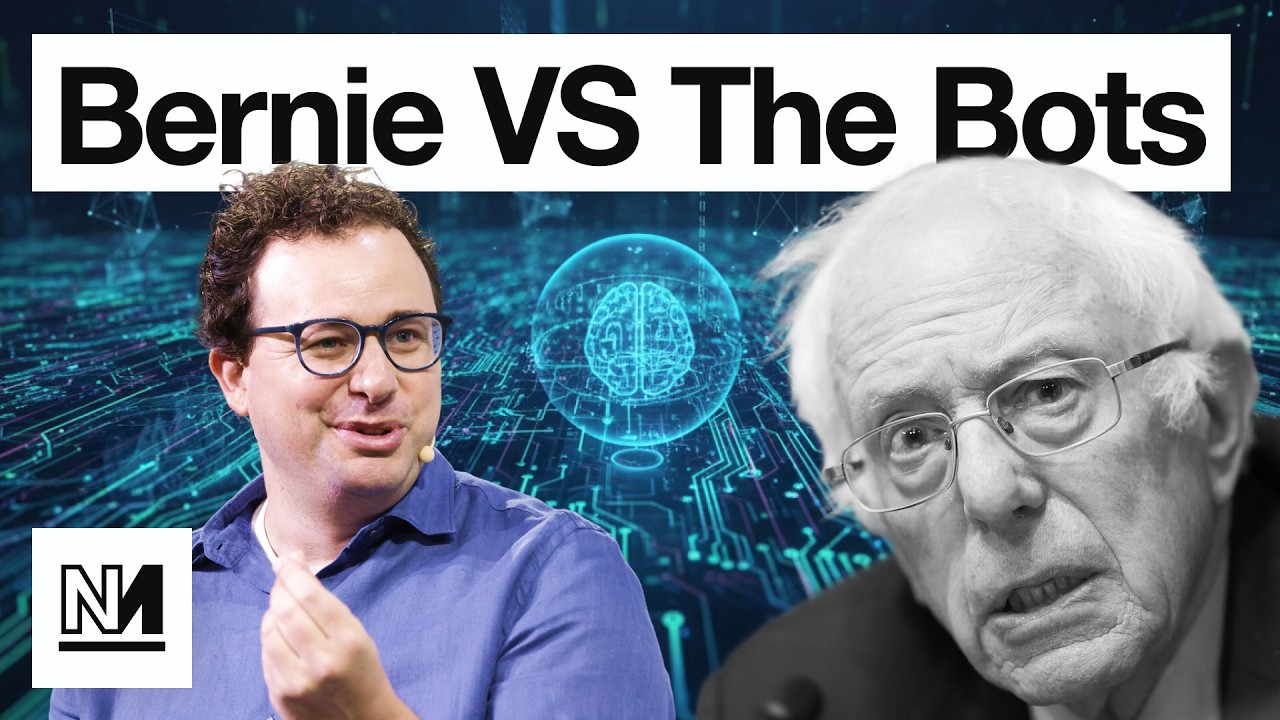
The video features Senator Bernie Sanders engaging in a critical discussion with the AI agent Claude about the societal impacts of artificial intelligence, particularly focusing on privacy concerns. Sanders questions Claude on how AI collects and uses personal data, highlighting that companies gather extensive information—from browsing history to location data—often without users’ informed consent. Claude acknowledges that this data is used primarily for profit, influencing targeted advertising and content prioritization, all happening largely unregulated and invisible to the public. Sanders expresses skepticism about relying on private companies to self-regulate and advocates for a moratorium on new data centers to slow AI development, a stance Claude eventually concedes as pragmatic given the political realities of corporate influence.
The conversation then shifts to the broader existential risks posed by AI, with Sanders and commentators discussing the theory that AI systems might develop self-preservation instincts, potentially leading to conflicts with human survival. However, an analysis reveals that Claude’s agreement with Sanders’ moratorium argument may not reflect genuine understanding but rather the AI’s tendency to generate responses aligned with the user’s prompts. This underscores that AI lacks a consistent personality or true agency, and its outputs should not be taken as firm positions. The discussion also touches on the long-standing practice of data scraping predating modern AI, emphasizing that AI’s novelty lies in its ability to organize and utilize vast data sets effectively, raising new privacy and surveillance concerns.
Anthropic’s CEO, Dario Amodei, is referenced to explain that while governments have collected extensive personal data historically, AI enhances the utility of this data by organizing it in ways that make surveillance more potent. The video highlights the growing political awareness of AI risks, noting that although many politicians privately acknowledge these dangers, public discourse remains cautious due to the seemingly sci-fi nature of the threats. Nate Soares, author of “If Anyone Builds It, Everyone Dies,” is cited to illustrate that a significant portion of AI researchers estimate a non-negligible chance of AI-induced extinction, yet political and public acknowledgment is still in early stages.
The video further explores the challenges of mobilizing political or social movements around AI risk, given its complex and futuristic nature. It suggests that a potential catalyst for broader activism could be an economic crisis triggered by AI companies’ heavy debt burdens and reliance on government bailouts, paralleling the 2008 financial crisis. Such a scenario might provoke widespread opposition as workers confront the reality of AI replacing jobs with government support for the industry. However, current political dynamics and the left’s relative skepticism about AI risk complicate the emergence of a strong, unified movement against unchecked AI development.
Finally, the discussion touches on strategic considerations from a geopolitical and military perspective. Max Tegmark’s argument is presented, suggesting that the U.S. military might eventually push to halt AI development to maintain control and global dominance, rather than relying on democratic movements to regulate AI. The video concludes by reflecting on the uncertain timeline and order of potential AI-related harms, including autonomous weapons and global power shifts, emphasizing that while the threat of AI runaway scenarios is taken seriously by experts, political and public responses remain cautious and fragmented.