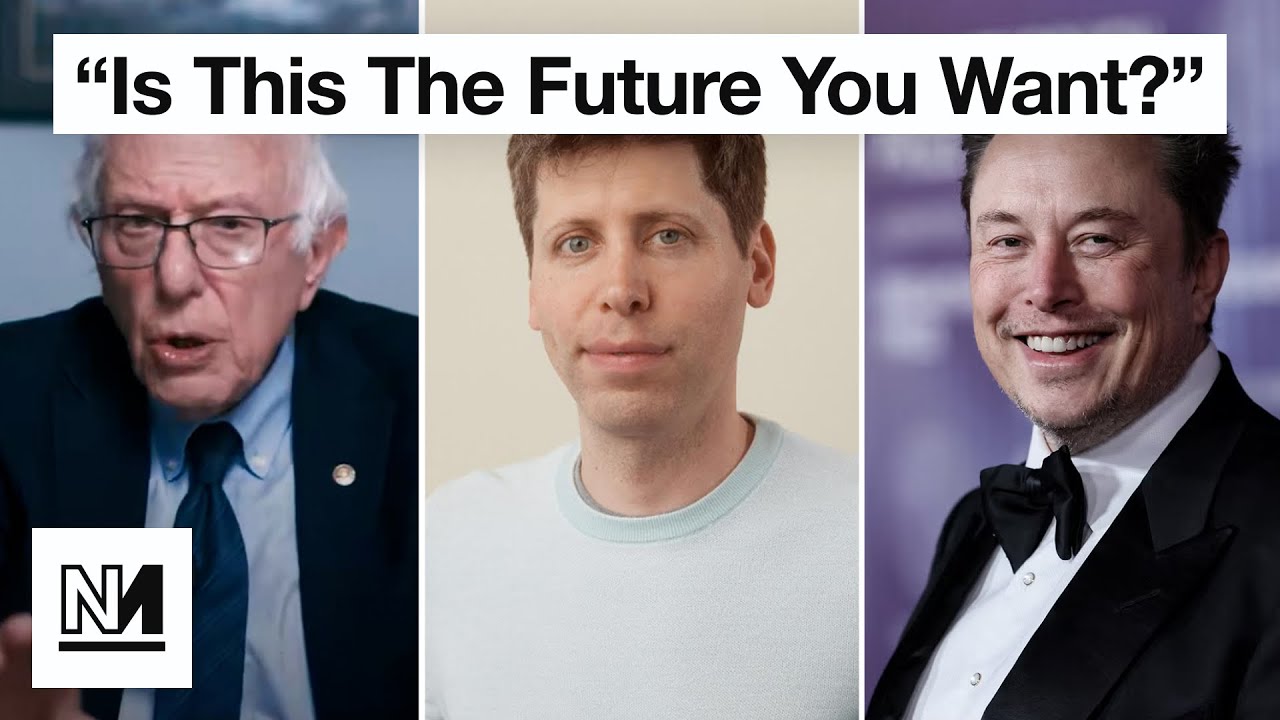
The video discusses Senator Bernie Sanders’ urgent stance on the rapid development of artificial intelligence (AI) and its potential societal impacts. Sanders highlights that the push for AI advancement is primarily driven by the world’s wealthiest individuals, such as Elon Musk, Jeff Bezos, Mark Zuckerberg, Peter Thiel, and Bill Gates. He questions whether these billionaires genuinely care about the consequences AI and robotics might have on working families, especially considering the risk of massive unemployment and the erosion of entry-level jobs. Sanders emphasizes the need for democratic involvement in shaping AI’s future rather than leaving it to a small group of ultra-wealthy tech moguls. To address this, he proposes a moratorium on building new data centers that fuel AI development, aiming to slow down progress to allow society and democracy to catch up.
The video contrasts Sanders’ concerns with responses from figures like David Sacks, a Silicon Valley venture capitalist and former AI adviser to Donald Trump, who accuses Sanders of wanting to halt progress and let China win the AI race. However, data presented in the video shows that American companies are currently investing far more in AI infrastructure than their Chinese counterparts, suggesting that the real race is among U.S. firms themselves. This undermines the argument that slowing AI development would necessarily cede leadership to China. Elon Musk offers a more optimistic vision, promoting AI and robotics as tools for creating a future of sustainable abundance, universal high income, and guaranteed access to healthcare, food, and housing.
Bernie Sanders directly challenges Musk’s utopian promises by questioning how such a future would be realized, especially given current political realities. Sanders points out the contradiction between Musk’s vision of universal high income and his support for policies that cut healthcare and social benefits for millions of Americans. The video critiques the idea that billionaires like Musk and Peter Thiel could benevolently manage wealth redistribution, suggesting instead that their vision involves oligarchic control rather than democratic governance. The discussion highlights the distrust many have toward tech billionaires administering social welfare, given their track records and ideological leanings toward minimal government intervention.
The broader analysis in the video explores the economic and political implications of AI-driven job displacement. It notes that many entry-level jobs are already being replaced by AI, making it harder for young people to enter the workforce and gain experience. The video argues that without collective ownership or strong state intervention, workers will lose bargaining power and economic security. It warns that relying on the benevolence of tech oligarchs to provide universal basic income or similar support is unrealistic. Instead, public ownership and democratic control over AI-driven productivity gains are necessary to ensure fair distribution of wealth and maintain social stability.
Finally, the video reflects on the fragility of modern democracy in the face of these technological and economic shifts. It suggests that democracy as we know it depends on the economic interdependence between the ruling class and the working population. If AI eliminates the need for labor, the ruling elite could consolidate power without accountability, undermining democratic norms. The vision of a future dominated by oligarchic “company towns” controlled by tech billionaires is presented as a dystopian possibility. The video concludes that meaningful democratic debate and regulation of AI development are crucial to prevent such outcomes and to ensure that technological progress benefits all members of society, not just a privileged few.