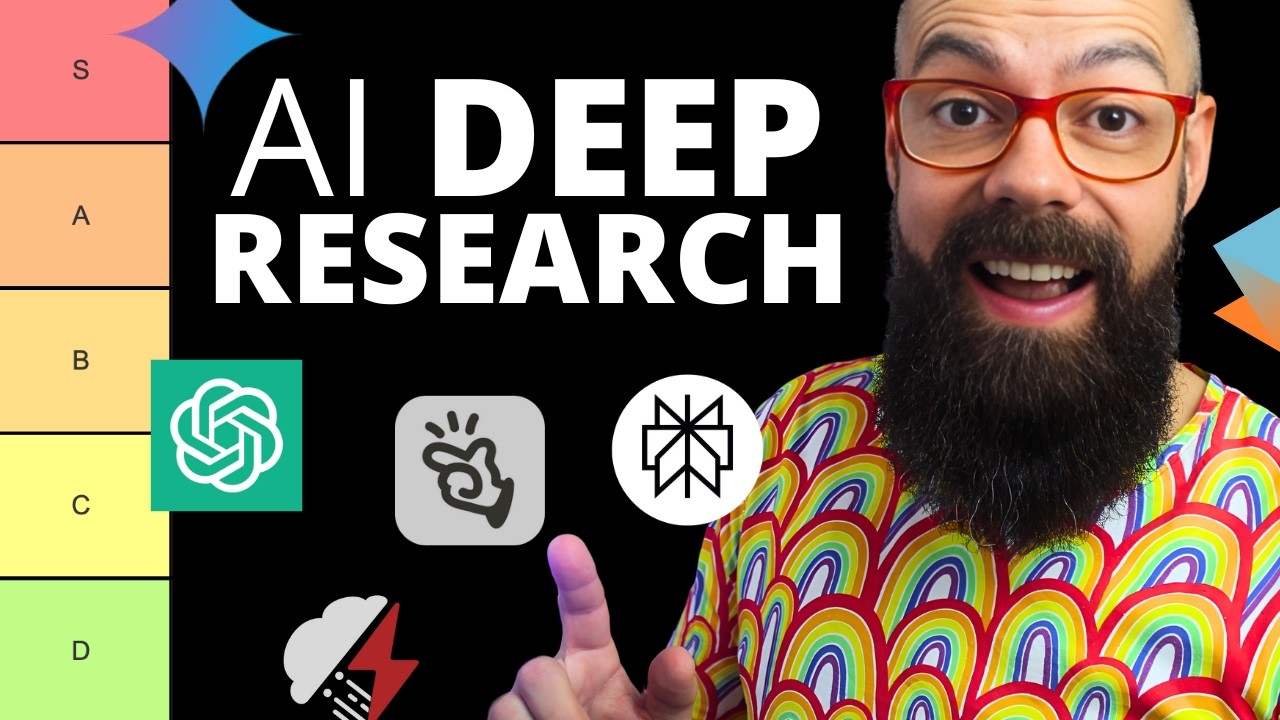
The video evaluates several AI tools for deep academic research, focusing on their ability to provide recent, well-referenced, and comprehensive information suitable for scholarly work. The presenter tests each tool using the same prompt about nanostructured electrodes in organic solar cells, emphasizing key criteria such as access to recent data from the past two years, quantity and quality of references, clarity of explanations, multimedia support, and exportability of results. The goal is to determine which AI tools are most effective for deep research in academia, moving beyond hype to practical utility.
The first tool tested is ChatGPT, which performs well in providing detailed explanations and includes some multimedia elements like figures and tables. However, it struggles with referencing accuracy, often showing discrepancies between the number of references cited and those actually provided. While the information is useful and clear, its export options are limited for academic purposes, leading to a moderate score. Overall, ChatGPT offers valuable insights but falls short in delivering comprehensive, well-cited research suitable for rigorous academic use.
Next, SciSpace is examined for its ability to deliver references and structured summaries. It provides a concise review based on the top 20 papers, with some multimedia support like tables. It excels in sourcing recent papers from the last two years and allows exporting references in various formats, making it useful for reference management. However, it offers less detailed textual explanations compared to ChatGPT, which limits its usefulness for in-depth understanding. Its overall score is slightly lower, as it prioritizes references over detailed narrative, but it remains a solid tool for academic referencing.
Perplexity is then evaluated, showing that it provides a good number of sources and references, with a clear and relevant overview of recent research. However, it lacks multimedia support and has inconsistencies in the number of references it displays versus those available for export. Its structure is less clear, and it doesn’t highlight recent breakthroughs effectively. While it can export PDFs, its limited depth and presentation reduce its overall utility for deep research, earning it a lower score compared to other tools.
The most impressive tools are Gemini and Manis AI, which both excel in providing extensive, highly referenced reports suitable for deep academic research. Gemini offers a comprehensive, highly detailed report with over 250 references, all well-cited and exportable in multiple formats. Manis AI segments research into multiple files, including recent breakthroughs and key materials, with a large number of references and export options. Both tools outperform others in depth, referencing, and exportability, making them the top choices for serious academic research. The video concludes by recommending Gemini and Manis AI as the best options, with SciSpace also being useful for reference management, while Storm is deemed the least effective.