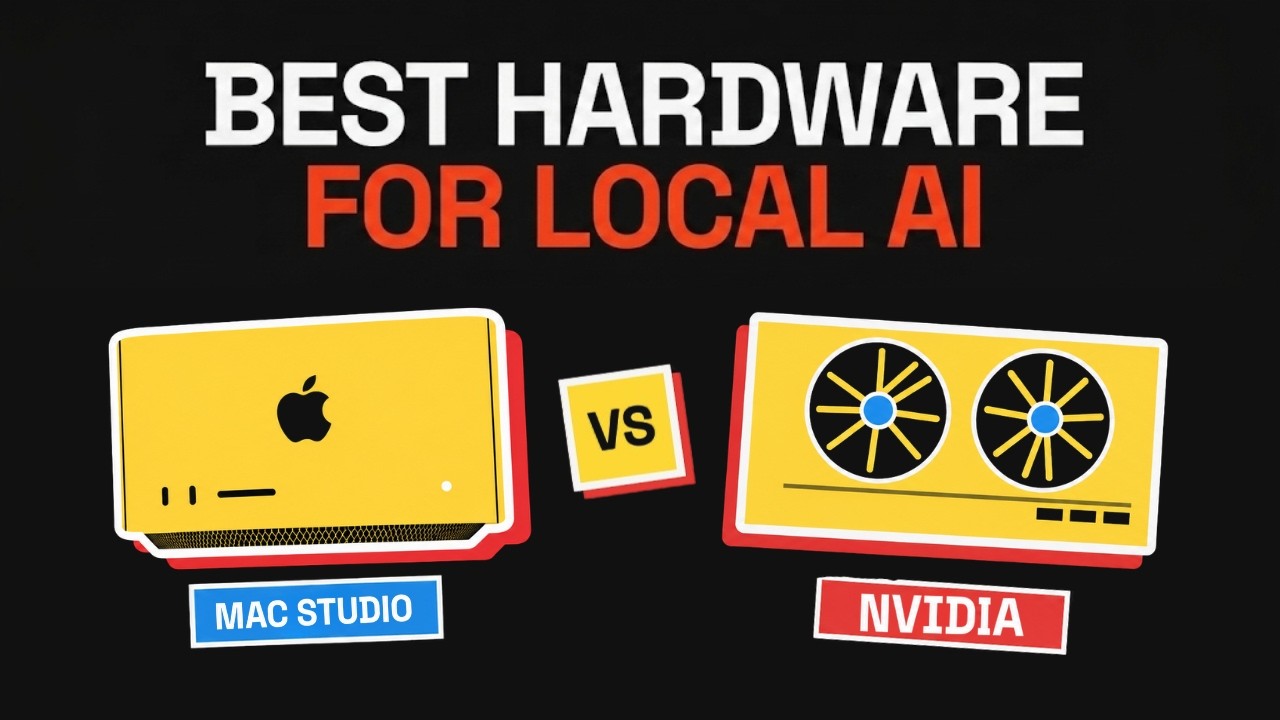
In this video, the creator shares their journey and insights into running local large language models (LLMs) in 2026, motivated by the high costs of paying per AI token for cloud services. They compare three main hardware options: Apple’s Mac Studio with the M4 Max chip, Nvidia RTX GPUs, and cloud GPU rentals. The key breakthrough enabling feasible local LLM use is the emergence of efficient models like Quen 3 coder next, which fits into 46GB of memory with quantization, and a smaller 3.6 billion parameter dense model that runs well on 16GB, making local inference practical for everyday coding tasks such as refactoring and code review.
The creator highlights a critical technical lesson learned about serving frameworks: using VLM, a data-center optimized serving tool, on consumer GPUs can drastically reduce performance due to VRAM constraints and CUDA graph compilation failures. Switching to Llama CPP, a lighter-weight framework, resulted in a 6-7x speed improvement on the same hardware. This underscores that the choice of software stack is as important as the hardware itself, especially for single or dual GPU setups.
Regarding hardware, the Mac Studio M4 Max with 128GB unified memory impressed the creator with its high memory bandwidth (546 GB/s) and seamless user experience, running large models at competitive speeds without driver hassles or noisy fans. It is recommended for solo developers who want a quiet, maintenance-free machine and are willing to invest around $4,000-$5,000. Nvidia’s RTX 5090 with 32GB VRAM offers the best tokens per dollar on paper and is ideal for those comfortable managing Linux servers, though verified benchmarks are still pending. Multi-GPU consumer setups beyond two cards are discouraged due to PCIe synchronization bottlenecks, which negate performance gains.
The video also touches on AMD’s Stricks Halo, which offers a large memory pool at a lower price but suffers from limited memory bandwidth, making it unsuitable for dense models but viable for mixture-of-experts (MOE) models that activate fewer parameters per token. For those not ready to buy hardware or with irregular workloads, cloud GPU rentals remain a rational choice, but users should be aware of cold start latencies and the cost trade-offs between keeping instances warm versus paying for on-demand usage.
In conclusion, the creator recommends the Mac Studio M4 Max for quiet, turnkey local inference, a single RTX 5090 build for cost-effective performance if comfortable with Linux, and a dual RTX 3090 setup for small teams. They caution against over-investing in multi-GPU consumer builds and emphasize that local LLMs complement rather than replace cloud APIs. Local models provide unlimited tokens, privacy, offline capability, and fine-tuning options but currently lag behind frontier models on complex reasoning tasks. The best approach is to run most daily coding work locally and reserve cloud APIs for the hardest problems, balancing cost, control, and performance.