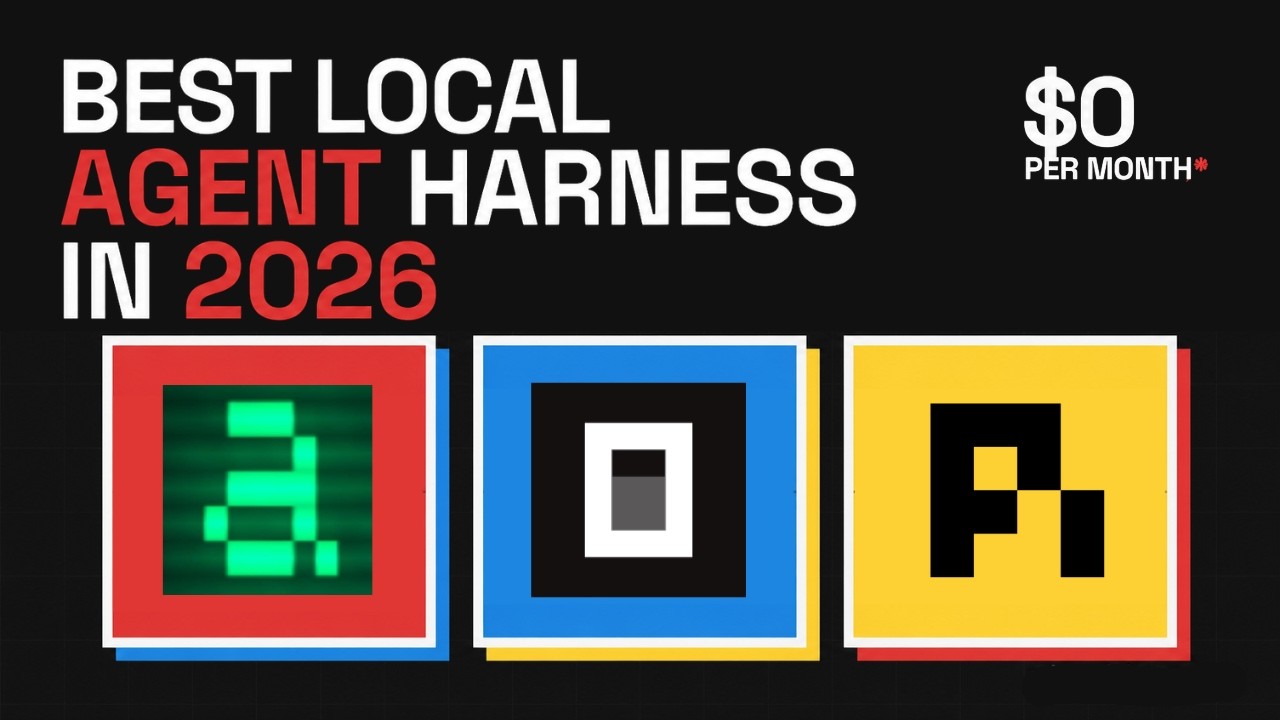
The video discusses the best local agent harnesses for 2026, emphasizing that the choice of harness, rather than the model itself, is what truly impacts user experience. While models like Claude Opus 4.8, GPT 5.5, and Gemini 3.5 have converged in performance, the harnesses that wrap these models differ significantly in reliability and functionality. The speaker highlights four key factors to consider when choosing a harness: the harness itself, the model it uses, where the model is hosted, and the specific tasks the agent is asked to perform. Getting any of these wrong can undermine the overall effectiveness of the setup.
The first recommended harness is Open Code, the default open-source choice for newcomers and experienced users alike. It boasts over 172,000 GitHub stars and supports more than 75 model providers, running local models securely without sending code off the machine unless explicitly allowed. Open Code offers deep customization with JSON or markdown-defined agents, multi-language support, and a client-server architecture with a headless API. Its terminal interface is praised for being user-friendly and reliable, though it does not support Claude Pro or Max subscriptions due to Anthropic’s restrictions.
For users needing precise, controlled editing with strong Git integration, Ader is the standout harness. It excels in disciplined, commit-by-commit editing where every AI-generated change is an atomic Git commit, making it easy to track and revert changes. Ader supports over 70 models and allows seamless model switching mid-session, including offline local models. However, it lacks native support for MCP agents and is designed more as a pair programming tool rather than an autonomous agent, requiring active user involvement in reviewing changes.
The third harness, Pi, is ideal for developers who want a lightweight, hackable foundation to build custom agents. Created by Armen Ronacher, Pi uses a modular approach with “lazy skills” that load only when needed, keeping the system prompt lean and efficient. While less polished out of the box compared to Open Code, Pi offers deep control and transparency, making it popular for those who want to understand and customize every step of the agent’s operation. It serves as a foundation for projects like Open Claw, emphasizing minimalism and extensibility.
The video concludes by noting that while the model race has largely settled, the harness landscape is rapidly evolving, with some projects being archived or discontinued. Users are advised to check project licenses and recent activity before committing to a tool. The speaker summarizes the top picks: Open Code for broad provider support and depth, Ader for Git-centric editing, and Pi for hackability. Many heavy users combine harnesses to match different tasks and models. Ultimately, choosing the right harness tailored to one’s workflow and hardware makes local agent setups a compelling and cost-effective choice.