In this lecture, John Yang continues the discussion on improving language models by focusing on data selection, quality, and efficiency, particularly in the context of training AI agents. Building on the previous lecture’s exploration of agent scaffolding and environment-task dynamics, the emphasis here is on refining the base language model itself through careful curation of training data. Yang introduces three central research questions: which tasks or environments to train on from a large pool, how to select trajectories for fine-tuning or reinforcement learning, and whether simply increasing data quantity always leads to better model performance. The lecture underscores that quality and relevance of data often trump sheer volume, especially given computational constraints.
A significant portion of the lecture delves into task validity and learnability. Using examples like the SweetBench Verified dataset, Yang highlights the challenges in ensuring tasks are well-specified, verifiable, and aligned with intended problem statements. Human annotation revealed that many tasks suffer from underspecification or unreliable verification, which can mislead model training. Automated filtering pipelines, such as those used in API Gen and Code Midas, are discussed as scalable solutions to maintain data quality by checking format correctness, reproducibility, and semantic validity. These filters help prevent reward hacking and ensure that models learn from meaningful and diverse task distributions.
The concept of learnability is explored through the lens of reinforcement learning, where tasks should ideally be neither too easy nor too hard for the model. Yang explains that tasks providing a balanced success-failure ratio yield the most informative learning signals. As models improve, the distribution of tasks must evolve, introducing progressively harder challenges to maintain effective training. Papers like Lego RL and Web RL demonstrate the benefits of self-evolving curricula, where task difficulty is dynamically adjusted based on model performance, leading to significant gains on challenging benchmarks like Web Arena.
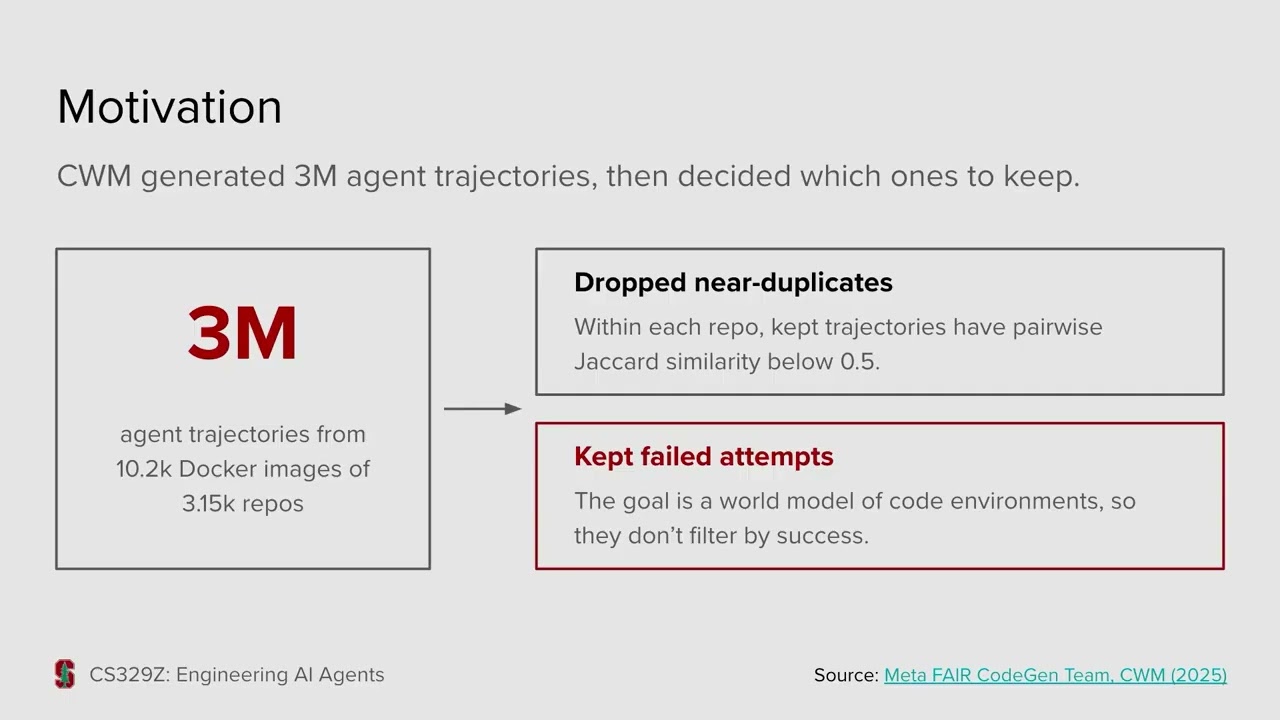
The lecture also examines the nuances of training on trajectories, emphasizing that not all successful trajectories are equally valuable. Some may contain reward hacks or undesirable shortcuts, which can degrade model quality if blindly imitated. Recent research challenges the practice of training solely on successful trajectories by incorporating failure cases with explicit negative signals, enhancing the model’s understanding of what not to do. Techniques like rejection sampling fine-tuning and trajectory masking (as in Sweep Prime) help focus training on high-quality actions within trajectories, improving efficiency and effectiveness.
Finally, Yang addresses the trade-offs between data quantity and specialization. Drawing parallels to instruction tuning research (e.g., the LIMA paper), he suggests that training smaller, specialized models on carefully selected subsets of data can rival or surpass larger, generalized models trained on vast datasets. This approach is particularly useful when computational resources are limited or when targeting specific domains. The lecture concludes by emphasizing the importance of rigorous data filtering, dynamic task selection, and thoughtful evaluation to build more capable and reliable AI agents, setting the stage for the next lecture on evaluation methodologies.