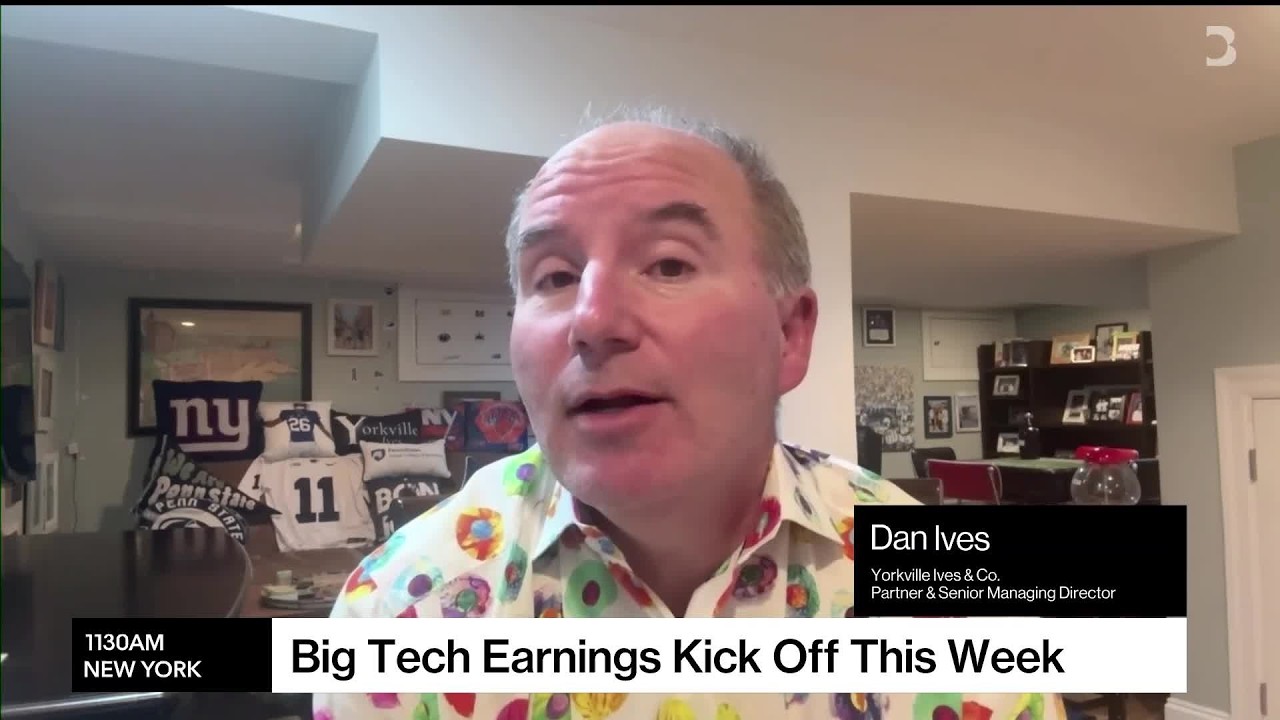
Dan Ives, partner and senior managing director at Yorkville, Ives & Company, discusses the critical importance of the upcoming big tech earnings season as a validation moment for AI investments. With many major tech companies reporting soon, the market is eager to see concrete data on AI spending, chip demand, and enterprise adoption. Ives highlights that despite recent market turbulence and nervousness, especially in the semiconductor sector, the underlying demand for AI-related technology remains robust, particularly among hyperscalers like Microsoft, Amazon, and Google.
During a recent trip to Korea, Ives observed nervousness in the semiconductor market but noted a strong demand-to-supply ratio for memory chips, indicating ongoing acceleration in AI-related chip consumption. He emphasizes that the earnings reports will be crucial in restoring investor confidence by providing clarity on fundamentals such as chip demand, enterprise AI use cases, and hyperscaler investments. Ives believes the AI industry is still in the early stages of a long-term growth cycle, estimating it to be year three of a ten to twelve-year build-out.
Ives also addresses the evolving landscape of cloud computing, contrasting hyperscalers with emerging “neo cloud” companies like Enscale. While acknowledging valuation concerns and market skepticism around some neo cloud players, he maintains that hyperscalers hold a dominant position due to their strong balance sheets and strategic data center investments. Ives is cautiously optimistic about private AI companies and has recently launched a $200 million fund to give broader investor access to these private AI leaders, reflecting his belief in the ongoing innovation boom despite market volatility.
Regarding what could shake his bullish stance on AI, Ives points to potential signs such as a reduction in capital expenditures by big tech or a slowdown in anticipated demand deals. He explains that AI investments have a significant multiplier effect across the tech sector, and any pullback in spending could signal trouble. However, he notes that investors are becoming more discerning, seeking to understand capacity, backlog, and risk profiles among companies, which will help differentiate winners from losers in this maturing market.
Finally, Ives expresses caution about certain companies like Oracle, which face challenges balancing core business cuts with data center expansion, potentially impacting their stock performance. He contrasts this with the strong positioning of hyperscalers such as Microsoft, Amazon, and Google, who are better equipped to lead the AI evolution. Overall, Ives views the current period as a “white knuckle moment” rather than a time to panic, emphasizing that the AI sector’s fundamentals and long-term growth prospects remain compelling.
Useful Links