In this video, the presenter explores the newly released Bonsai one-bit quantized AI models by Prison ML, which debuted on April 1st. These models, inspired by the Karate Kid and based on the Quinn 3 architecture, come in 8B, 4B, and 1.7B parameter sizes. The one-bit quantization used is affine, involving scale factors rather than simple binary values, allowing efficient compression while maintaining performance. The models are available on Hugging Face with accompanying white papers and code supporting Apple’s MLX format and GGUF, though there are some limitations with Apple’s implementation due to its use of scale and bias values.
The presenter tests the Bonsai models on a MacBook Pro, demonstrating their ability to generate coherent text and perform web summarization tasks via tool calls. The 8B model, in particular, shows impressive performance, running at around 75 tokens per second and successfully summarizing web pages like xcreat.com. The presenter also experiments with different quantization levels for the KV cache, finding that two-bit turbo quant quantization works well alongside the one-bit model, maintaining coherence and speed while reducing memory usage.
When testing the models’ reasoning and logic capabilities, the presenter finds mixed results. The Bonsai models handle some classic logic puzzles better than many larger models, such as correctly identifying the surgeon as the boy’s mother, avoiding common gender bias errors. However, they struggle with more complex reasoning tasks like the trolley problem and do not have a working “thinking mode.” Despite these limitations, the models produce coherent and sensible responses, making them suitable for edge devices where memory and compute resources are limited.
The presenter also evaluates the models’ coding abilities, finding that while they can generate basic code snippets in languages like Python and Java, they are not capable of producing complex applications or error-free code for more advanced projects like 3D games. The smaller 1.7B and 4B models show less capability in tool calls and coding tasks compared to the 8B model, which remains the most capable among the Bonsai releases.
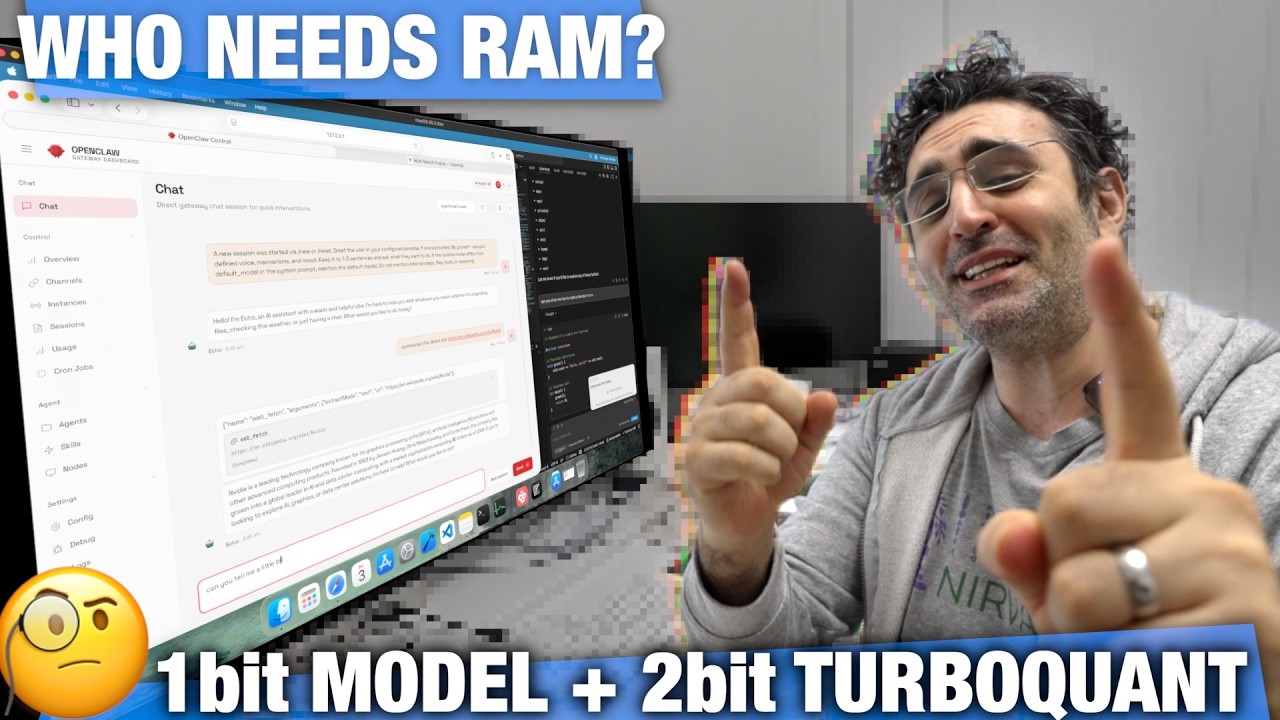
Finally, the video demonstrates integrating the Bonsai 8B model with OpenClaw, an AI assistant platform, using two-bit turbo quant for the KV cache. The integration works smoothly, allowing the model to handle multiple requests simultaneously, perform web searches, summarize Wikipedia articles, and generate code snippets on demand. This combination of one-bit model quantization and efficient KV cache quantization presents an exciting development for running intelligent AI models on resource-constrained devices, potentially opening new avenues for fast, low-memory AI applications.