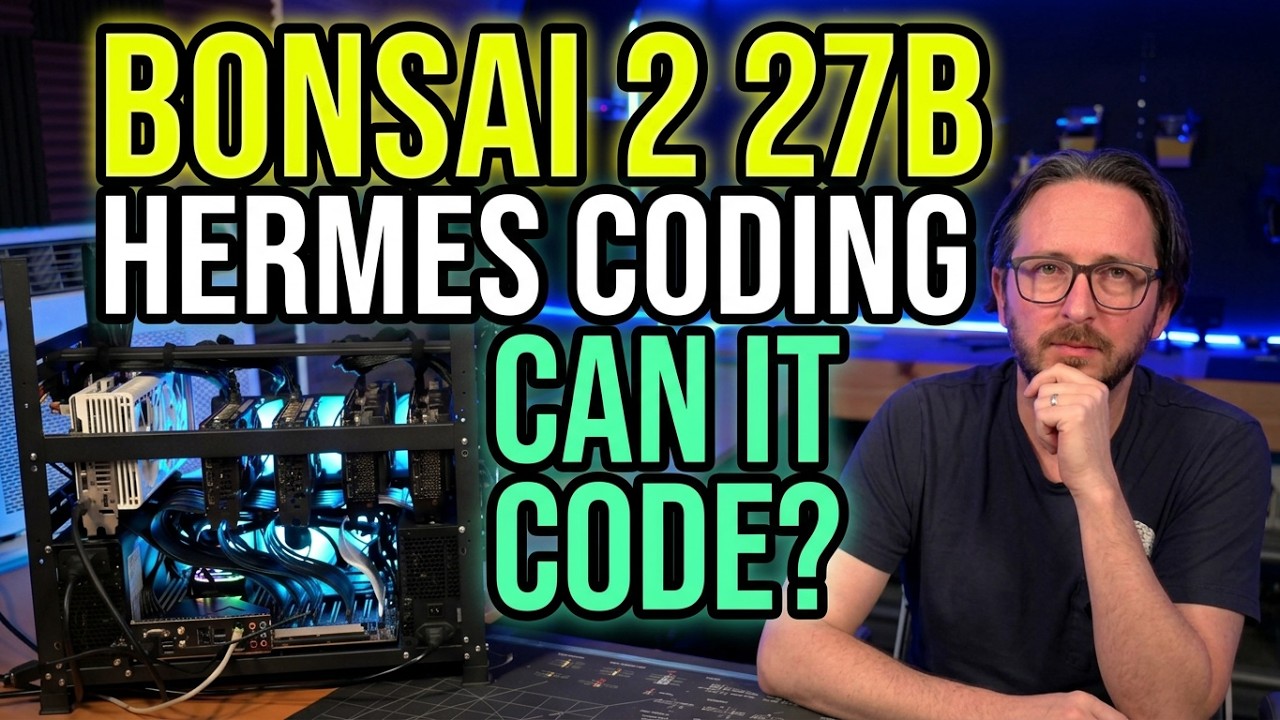
The video explores running high-quality AI models on limited VRAM setups, specifically focusing on the Turnary Bonsai 2 27B model, which uses ternary representation (-1, 0, +1) to reduce size while maintaining quality. This model is about nine times smaller than the full 27B and fits within 24 GB of VRAM, making it suitable for GPUs like the RTX 3090 or dual RTX 3060s. The presenter demonstrates setting up the model on a Proxmox container, highlighting the ease of installation and configuration, including environment variables and network settings to enable access across a local network.
Performance testing on a single RTX 3090 shows the Bonsai model running at around 69 tokens per second, which is significantly faster than the full 27B FP16 model that requires multiple GPUs to achieve lower speeds. The model handles tasks such as generating animated SVGs with decent quality and retains precision well, although some minor quality differences compared to FP16 are noted. The presenter also mentions the model’s support for vision tasks and speculative decoding, which can enhance performance in certain scenarios like structured coding or math.
The video then compares the Bonsai model’s output with that of the Qwen 3.8 27B FP16 model by running a complex agentic coding task involving the creation of a video game arcade console. The Bonsai model takes considerably longer and produces lower-quality results, with issues in gameplay mechanics, font rendering, and overall polish. While the FP16 model delivers a more refined and playable experience, the Bonsai model’s output is still functional but noticeably less impressive, earning mixed grades on the games tested.
Despite the quality gap, the presenter emphasizes the Bonsai model’s speed advantage and usability for chat and single-stream agentic workflows, making it a viable option for users with limited hardware resources. However, for more demanding tasks like agentic code development, the FP16 model remains preferable. The video concludes by encouraging viewers to share their thoughts and highlights the channel’s milestone of surpassing 100,000 subscribers, promising more content on local LLM setups and hardware guides.
Overall, the video provides a practical evaluation of running large language models on constrained hardware, showcasing the trade-offs between model size, speed, and output quality. It offers valuable insights for users seeking to maximize performance on GPUs like the 3090 or 3060, balancing accessibility with the demands of advanced AI applications. The comparison between Bonsai and Qwen models helps clarify which scenarios each model is best suited for, aiding informed decision-making for local AI deployments.