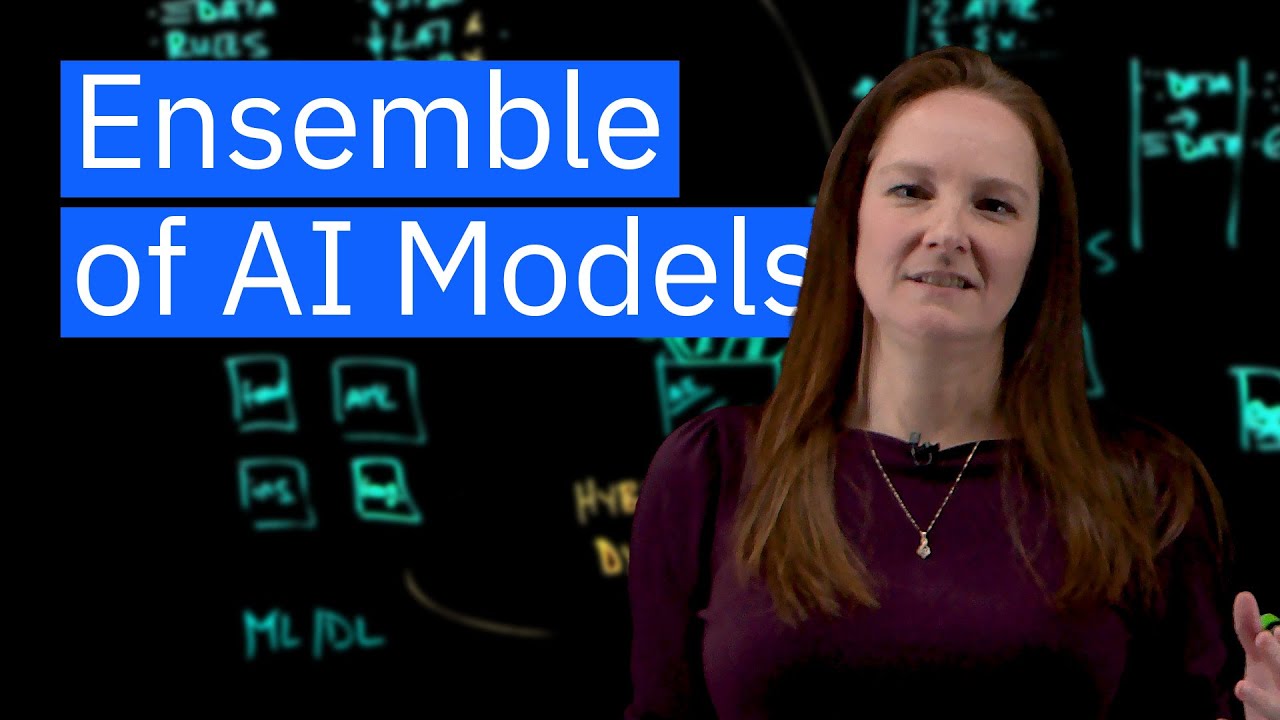
The video discusses the growing importance of artificial intelligence (AI) in business and introduces a new approach that leverages an ensemble of AI models to maximize the value derived from various AI tools. The speaker emphasizes the need for businesses to adapt their use of AI dynamically, given the rapid innovations in the field. The presentation is structured around three main points: understanding the AI toolbox, exploring the attributes of different AI models, and providing practical use cases to illustrate the concepts.
The first part of the discussion focuses on the AI toolbox, which includes traditional AI models based on machine learning and deep learning, as well as large language models (LLMs). Traditionally, the conversation has revolved around choosing between these two types of models. However, the ensemble approach allows businesses to utilize both types of models simultaneously, capitalizing on their unique strengths depending on the specific situation and data requirements.
Next, the video delves into the characteristics of traditional AI and LLMs. Traditional AI typically works with structured data, making predictions based on established rules, and is known for its lower latency, smaller size, and energy efficiency. In contrast, LLMs, particularly encoder models, can handle both structured and unstructured data but tend to be larger, slower, and less energy-efficient. Despite these drawbacks, LLMs offer greater accuracy, making them valuable in scenarios where precision is critical.
The speaker illustrates the ensemble approach with practical examples from the financial industry, specifically focusing on fraud analysis and insurance claim analysis. In the case of credit card fraud, a traditional AI model can quickly assess transactions for potential fraud, while a large language model can be employed when higher accuracy is needed. Similarly, for insurance claims, the combination of structured and unstructured data allows for the use of LLMs to extract insights before applying traditional models for analysis.
In conclusion, the video highlights the advantages of adopting a multi-model AI environment, where businesses can switch between different AI models based on their strengths and the specific demands of a situation. This hybrid approach not only enhances accuracy and efficiency but also allows organizations to make more informed decisions by leveraging the best of both traditional AI and large language models. The speaker encourages viewers to consider how they can implement this strategy to improve their AI performance and overall business outcomes.