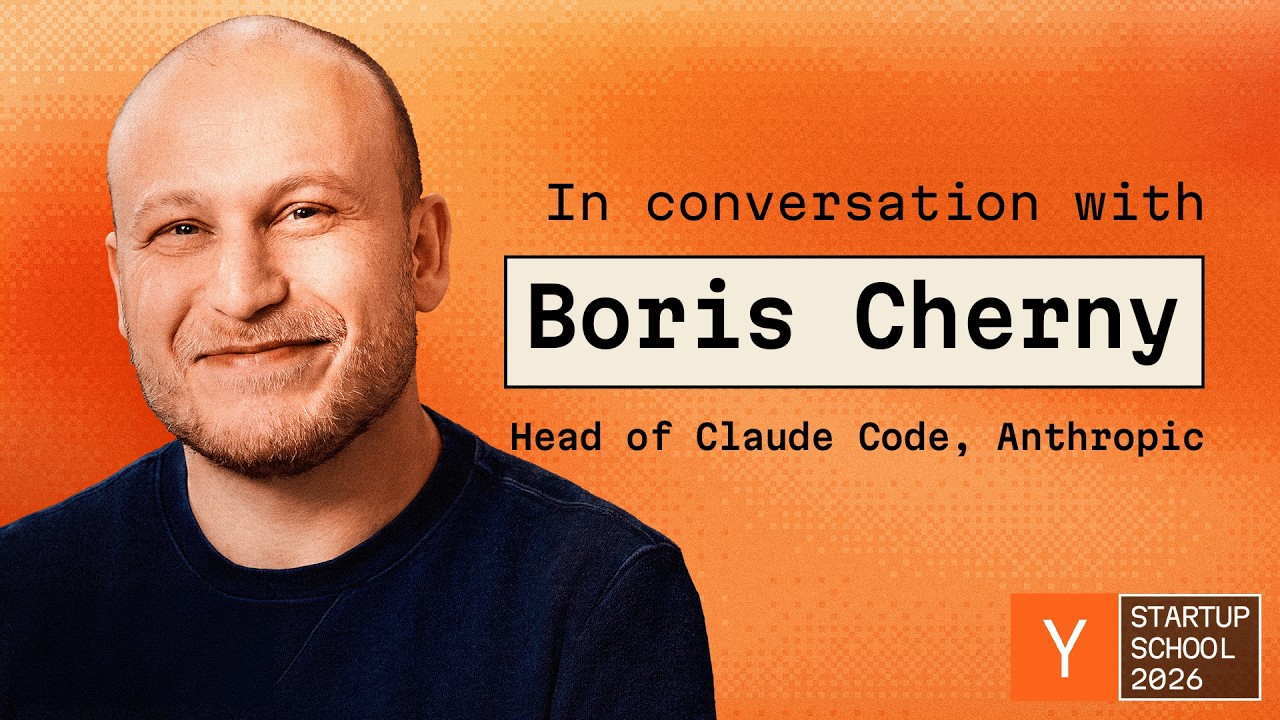
Boris Cherny, creator of Claude Code, discusses the recent release of Opus 5, highlighting its significant advancements in model performance and capabilities. Opus 5 can run tasks continuously for extended periods without needing scaffolding tools, and it exhibits strong resistance to prompt injection attacks due to a combination of alignment research and prompt injection classifiers. This marks a new frontier in AI model reliability and safety, enabling more robust and secure agentic applications.
A key insight Boris shares is the evolving nature of system prompts and harness design with each new model release. With Opus 5, over 80% of the system prompt was removed because the model inherently understands many instructions that previously required explicit prompting. This iterative process involves deleting and rebuilding prompts and tools to empirically determine what is truly necessary, a practice Boris encourages for all AI product developers to embrace. He emphasizes that unlike traditional software engineering, building with AI models requires a flexible, scientific approach that adapts to the model’s changing behavior and personality.
Boris introduces the concept of “unhobbling” models, which means removing product constraints that limit the model’s natural capabilities. He explains that many existing AI products suffer from “product overhang,” where the model’s potential is not fully realized due to overly restrictive design. Claude Code was born from this idea by stripping away scaffolding to allow the model to write entire files or features autonomously. He encourages developers to assign challenging, high-level tasks to models and provide mechanisms for verification, enabling the model to work creatively and efficiently without micromanagement.
He shares impressive examples of what Opus 5 can achieve, such as rewriting an entire JavaScript runtime codebase from Zig to Rust over 11 days using dynamic workflows that orchestrate thousands of agents. Another example includes using OpenCV for image generation, demonstrating the model’s surprising versatility beyond coding. Boris also highlights how Claude Code runs numerous autonomous routines daily to maintain and improve its own codebase, automating tasks like dead code removal, test writing, and abstraction unification, effectively performing the work of many engineers.
Finally, Boris reflects on the future of programming and AI-assisted development. While coding is becoming increasingly automated for many tasks, he stresses the importance of an empirical mindset—testing, observing, and iterating—over traditional rigid engineering approaches. He advises students and developers to focus on practical problem-solving and product-building skills alongside computer science fundamentals. Boris concludes by encouraging the audience to experiment boldly with the new capabilities of Opus 5, leveraging its power to build innovative, long-running AI-driven products.