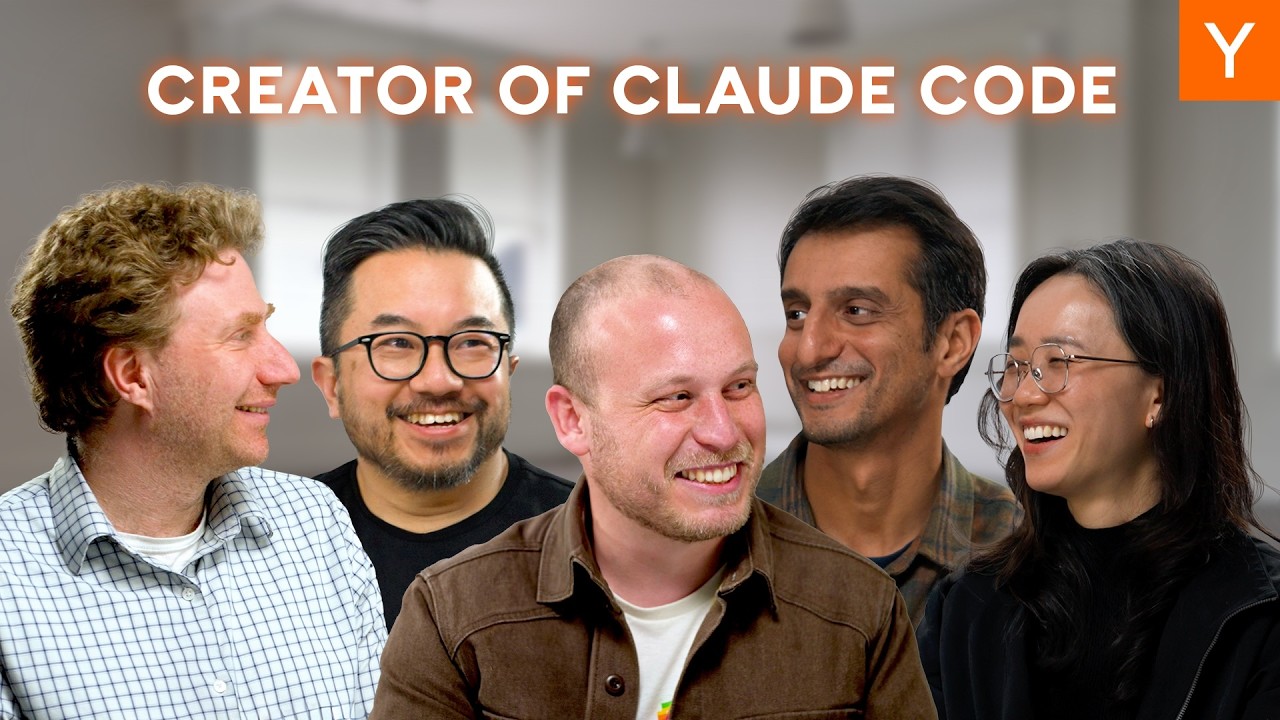
Boris Cherny, the creator engineer behind Claude Code at Anthropic, discusses the philosophy and process behind building the tool. He emphasizes that the team doesn’t build for the current capabilities of large language models (LLMs), but rather anticipates what the models will be able to do six months into the future. This forward-thinking approach means that Claude Code is constantly rewritten and improved, with no part of the codebase remaining unchanged for long. Cherny advises founders and engineers to focus on the “frontier” of what models can’t do yet, as rapid advancements will soon make those capabilities possible.
The origin of Claude Code was somewhat accidental. Cherny initially built a simple terminal-based chat app to experiment with Anthropic’s API, choosing the terminal for its simplicity and lack of need for a user interface. The product quickly gained traction internally, as engineers found it useful for automating tasks like Git commands and Kubernetes operations, even before the model was proficient at writing code. The team observed how users interacted with the tool, leading to features like QuadMD, which emerged from users’ habits of writing markdown instructions for the model.
A key principle in Claude Code’s development is “latent demand”—building features that make existing user behaviors easier, rather than trying to force new behaviors. The team iterates rapidly based on user feedback, often shipping features in response to observed needs rather than following a rigid roadmap. Cherny notes that as models improve, much of the scaffolding or extra code built to compensate for model weaknesses becomes obsolete and is removed, reinforcing the importance of building for future capabilities rather than present limitations.
Cherny also discusses the evolving nature of engineering roles in the age of advanced LLMs. He predicts that as coding becomes increasingly automated, the traditional title of “software engineer” may fade, replaced by more generalist roles like “builder” or “product manager.” At Anthropic, everyone from designers to finance staff codes, and productivity has soared—measured by metrics like pull requests—since the adoption of Claude Code. Cherny stresses the importance of humility, scientific thinking, and a willingness to be wrong as key traits for engineers and founders in this rapidly changing landscape.
Looking ahead, Cherny envisions a future where collaboration between agents (and between agents and humans) becomes more sophisticated, with features like plan mode eventually becoming unnecessary as models become capable of independently planning and executing complex tasks. He encourages founders to build for both the needs of users and the “desires” of the model, enabling tools and workflows that align with how LLMs naturally operate. Ultimately, Cherny’s approach is rooted in rapid iteration, user-centric design, and a deep belief in the exponential progress of AI capabilities.