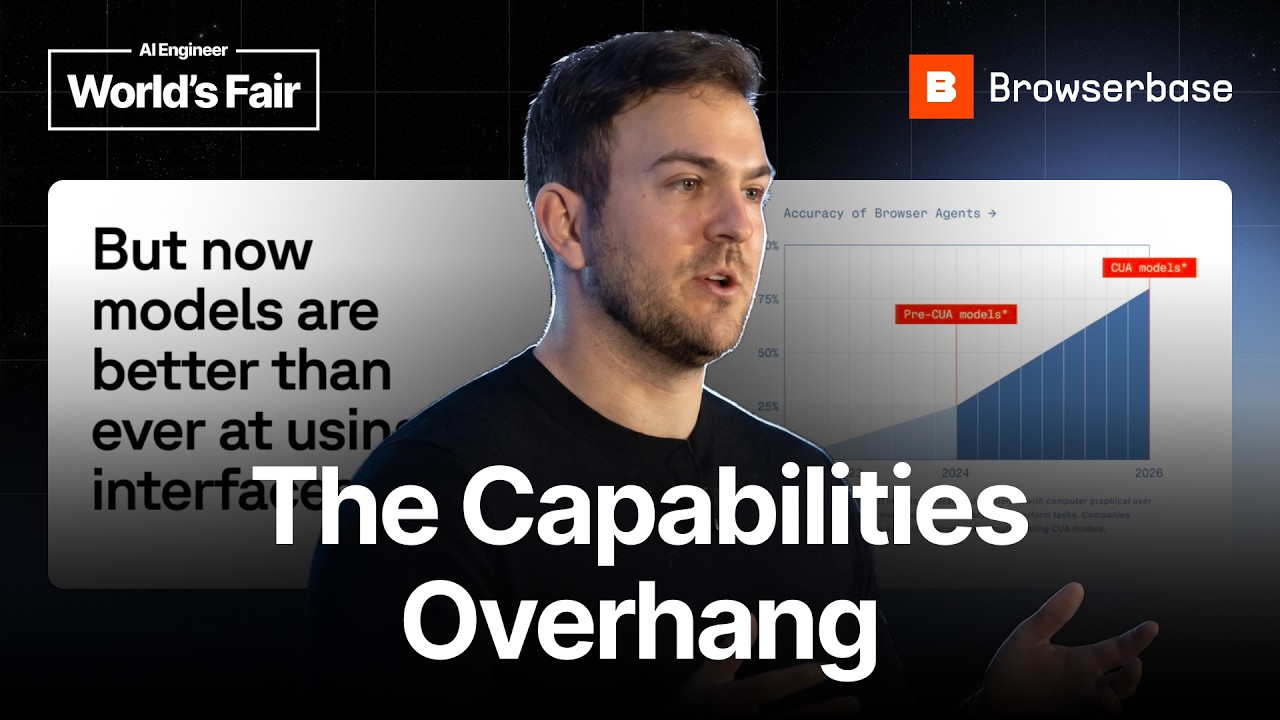
Paul Klein, founder of Browserbase, discusses the challenges and opportunities in bringing AI agents onto the World Wide Web. He begins by highlighting that the web was originally designed for human users, not automated agents, which creates significant difficulties in building reliable web automation. Despite advances in AI models, especially in handling long-context tasks and improved interface usage, web agents still face issues due to the web’s complexity, frequent changes, and inefficient design for automation. Klein emphasizes that the bottleneck is no longer the AI models themselves but rather the engineering around these models, specifically the need for effective “harnesses”—the systems and tools that enable models to interact with the web reliably.
Klein explains that harness engineering is crucial for extracting the full potential of AI models in computer use tasks. Harnesses optimize how models interact with specific domains, improving performance beyond what the base models can achieve alone. He cites examples from coding agents, where custom harnesses have led to better results, and notes that similar approaches are essential for web automation. Harnesses incorporate memory, skills, and optimized token usage to make agents more efficient and durable. This engineering work is accessible to many developers and companies, not just large AI labs, and represents a significant opportunity to push web agents forward.
The talk also covers the importance of multimodal approaches and reliable infrastructure in building effective browser agents. Multimodality means using different models or combining coding with browser automation to handle various tasks more efficiently. Reliable infrastructure ensures consistent environments for agents to operate, avoiding issues like inconsistent page layouts that can break automation. Klein points out that scaling infrastructure for thousands of agents, maintaining security, and ensuring consistent rendering are major engineering challenges that need to be addressed to make browser agents viable in production.
Klein highlights the need to improve the web itself to better support agents, focusing on accessibility, authentication, and trust. Modern browser agents leverage accessibility trees and new standards like WebMCP to interact with websites more effectively. Authentication remains a complex problem, as agents need secure ways to log in and perform actions on behalf of users without compromising security. Trust is another critical area, as distinguishing between good agents and malicious bots is essential. Klein envisions a future where trusted agent identities are certified, similar to SSL certificates, to enable secure and reliable agent interactions on the web.
In conclusion, Klein stresses that building reliable browser agents is primarily an engineering challenge rather than a model limitation. He encourages developers to leverage existing tools and platforms, like Browserbase’s new product that provides a ready-made harness and runtime for web automation. This platform approach allows developers to focus on solving real-world problems instead of reinventing browser agents. Klein is optimistic about the future, predicting that as models, techniques, and tools improve, web agents will become more widespread and effective, unlocking significant value across industries worldwide.