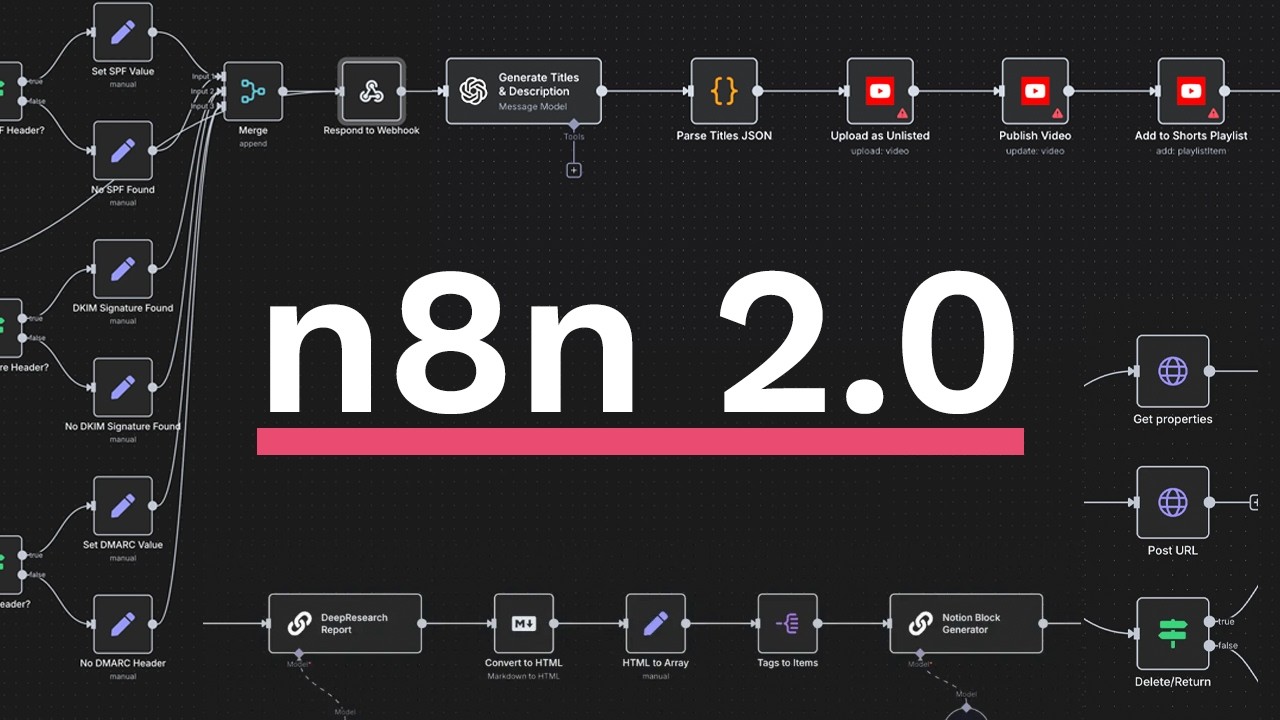
In this video, David Andre introduces the revolutionary new workflow builder from NA10, which drastically simplifies the process of building AI agents. He demonstrates how creating an AI agent that automates repetitive or boring tasks can now be done in just a couple of minutes, a task that previously took much longer. David showcases the power of the new NA10 AI assistant, which can build entire workflows from a single prompt, connecting nodes, filling in parameters, and even handling credentials automatically. This update marks a significant leap forward, making AI automation accessible to a much broader audience, including beginners.
David walks through building three AI agents of increasing complexity to push the limits of the NA10 workflow builder. The first agent is a simple automation that drafts emails, which the AI builds quickly and with minimal errors. When minor issues arise, such as incorrect variables or email errors, the AI assistant helps fix them seamlessly. This hands-on demonstration highlights how the new NA10 AI can drastically reduce the time and effort needed to create functional workflows, making it a game-changer for automating business or personal tasks.
The video also covers hosting AI agents on Hostinger, which David recommends for its unlimited workflows and concurrent executions. He explains how easy it is to set up a virtual private server (VPS) with Hostinger, especially with their Black Friday deal, which offers significant discounts and a free domain for a year. Hosting on Hostinger allows users to run multiple AI agents reliably and affordably, making it an ideal solution for those serious about scaling their AI automation efforts.
For more complex workflows, David demonstrates a step-by-step approach using an external tool called Vectal to overcome NA10’s 1,000-character prompt limit. This method involves building the workflow node by node, allowing the AI to focus on each part individually, reducing errors and improving accuracy. He also highlights the advantage of combining NA10 AI’s deep knowledge of its own platform with more advanced AI models like Sonet 4.5 from Enthropic for coding tasks, resulting in cleaner and more efficient automation scripts.
Finally, David showcases an ambitious, large-scale AI agent designed to convert long-form YouTube videos into multiple short clips with A/B testing. Despite the complexity and the 25 nodes involved, the NA10 AI manages to assemble a solid workflow outline quickly, demonstrating the platform’s potential to handle sophisticated automations. David emphasizes that while AI agents will handle repetitive tasks, human creativity and oversight remain crucial. He encourages viewers to start building their own workflows now, as automating even small inefficiencies can save significant time and provide a competitive edge in the near future.