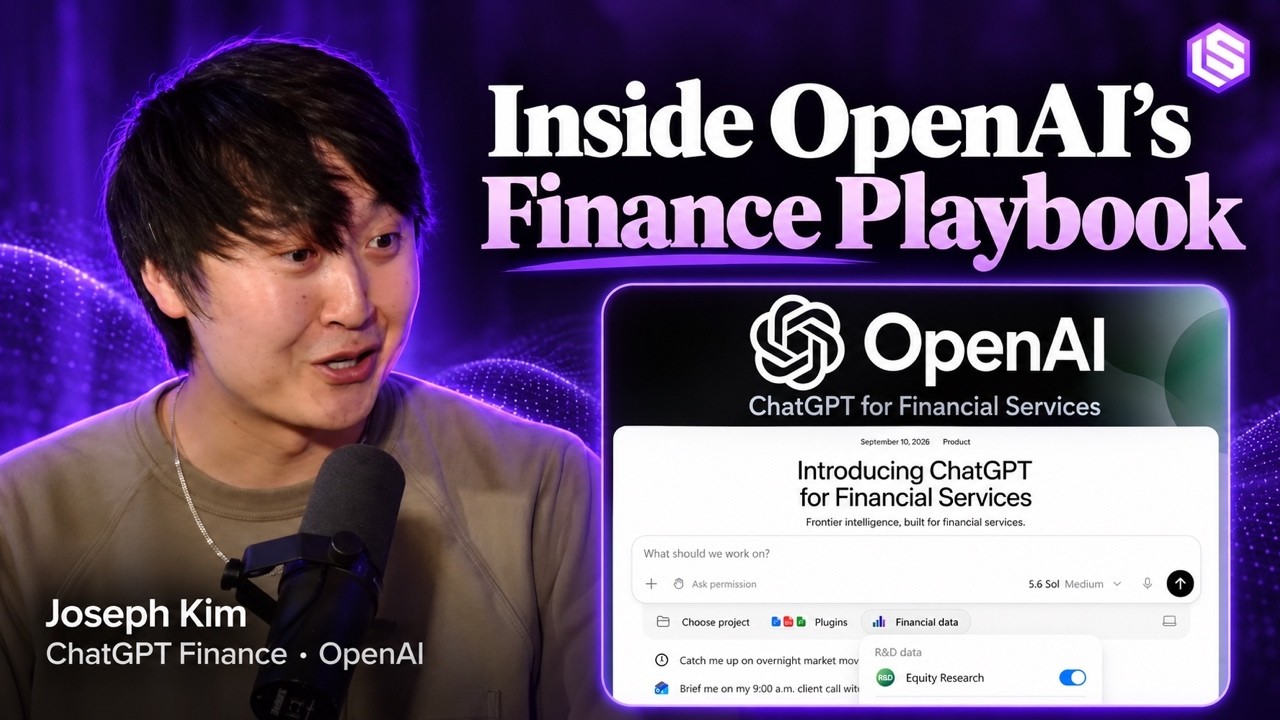
In this discussion, Joseph Kim, head of ChatGPT Finance at OpenAI, shares insights into the development and future of ChatGPT for financial services. The product is an enterprise-focused solution that integrates ChatGPT’s capabilities with firm-specific templates and trusted financial data sources like S&P and Dilupa. Collaborations with partners such as Morgan Stanley and Evercore have yielded positive reception. Kim emphasizes that while the product leverages advanced AI models, most of the work involved building accessible tools and integrations that startups or other companies could replicate using OpenAI’s plugin architecture.
Kim explains that financial-specific training data is incorporated into the main model during pre-training, making the intelligence broadly accessible for various applications, including startups and financial firms. OpenAI operates as a research and deployment company, prioritizing model capability improvements before building product features to make these capabilities accessible. The launch of Codex desktop app notably increased adoption in finance, legal, and sales sectors, highlighting the importance of co-developing user-friendly products alongside AI models.
A significant challenge in building ChatGPT for financial services was handling data quality, especially with third-party market data providers (MCPs) that exhibited high error rates. To address this, OpenAI decided to bring critical financial data in-house to control quality and user experience, a decision that resonated well with customers. Kim also stresses that 95% of the product’s development relied on existing plugin architectures and tools, with only 20% requiring unique enhancements, underscoring the potential for others to build domain-specific AI products using similar approaches.
Safety and human oversight are central to the product’s design, particularly given the high stakes in finance. The current model assumes a human-in-the-loop approach where financial analysts review and audit AI-generated outputs, mirroring existing hierarchical review processes in financial institutions. Kim envisions future AI tools behaving more like human collaborators, with built-in checks and balances similar to those used for junior analysts, enabling safer and more intuitive integration of AI into financial workflows.
Looking ahead, Kim discusses the evolving capabilities of AI models, particularly in handling subjective tasks like taste and investment thesis generation. He highlights the use of reinforcement learning from human feedback to train models on human preferences, a technique proven effective in coding tasks and now being adapted for finance. While current AI excels at automating junior analyst tasks, future developments aim to support higher-level decision-making roles by improving model reliability, interpretability, and alignment with expert judgment. Kim concludes by inviting finance professionals to engage with OpenAI’s financial services product and join their growing team to help advance AI in finance.
Useful Links