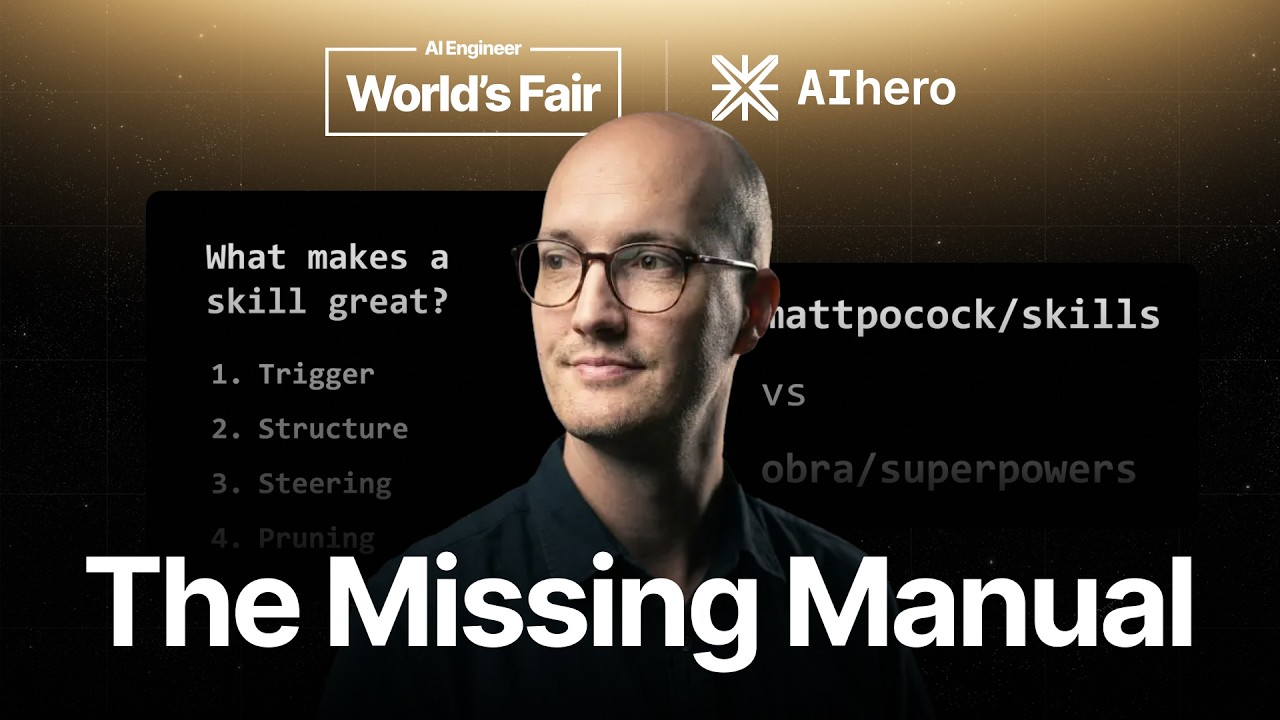
The talk “Building Great Agent Skills: The Missing Manual” addresses the challenge of managing and improving AI skills by introducing a structured checklist focusing on skill invocation, internal structure, agent steering, and pruning to enhance efficiency and predictability. The speaker advocates for user-invoked skills, modular design, clear guiding phrases, and careful elimination of redundancies to help developers create effective, maintainable AI skills and avoid the pitfalls of “skill hell.”
In this talk titled “Building Great Agent Skills: The Missing Manual,” the speaker addresses the challenge developers face in distinguishing good AI skills from bad ones, a problem he terms “skill hell.” This issue arises from the overwhelming availability of skills without a clear framework to evaluate or improve them, leading to inefficiencies both for individuals and organizations. The speaker emphasizes the need for a structured approach to skill development and introduces a comprehensive checklist designed to help developers create and refine effective skills.
The first part of the checklist focuses on the skill’s trigger—how the skill is invoked. The speaker contrasts user-invoked skills, which require manual activation, with model-invoked skills, which the AI agent can trigger autonomously based on context. Each approach has trade-offs: model-invoked skills increase the agent’s context load and unpredictability, while user-invoked skills place more cognitive load on the user. The speaker prefers user-invoked skills for their predictability and control, despite the higher demand on the user’s understanding.
Next, the internal structure of a skill is discussed, which the speaker breaks down into two main components: steps and reference material. Steps outline the procedural actions the skill performs, while reference material supports these steps with necessary information. To optimize skills, the speaker advises keeping the main skill file as small as possible by externalizing branch-specific reference materials. This modular approach not only reduces complexity but also improves maintainability and efficiency by minimizing token usage in AI contexts.
Steering the agent effectively is the third focus area, where the speaker introduces the concept of “leading words”—concise, meaningful phrases embedded in the skill to guide the agent’s behavior consistently. This technique helps overcome common issues where agents fail to perform as expected. Additionally, the speaker highlights the importance of ensuring the agent does sufficient “leg work” on each step, sometimes by splitting complex processes into separate skills to maintain focus and thoroughness.
Finally, the speaker covers pruning, a critical step to eliminate redundancy, irrelevant content (sediment), and no-ops—parts of the skill that do not influence the agent’s behavior. Large, bloated skills often indicate underlying structural problems, and careful pruning ensures clarity and efficiency. The talk concludes by encouraging developers to use the provided checklist and the “writing great skills” skill available in the speaker’s repository to improve their own skills and avoid skill hell, with additional resources and future plans shared for continued learning.