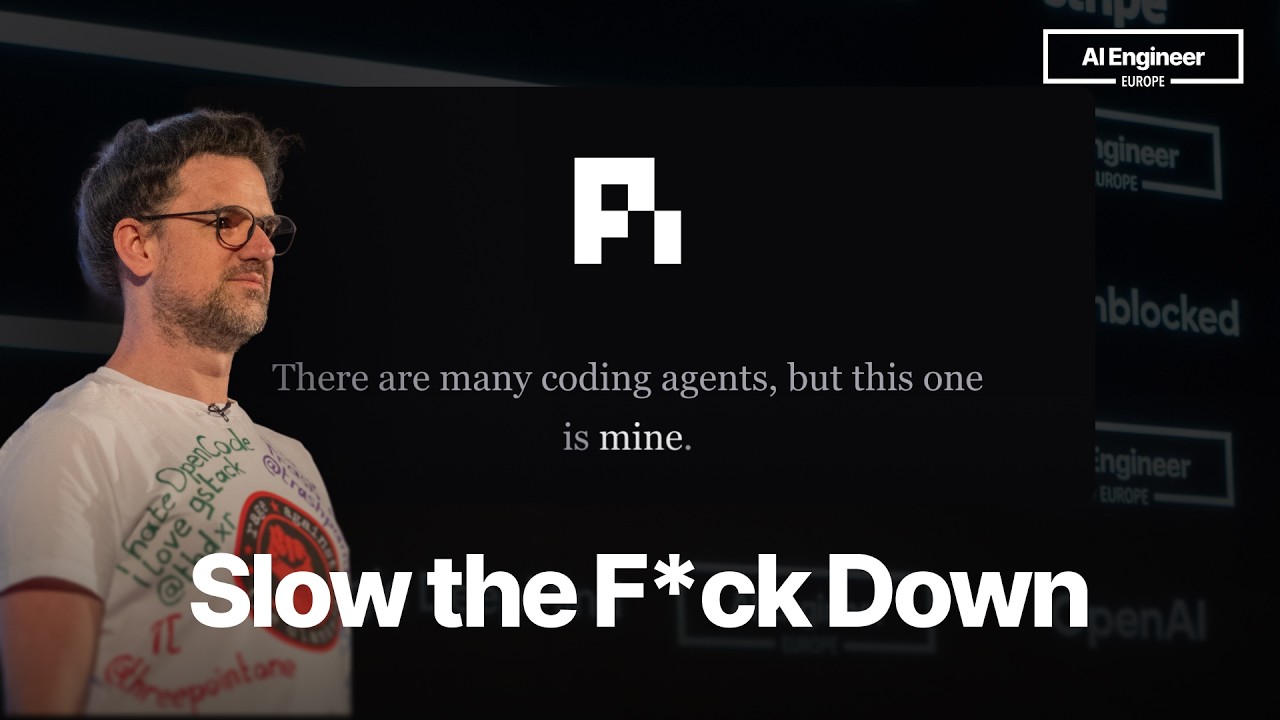
Mario Zechner’s talk, “Building Pi in a World of Slop,” is a candid reflection on his journey developing Pi, a coding agent harness, amidst the challenges posed by existing tools and the broader AI coding ecosystem. He begins by recounting his initial enthusiasm for Cloud Code, praising the talented team behind it but expressing frustration over its increasing complexity, lack of transparency, and limited extensibility. Zechner highlights how Cloud Code’s evolving system prompts and opaque context management disrupted his workflows, prompting him to seek alternatives that offered more control and adaptability.
Exploring other options, Zechner found inspiration in open-source projects like Open Code and benchmarks such as Terminal Bench, which demonstrated that minimalistic, efficient harnesses could outperform more complex ones. This led him to develop Pi, a lightweight, extensible agent designed to adapt to individual workflows rather than forcing users to conform. Pi’s architecture includes a core loop, an AI abstraction layer, a custom toy framework to reduce flicker, and a coding agent with self-modifying capabilities through extensions written in TypeScript. This design empowers users to tailor the agent’s behavior dynamically, fostering a more personalized and efficient coding experience.
Zechner also discusses the challenges of maintaining open-source projects in an era he dubs the “age of clankers”—users who flood issue trackers with low-quality or spammy contributions, complicating project management. To combat this, he implemented filtering mechanisms and tools to prioritize meaningful interactions, allowing him to reclaim control over his projects and maintain a healthier development environment. This struggle underscores the difficulties of sustaining open-source initiatives amid growing community noise and misuse.
In the final act, Zechner addresses the broader implications of relying heavily on AI agents for software development. He warns that agents, trained on vast amounts of internet code—much of it low quality—tend to propagate errors and complexity, leading to bloated, hard-to-maintain codebases. Unlike humans, agents do not experience pain or learn holistically, resulting in unchecked accumulation of technical debt. He stresses the importance of human oversight, disciplined workflows, and cautious use of agents, advocating for modular tasks with clear scopes and human review of critical code to mitigate risks.
Concluding, Zechner urges developers to slow down and thoughtfully consider their use of AI agents. He emphasizes prioritizing quality over quantity, maintaining human agency in decision-making, and using agents as tools to polish and assist rather than replace human judgment. His message is a call for balance—leveraging AI’s strengths while acknowledging its limitations and preserving the essential role of human developers in crafting reliable, maintainable software.