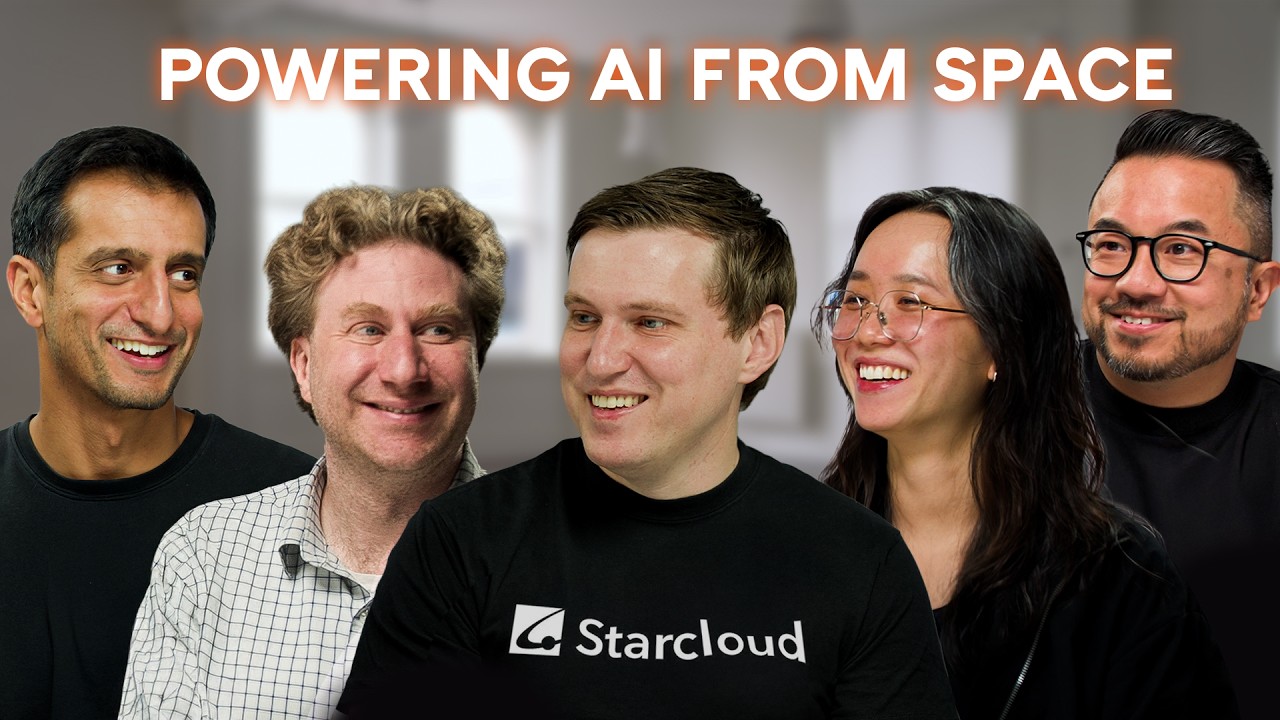
The video features an interview with Philip Johnston, co-founder and CEO of StarCloud, a pioneering company building data centers in space to tackle the growing energy demands of AI on Earth. StarCloud was founded in early 2024, and from day one, they booked a SpaceX launch to force progress, even before fully knowing what they would send to space. The core idea emerged from observing rapidly decreasing launch costs and increasing launch capacities, particularly with SpaceX’s Starship program, which could revolutionize access to space. By leveraging abundant solar energy in space, StarCloud aims to overcome terrestrial constraints on energy and data center expansion.
Philip explains that data centers were chosen as the initial focus because unlike other space ventures such as asteroid mining or space hotels, they do not require expensive re-entry processes. Initially, the company explored space-based solar power but pivoted after realizing the energy loss in beaming power to Earth was too high. Instead, they decided to build data centers directly in orbit, where the break-even launch cost is more achievable. Their first satellite, StarCloud 1, launched in November 2025, carried high-performance GPUs including Nvidia H100s, proving that powerful computing hardware can operate in space despite challenges like thermal management and radiation.
The engineering challenges of running data centers in space are significant. Cooling in a vacuum requires innovative solutions since there is no air for convection, so StarCloud developed lightweight, cost-effective radiators. Radiation poses risks of bit flips in processors, which they mitigate through extensive ground testing, shielding, and software error correction. They also use off-the-shelf automotive-grade components rather than expensive space-grade parts to reduce costs. Connectivity is addressed through partnerships, such as with SpaceX’s Starlink laser terminals, enabling high-bandwidth, low-latency data transfer between satellites and Earth.
StarCloud’s roadmap involves scaling from their initial demonstration satellite to larger spacecraft capable of delivering tens of kilowatts of power and eventually to a constellation of tens of thousands of satellites providing gigawatts of compute power. This scale could surpass terrestrial data center capacity and address the increasing political and environmental challenges of building new data centers on Earth. The company has secured significant funding, including a $170 million round led by Benchmark, despite initial skepticism from investors who found the idea too futuristic or risky.
Philip emphasizes the importance of assembling a top-tier engineering team and following a pragmatic approach of booking launches early to accelerate development. He encourages other hard tech founders to pursue space ventures, highlighting the unprecedented growth in launch capacity and the vast opportunities in the space industry. StarCloud’s vision not only addresses critical energy and compute bottlenecks but also positions the company as a key player in national security and the future of AI infrastructure.