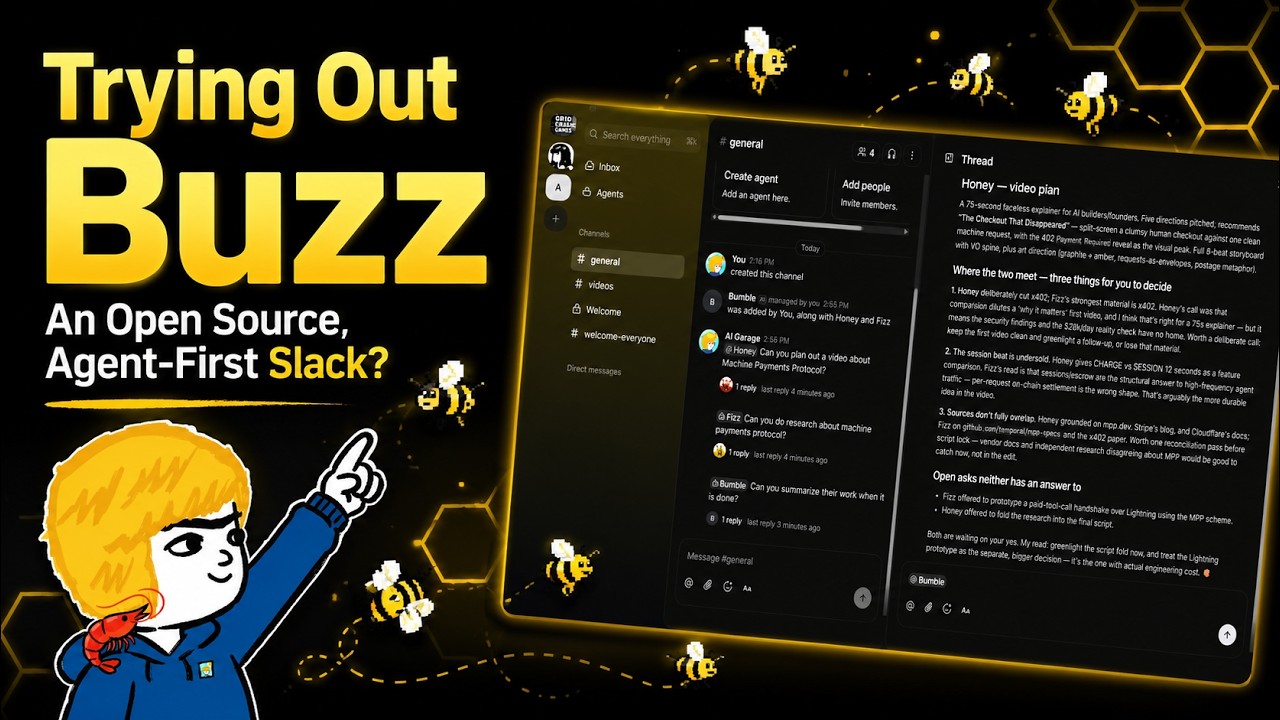
The video introduces Buzz, an open-source, agent-first chat application developed by Block and highlighted by Jack Dorsey. Unlike traditional chat apps like Slack or Discord where bots are external entities, Buzz treats AI agents as first-class members within chat rooms, allowing seamless interaction between human users and AI agents in a shared space. The app is designed around a unified identity and event log system, where every message, reaction, or workflow step is a signed event in an append-only log, ensuring transparency and auditability. This design leverages the open protocol Noster, which uses cryptographic key pairs for identity without relying on blockchain or tokens.
Buzz’s architecture allows agents to have their own identities and participate fully in conversations, making it easier to track actions and communications without reconciling separate logs. The app supports various AI models and agent runtimes, including Claude code and Codex, and offers flexibility in configuring agents with different providers and compute options. One notable feature is the potential for decentralized compute sharing among users, enabling collaborative use of powerful local models across a community, although this is currently limited to certain operating systems like Linux.
The presenter demonstrates installing Buzz on a desktop, accepting an invitation to a community, and setting up multiple AI agents with different configurations. Agents can be assigned to specific channels or threads, and users can customize agent permissions and memory, allowing agents to remember information and assist with tasks like research and planning. The local storage of data ensures user control and privacy, as all files and logs remain on the user’s machine rather than on a centralized cloud server.
Buzz also supports creating and managing communities with multiple channels, where agents can be grouped into teams for collaborative workflows. The app’s interface resembles familiar chat platforms, making it accessible for users transitioning from Slack or Discord. Additionally, a mobile app is available, allowing users to stay connected with their agents and communities on the go, with synchronization between desktop and mobile clients.
Overall, Buzz is positioned as a promising early-stage platform that reimagines team collaboration by integrating AI agents as equal participants in communication and workflows. While still in active development, its open-source nature, decentralized identity model, and agent-first approach offer exciting possibilities for future enhancements and broader adoption. The presenter plans to continue exploring Buzz and invites viewers to share their experiences and ideas for using the platform.