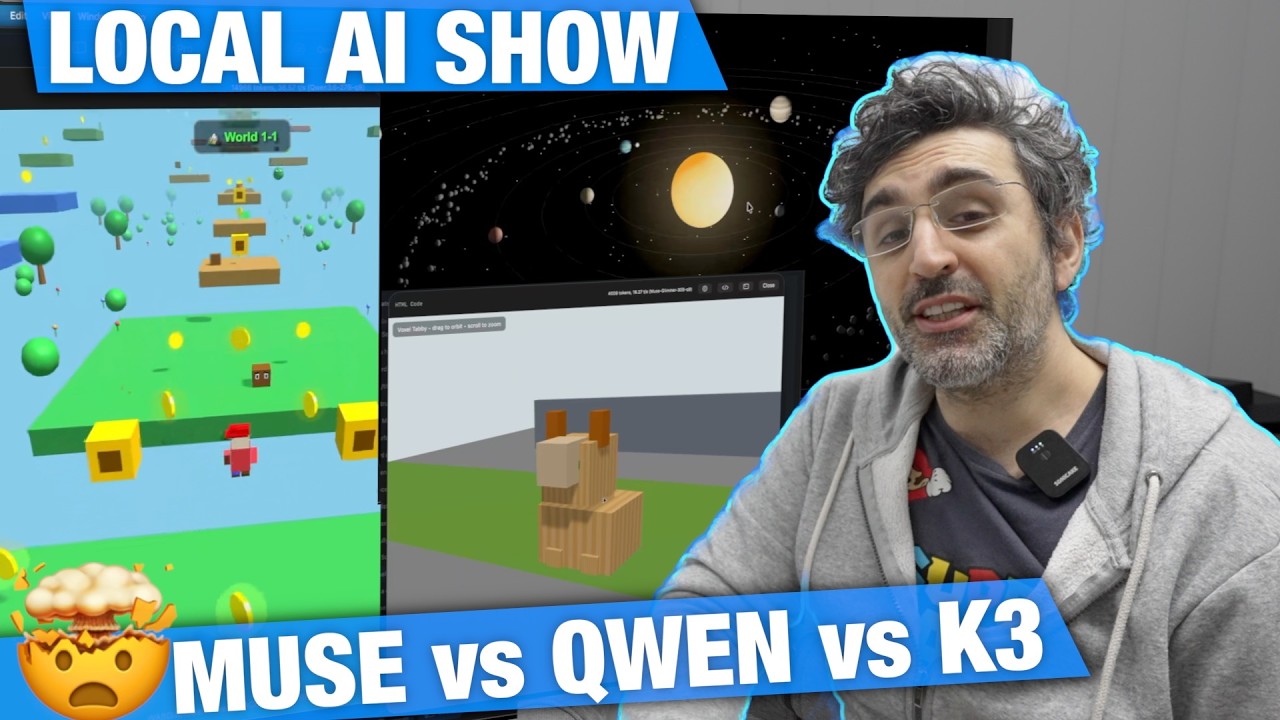
The video reviews and compares three AI models for local AI generation: Meta’s Muse Glimmer (a 30 billion parameter model), Qwen 3.6, and Kimi K3. Muse Glimmer is highlighted as a promising new release from Meta, designed for end-to-end synthetic coding and multimodal tasks such as image and video inference. The reviewer notes that while Glimmer performs well in some benchmarks, it slightly trails behind Qwen and K3 in others, but shows potential for future improvements.
In practical tests involving 3D animation and coding tasks, Muse Glimmer often produces visually appealing and coherent outputs, such as an animated cat with a moving tail and a basic flight simulator. However, it sometimes encounters runtime errors or produces less detailed results compared to Qwen and K3. For example, in a 3D solar system generation test, K3 outperformed both Glimmer and Qwen with more colorful and interactive planets, while Glimmer struggled with errors.
Qwen 3.6 generally delivers more complex and higher-fidelity generations, especially in tasks like anatomical human models, game-like environments (e.g., GTA and Mario-style platformers), and logic tests. It can generate large token counts (up to 30,000 tokens) and handle intricate scenes with better lighting and detail. However, Qwen also experiences occasional runtime errors and some glitches, indicating room for stability improvements.
Kimi K3, running locally, impresses with its quality and efficiency, often producing superior results with fewer tokens compared to Qwen and Glimmer. Its 3D solar system and other visual generations are noted as particularly strong, with better lighting and interactivity. The reviewer is still working on fully integrating K3 but is optimistic about its capabilities and potential to compete with larger models like Qwen and Glimmer.
Overall, the reviewer concludes that while Qwen 3.6 currently leads in complexity and output quality, Muse Glimmer shows significant promise, especially given its open license and multimodal features. Kimi K3 also stands out for its efficient and high-quality local generation. The video emphasizes the importance of testing these models on basic prompts to gauge their reliability and suggests that future versions of Glimmer and K3 could close the gap with Qwen, making the local AI landscape increasingly exciting.