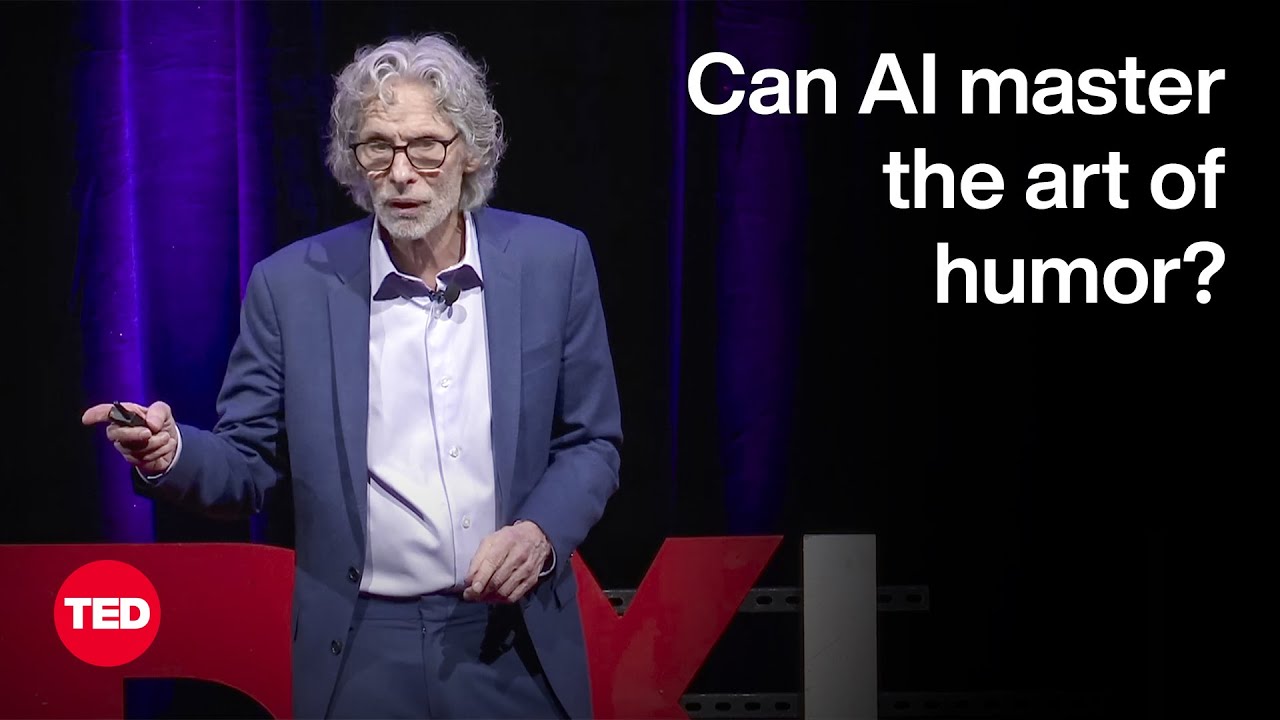
In the TED talk “Can AI Master the Art of Humor?”, Bob Mankoff explores the intersection of artificial intelligence and humor, questioning whether AI can truly understand and create comedy. He humorously expresses that while concerns about AI’s potential dangers are prevalent, he is more interested in its ability to generate humor. Mankoff, a cartoonist, reflects on his career of creating cartoons, emphasizing that humor often involves making things up, which he sees as a feature rather than a flaw in AI.
Mankoff discusses various theories of humor, such as the superiority theory, incongruity theory, and benign violation theory, which attempt to explain what makes something funny. He shares a famous cartoon he created and muses on the possibility of AI being able to replicate his creative process. While he initially believed that humor was beyond the reach of algorithms, he acknowledges the rapid advancements in AI technology and considers the potential for AI to assist rather than replace human creativity.
The talk highlights the historical context of fears surrounding machines and their impact on humanity, referencing Norbert Wiener and the alignment problem. Mankoff humorously contrasts these fears with the absurdity of some tech figures, like Elon Musk, who warn about AI’s threats. He introduces the concept of “p(funny)” as a metric for assessing humor, contrasting it with the more ominous “p(doom)” associated with AI.
Mankoff shares his experience with the New Yorker caption contest, where readers submit captions for cartoons. He explains how the contest transitioned to crowdsourcing, allowing the public to vote on captions, which led to a more democratic selection process. He notes that while AI has made strides in understanding humor, it still lags behind human creativity, although it is closing the gap.
In conclusion, Mankoff presents a collaborative project where AI-generated cartoons were created based on previous contest data. While the results were described as “weird,” he sees potential for AI to serve as a brainstorming tool for cartoonists. He emphasizes that true human humor is rooted in vulnerability and the human experience, suggesting that while AI can assist in the creative process, it cannot fully replicate the depth of human emotion and understanding that underpins humor.