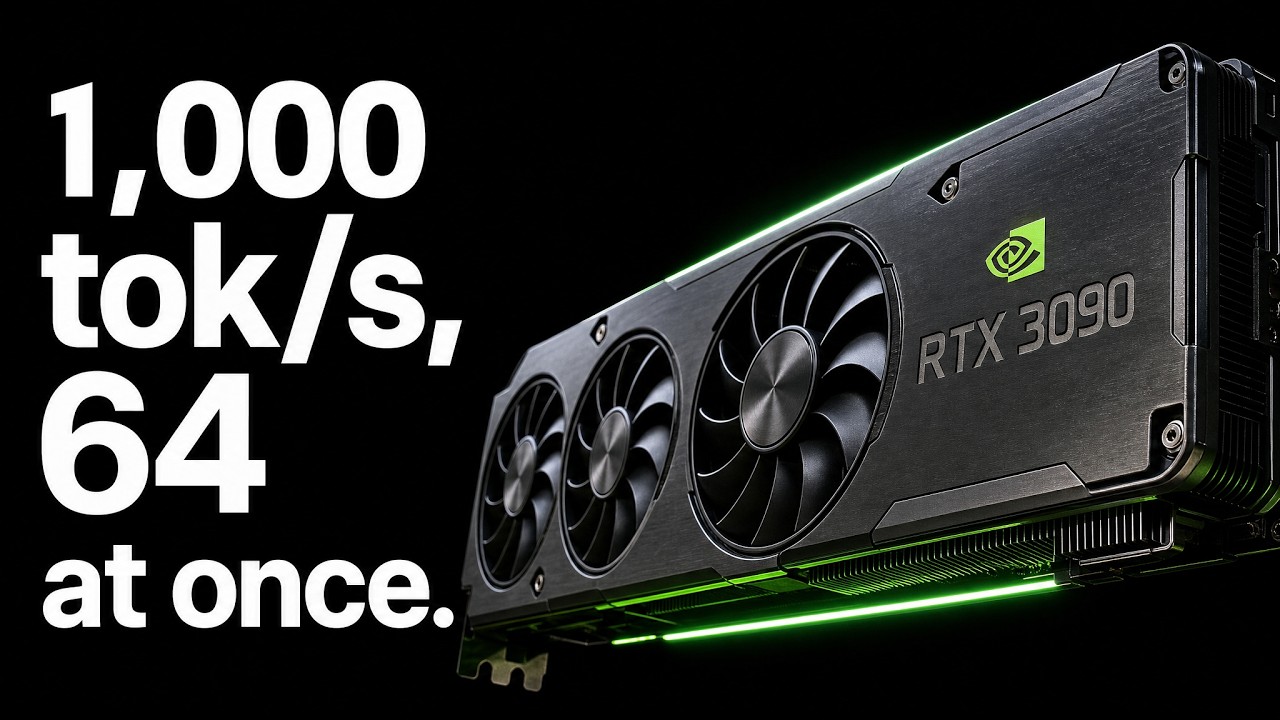
A GitHub repository claims that a single RTX 3090 GPU can run the Qwen3.8-27B model at about one thousand tokens per second while serving sixty-four concurrent requests, suggesting that one old gaming GPU can comfortably serve many users simultaneously. The repository provides patches, scripts, and benchmarks to support this claim, but independent reproduction of these results remains unverified. The main challenges lie in verifying whether the performance scales with multiple users, whether the advertised context window holds under load, and how fast individual users experience the model when many are active.
The RTX 3090’s memory bandwidth, roughly 936 GB/s, is the key limiting factor in token generation speed, as the GPU must read weights from memory for each token produced. Real-world throughput typically reaches only 50-80% of the theoretical maximum due to overheads like attention mechanisms and kernel processing. To serve sixty-four users simultaneously, the model uses batching to share weight reads across requests and employs techniques like PagedAttention to manage memory efficiently. However, no public data confirms that the large context window and concurrency claims have been measured together in practice.
Independent tests by Red Hat comparing different serving engines on the same hardware and model showed significant performance differences, with one engine achieving 793 tokens per second and another only 41, highlighting the impact of software on throughput. Real-world deployments, such as an Estonian GPU cloud using a single RTX 3090 to serve over a hundred concurrent users on a smaller 8-billion parameter model, demonstrate that serving many users is feasible but at much lower per-user token rates (around 12.88 tokens per second). This suggests that while concurrency is possible, individual user experience slows down significantly as more users share the GPU.
The size of the model relative to the GPU’s memory is another critical factor. The 27-billion parameter model requires significant memory even when quantized down to 4-bit precision, leaving limited space for conversation context and caching. Published memory usage calculations exist only for single-user scenarios, and no one has publicly demonstrated how the model and context scale to sixty-four concurrent users on a single RTX 3090. Consequently, the impressive concurrency claims lack transparent, reproducible evidence, and the actual per-user token rate in multi-user setups is much lower than the headline figures suggest.
Ultimately, the biggest lever affecting monthly AI costs is not just hardware speed but the model’s reasoning preset, which controls how much “thinking” the model does per token. Lowering this preset reduces token generation time by 6-7 times and thinking tokens by 7-9 times, allowing more users to be served on the same hardware without additional cost. Therefore, owning an RTX 3090 shifts the cost by enabling control over the thinking budget rather than eliminating the monthly AI bill entirely. The card’s value lies in putting that budget on the user’s side, not necessarily in raw speed, and the headline concurrency and speed claims should be viewed with caution until independently verified.
Useful Links