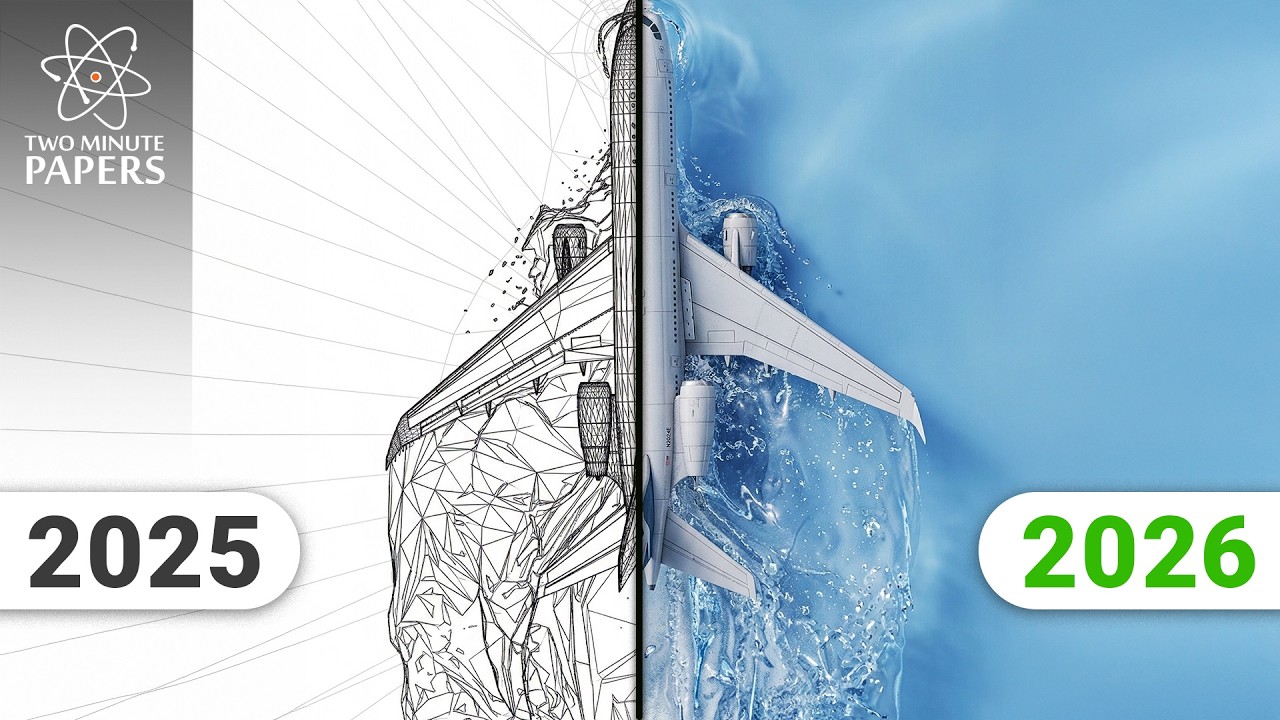
The video explores a groundbreaking new technique for simulating water and fluid interactions in computer graphics, addressing a long-standing problem where objects unrealistically clip through water. Unlike previous methods that often rely on shortcuts or ignore complex interactions to keep simulations stable, this approach accurately models the physics of both air and water, which have vastly different densities. The result is visually stunning and physically accurate simulations, such as propellers creating turbulence, objects splashing into water, and even whimsical scenes like cows and bunnies raining down and interacting with fluid surfaces.
A key innovation in this technique is its ability to handle “two-way coupling,” meaning that not only does water affect the movement of objects, but objects also influence the water. This is a significant leap from older simulations, which often treated solids and fluids as if they were in a chaotic mosh pit, colliding without any real rules. The new method transforms this chaos into a synchronized ballet, where every interaction is governed by precise physical laws, resulting in much more realistic and stable outcomes.
The underlying technology is based on the Lattice Boltzmann Method, which differs from traditional simulation techniques. Instead of issuing broad instructions to the entire system, it operates on a particle level, allowing for individual movement and interaction phases. This approach is likened to giving each “dancer” on the simulation floor their own set of instructions, leading to more nuanced and accurate behavior. The method also incorporates a hybrid moving bounce-back technique, ensuring that energy and momentum are properly exchanged during collisions.
One of the most impressive aspects of this new technique is its efficiency. Despite being more accurate and visually impressive, it is actually four times faster than previous methods, defying expectations that better simulations must be slower. It can handle complex scenarios that were previously impossible, such as simulating the thin layer of air that allows a stone to skip across water multiple times. This attention to detail enables the simulation to pass even the toughest tests when compared to real-life footage, such as a key slicing through water and creating realistic air bubbles and splashes.
Beyond the technical achievements, the video draws life lessons from the research, emphasizing the importance of two-way communication and mutual influence—both in physics and in relationships. The narrator encourages viewers to appreciate the beauty and complexity of nature, suggesting that observing real streams and water flows can be both inspiring and educational. The video concludes by highlighting the importance of sharing and celebrating such innovative research, which might otherwise go unnoticed.