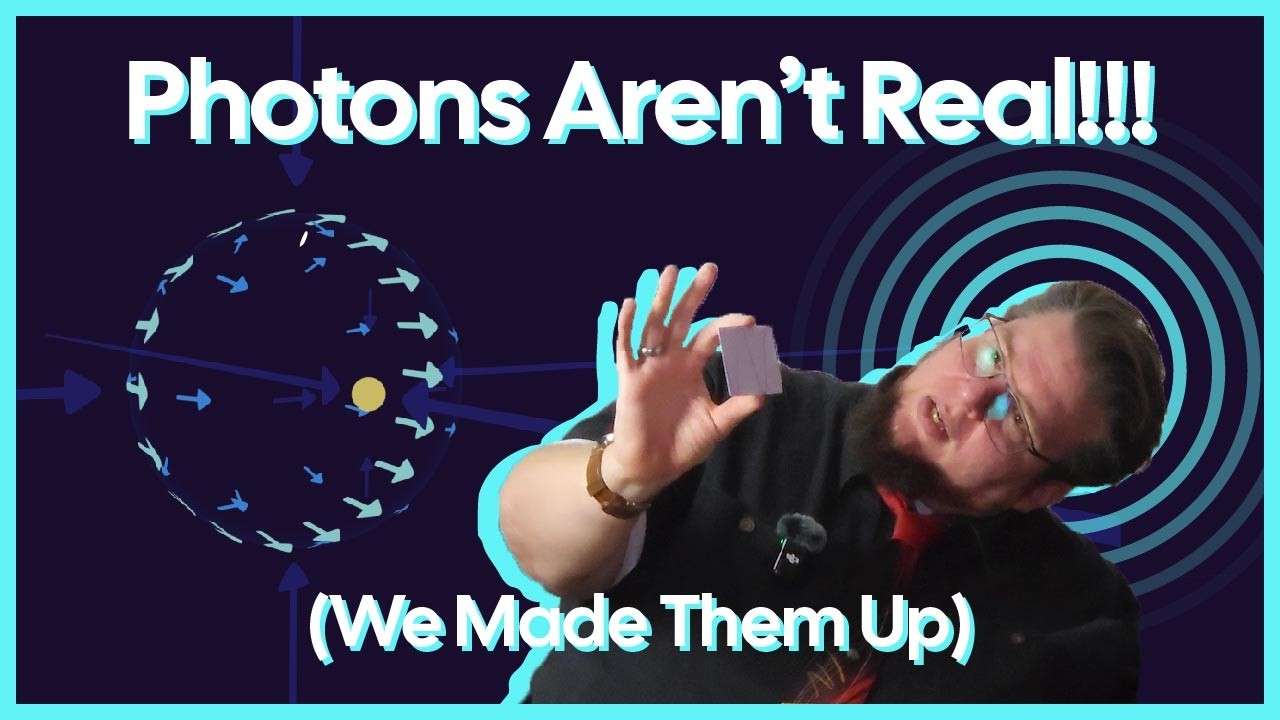
The video explores the concept of wave-particle duality in photons, proposing that photons are not discrete particles but rather interactions between electromagnetic waves and electrons, challenging traditional interpretations of quantum mechanics. It emphasizes that light behaves as a wave and that observed phenomena, such as the photoelectric effect and the double-slit experiment, can be explained through these interactions rather than particle-like properties.
In this video, the presenter delves into the perplexing nature of photons, which exhibit both wave-like and particle-like behaviors, a phenomenon known as wave-particle duality. The speaker expresses frustration with the current understanding of photons and proposes a new perspective: photons are not particles but rather interactions between electromagnetic waves and electrons. The core argument is that what we refer to as photons are merely geometric conditions that arise from these interactions, challenging the conventional view of light in quantum mechanics.
The video begins by explaining electromagnetic waves, focusing on the electric field generated by electrons. When an electron moves, it creates a disturbance in the electric field that propagates outward at the speed of light, forming an electromagnetic wave. The presenter emphasizes that for light to be perceived as a photon, specific conditions must be met, including the presence of another electron to detect the wave. This leads to the conclusion that photons are not discrete particles but rather events resulting from the interaction of electromagnetic waves with electrons.
The speaker then discusses several key experiments that have contributed to the understanding of light, such as the photoelectric effect and Compton scattering. These experiments initially led to the interpretation of light as both a wave and a particle. However, the presenter argues that the observed behaviors can be explained without invoking particle-like properties. For instance, the photoelectric effect demonstrates that light interacts with electrons in a probabilistic manner, while Compton scattering can be understood through the lens of electromagnetic waves rather than particles.
The double-slit experiment is highlighted as a pivotal demonstration of light’s dual nature. The presenter explains that when light passes through two slits, it creates an interference pattern indicative of wave behavior. However, when attempts are made to observe which slit a photon passes through, the interference pattern disappears. The speaker clarifies that this does not imply that photons are particles but rather that the act of measurement alters the interaction, reinforcing the idea that light is fundamentally a wave.
In conclusion, the video challenges the traditional interpretations of quantum mechanics, particularly the concept of wave-particle duality. The presenter asserts that photons should be understood as interactions rather than particles, which simplifies the explanation of various quantum phenomena. By re-evaluating the nature of light and its interactions with electrons, the speaker aims to provide a more intuitive framework for understanding quantum mechanics, paving the way for future explorations into the nature of light and magnetism.