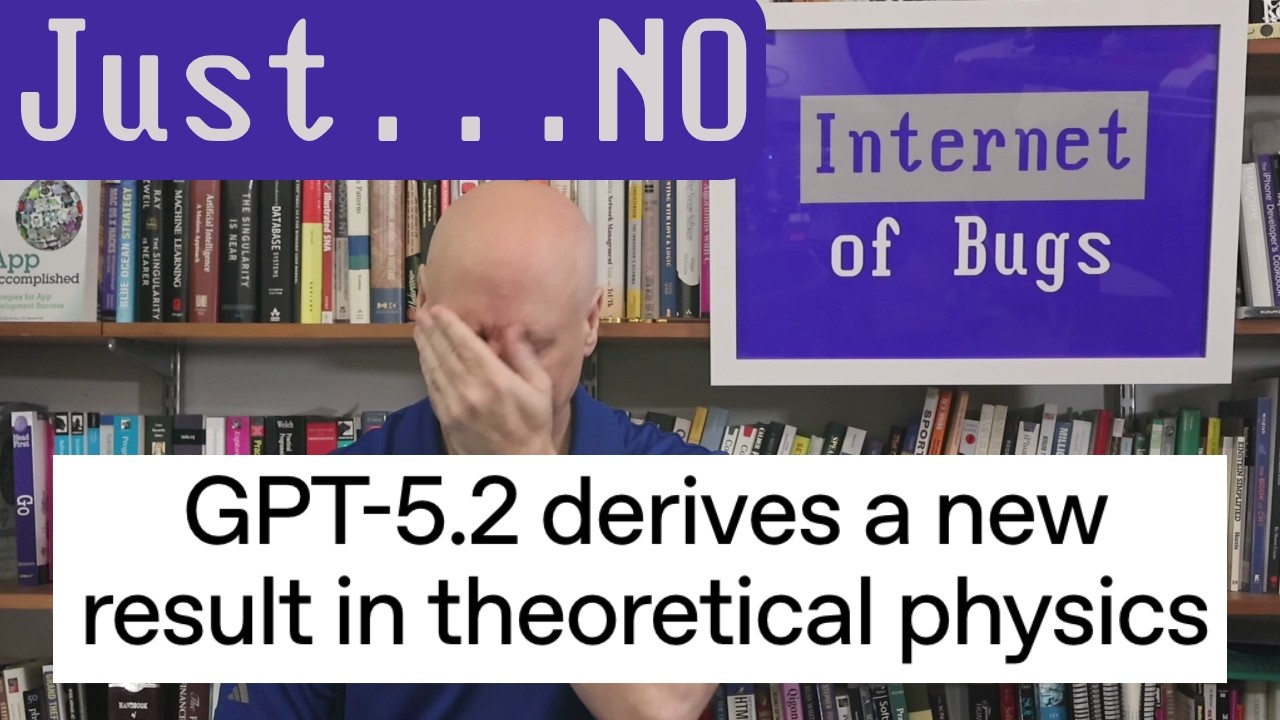
The video critically examines OpenAI’s claim that ChatGPT “derived a new result in theoretical physics,” clarifying that the AI merely simplified complex equations already worked out by human physicists—a task similar to what existing computational tools can do. The creator warns viewers not to be misled by sensational headlines, emphasizing that this is a useful but not groundbreaking achievement in physics or AI.
The video provides an unscripted, off-the-cuff reaction to a recent OpenAI press release claiming that ChatGPT “derived a new result in theoretical physics.” The creator, who has a background in physics and some knowledge of AI, aims to clarify what actually happened and to temper the hype that is likely to follow in the media. He expresses skepticism about the grandiose headlines and wants to offer a reality check before misinformation spreads.
According to the video, the actual process involved human physicists working out complex equations by hand and then providing these lengthy expressions to GPT-5.2 Pro. The AI spent about 12 hours processing the data and produced a simplified version of the equations. The creator points out that this is essentially a brute-force mathematical simplification, something that could have been done with existing computational tools like Mathematica, albeit with enough resources and time.
The video emphasizes that while this achievement is useful and demonstrates AI’s ability to assist in mathematical simplification, it is not a groundbreaking discovery in physics. The AI did not independently create new physical laws or concepts; it simply found a more concise form for equations that humans had already derived. The creator stresses that this is a valuable tool for physicists but not an example of AI surpassing human capability in theoretical physics.
He also speculates that OpenAI may have collaborated with university researchers, collecting complex equations that were candidates for simplification, running them through their AI, and then returning the results to the physicists. The press release, in his view, seems to overstate OpenAI’s role and the significance of the result, possibly for publicity purposes. He warns that the headlines will likely exaggerate what was actually accomplished.
In conclusion, the creator urges viewers to be cautious about sensationalized media coverage. He reiterates that while AI can now help simplify complex math, this is not evidence of AI making fundamental discoveries in physics. The video was made quickly and without a script, prompted by the desire to provide a more accurate perspective before misleading headlines take hold. He encourages viewers to remain critical and informed as the story develops.