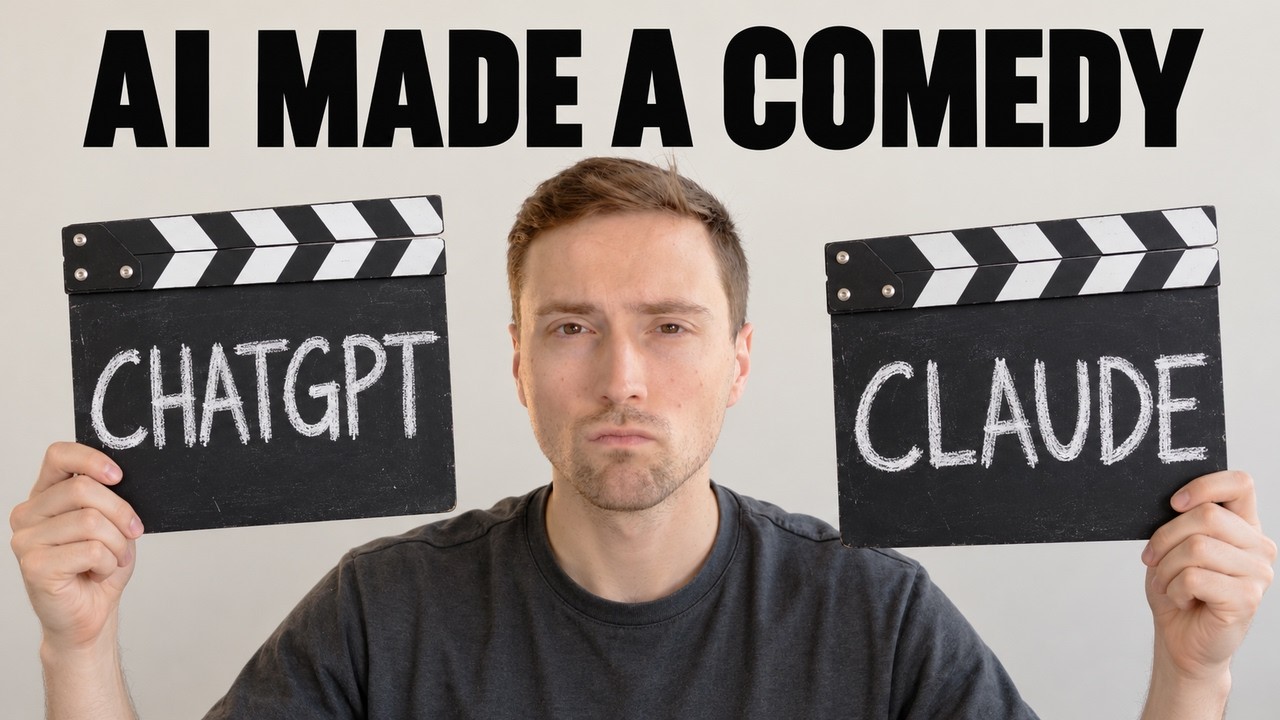
In this video, the creator experiments with two AI models, Claude and ChatGPT, challenging them to independently create a 90-second comedy film based on a simple story: a random man gets abducted by aliens while eating a sandwich and remains indifferent to the experience, treating the alien ship like a cheap hotel. Both AIs received identical instructions and budgets, and the films were produced using Kling 4.0 technology via the Higgsfield platform. The goal was to see if either AI could generate genuinely funny content and visually appealing short films despite AI’s known struggles with comedy.
The process began with both AIs researching comedy writing techniques and generating ten self-imposed rules to guide their joke creation. Interestingly, both acknowledged AI’s reputation for repetitive and uninspired humor, citing a study where ChatGPT repeated the same jokes 90% of the time. While their rules overlapped in some areas, each AI had unique guidelines—Claude avoided sticking to its first joke idea, whereas ChatGPT emphasized testing jokes on real people, though it did not actually perform such tests. After drafting scripts, Claude revised seven jokes while ChatGPT discarded its initial script entirely and wrote a new one.
Using Higgsfield’s Cinema Sol Studio, both AIs generated images and video clips to assemble their films, with Claude producing about 60 images and ChatGPT around 35. Both operated in fast mode, but Claude completed its film in roughly 45 minutes, while ChatGPT took nearly twice as long. Despite the same budget, neither used the full credit allowance. The films were composed of multiple short clips rather than fewer longer ones, likely to allow easier editing and more realistic visuals. The creator demonstrated how to edit imperfections in the films using Higgsfield’s tools.
Upon viewing, the first film (Claude’s) was noted for its artistic style, somewhat resembling plush toys, and had a quirky, confusing storyline with some humorous moments like mismatched socks. The second film (ChatGPT’s) had a claymation aesthetic but was considered less funny and more awkward in its jokes. The creator favored Claude’s film for its creativity and visual quality, despite some oddities and artifacts. After revealing which AI made which film, the creator expressed surprise that Claude outperformed ChatGPT in both speed and quality.
In conclusion, the experiment highlighted that AI still struggles with comedy, but Claude showed more promise in creating an engaging and visually interesting short film. The creator encouraged viewers to try making their own videos using Kling 4.0 on Higgsfield and to share their opinions on the films. Overall, while neither film was perfect, Claude’s effort was deemed the better of the two, suggesting that with further development, AI could become more capable in comedic storytelling and filmmaking.