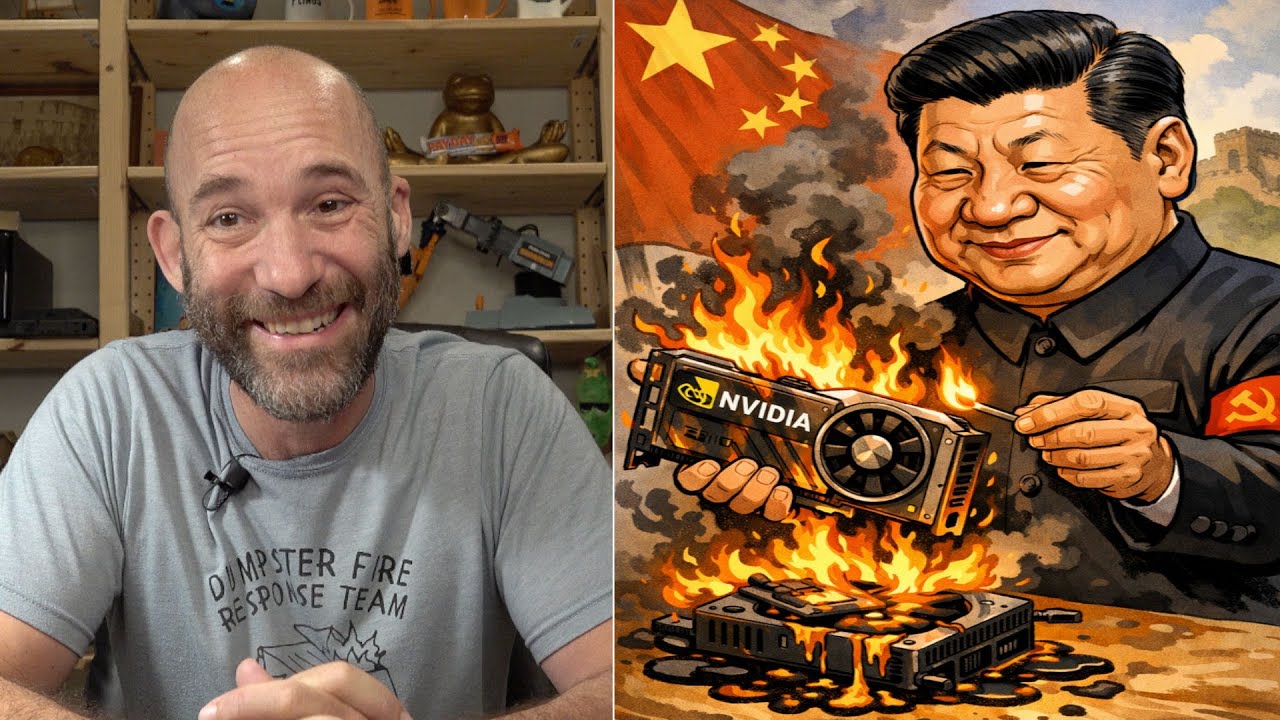
The video, presented by Eli the Computer Guy, begins with personal anecdotes about the realities of working in technology education, emphasizing that the job involves much more than just teaching or coding. He describes the logistical and operational challenges of running Silicon Dojo, a free hands-on tech education initiative in North Carolina, including issues like access control systems and HVAC in classrooms. Eli also outlines upcoming classes and the effort required to organize them, highlighting the often-overlooked aspects of tech careers that go beyond the passion for technology itself.
The main topic shifts to the intersection of politics and technology, specifically focusing on the recent developments regarding the export of Nvidia’s H200 GPUs to China. Eli explains that the U.S. government, under both the Biden and Trump administrations, has imposed restrictions on selling advanced AI hardware to China, citing national security concerns. Despite these restrictions, the Chinese market remains highly lucrative for American tech companies, leading to complex negotiations and attempts to find loopholes or compromises, such as selling older or less powerful chips.
Recently, China has responded by banning the import of Nvidia’s H200 GPUs, which are already considered a generation behind the latest technology. This move appears to be a reaction to both the U.S. export controls and the perception that the U.S. is trying to maintain technological dominance while still profiting from the Chinese market. As a result, Chinese companies are reportedly turning to the black market to acquire these GPUs, sometimes paying up to 50% more than the official price, or seeking alternative solutions like using data centers in other countries.
Eli discusses the broader implications of these political and economic maneuvers, noting that technology decisions are increasingly driven by international politics rather than pure technical or business considerations. He points out that Chinese companies are adapting by smuggling hardware, leasing foreign data centers, or relying on less powerful domestic chips. This situation complicates long-term planning for tech professionals, especially outside the U.S., as access to critical hardware can no longer be taken for granted.
The video concludes with reflections on the unpredictability of current U.S. politics and its impact on global technology infrastructure. Eli questions the wisdom of relying on American tech stacks in such a volatile environment and urges viewers—especially those in non-U.S. countries—to carefully consider their technology roadmaps. He reiterates the importance of understanding both the technical and political landscapes when making decisions about infrastructure, partnerships, and certifications, and invites viewers to share their thoughts on the ongoing China-U.S. tech standoff.