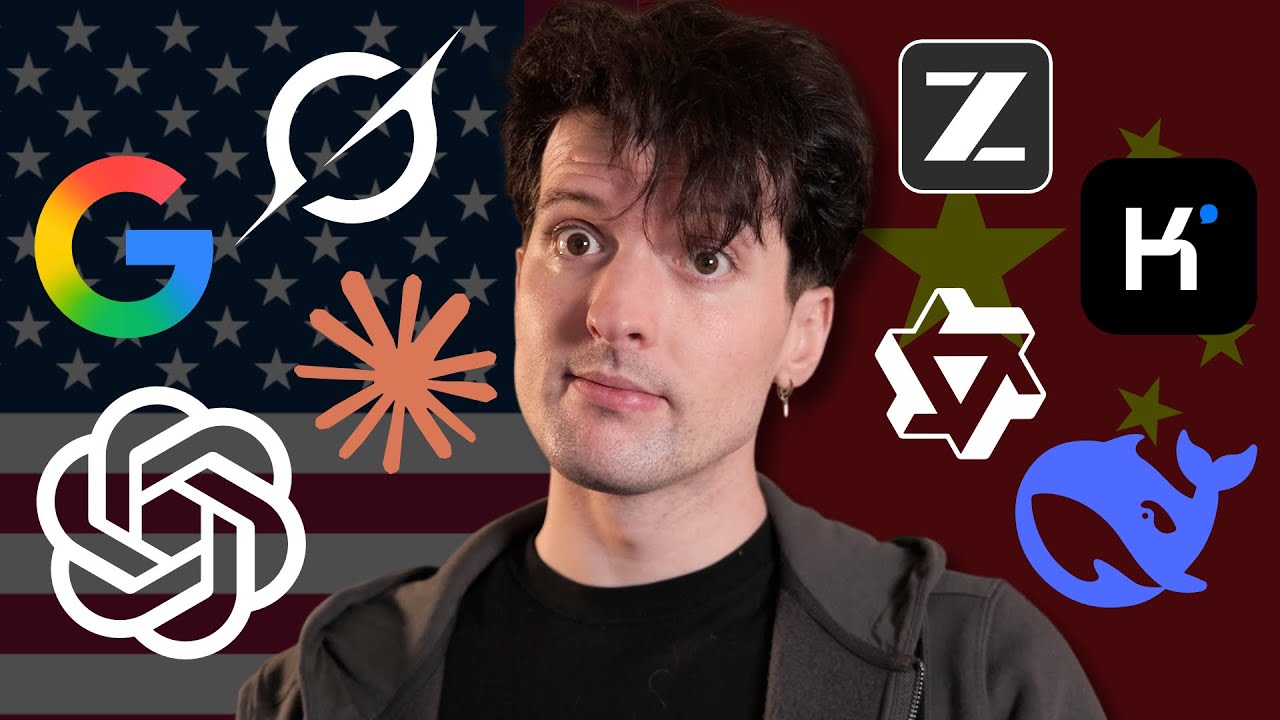
The video discusses the current landscape of artificial intelligence (AI) models, highlighting a distinction between closed-weight models predominantly developed by American companies like Google, Anthropic, and OpenAI, and open-weight models where the model weights are publicly available for use and modification. While the top-performing AI models in terms of intelligence and capabilities are mostly American, the open-weight model race is being led by Chinese labs such as Kimmy, Deepseek, and Mini Maxm2. These Chinese models are significantly larger and more powerful than their American open-weight counterparts, with some reaching up to a trillion parameters, making them difficult to run on typical consumer hardware but highly competitive in benchmarks.
Open-weight models differ from open-source software in that they provide the trained model weights rather than the underlying training code or data. This approach allows users and providers to run and host the models independently, fostering competition among infrastructure providers. The video explains that while open-weight models are not fully open-source in the traditional sense, they offer a valuable level of transparency and usability. Chinese labs have embraced this open-weight strategy to gain relevance and adoption outside China, especially in the US, where concerns about data security and government influence limit the use of Chinese-hosted AI services.
Despite the advantages of open-weight models, the video points out that Chinese AI labs struggle with software development and user experience, often relying on US-based teams to build usable interfaces and applications. This contrasts with American companies, which excel in software but are less inclined to release open-weight models due to commercial and security concerns. OpenAI, for example, has released smaller, more manageable open-weight models designed to run on consumer hardware, prioritizing usability and accessibility over sheer size and complexity. This strategy allows OpenAI to maintain a competitive edge in the open-weight space by targeting users who want to run models locally.
The video also touches on the collaborative culture in AI research, noting that early breakthroughs like the transformer model and generative pre-training were openly published, enabling rapid progress across the industry. However, as competition intensifies among American labs, collaboration has diminished, with companies becoming more protective of their innovations. In contrast, Chinese labs continue to share research and models openly, which helps them advance quickly in the open-weight domain. The video highlights the challenges and risks associated with releasing open-weight models, including security and liability issues, which American companies are more cautious about due to regulatory and investor pressures.
In conclusion, the video argues that while the US currently dominates in closed-weight AI models and software development, China is winning the open-weight model race due to its willingness to release large, powerful models openly despite the challenges. The US has an opportunity to compete by focusing on smaller, efficient models that can run on consumer hardware, but there is little incentive for American labs to release large open-weight models freely. The video suggests that the future of AI may involve a balance where Chinese labs lead in open-weight innovation, while American companies excel in software and controlled API-based models, with potential for collaboration and competition in different segments of the AI ecosystem.