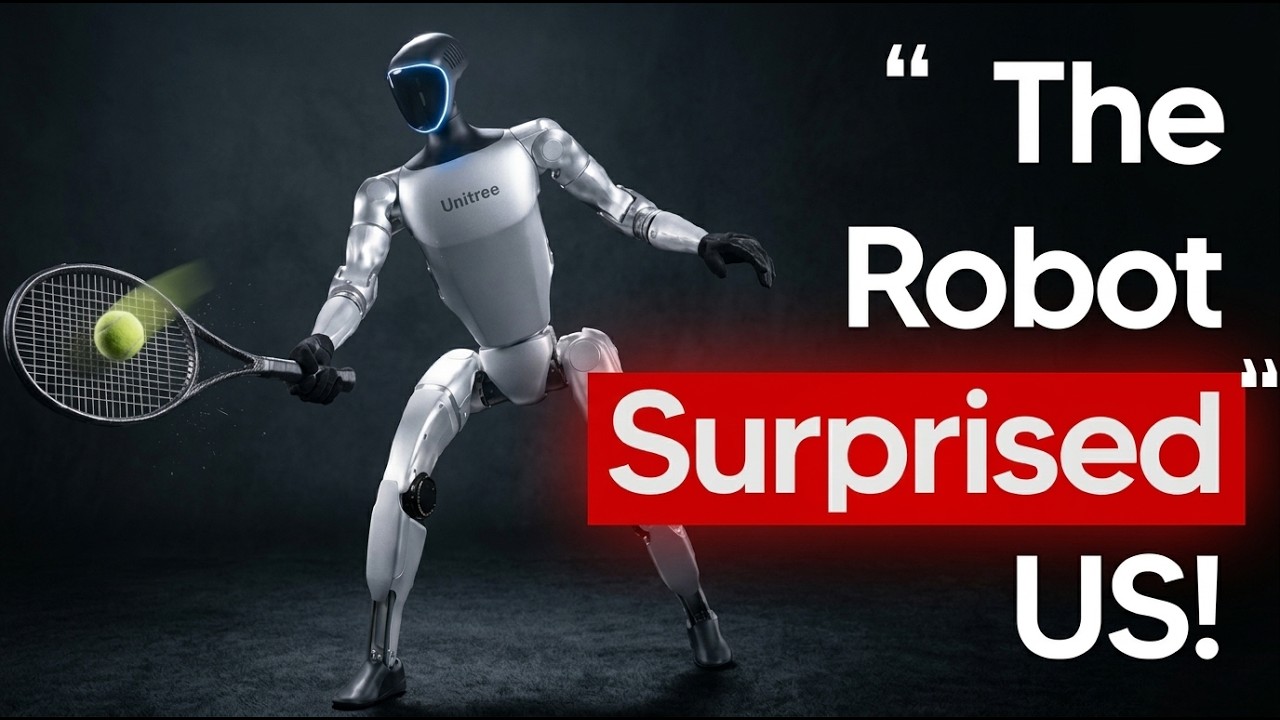
A team of researchers from leading Chinese institutions and robotics companies has achieved a significant breakthrough by teaching a small humanoid robot, the Unitree G1, to play tennis. Unlike previous attempts that focused on simpler tasks or robots with limited mobility, this project tackled the complex challenge of enabling a two-legged robot to perform a highly athletic, real-time activity requiring full-body coordination. Tennis was chosen as the testbed due to its demanding nature: the robot must track and intercept a fast-moving ball, position itself accurately, and execute precise swings—all tasks that even humans find difficult.
The researchers faced a major obstacle in acquiring suitable training data. While it might seem logical to use motion data from professional tennis players, such data is extremely hard to capture with the precision needed for robotics, and human and robot bodies differ significantly. Instead, the team used just five hours of motion capture data from five amateur players performing basic tennis movements in a small space. This imperfect, fragmented data was then processed by an advanced AI system called LATENT, which could translate and adapt these movements for the robot’s unique body.
LATENT’s architecture consists of three main layers: a motion tracker that translates human movements into robot-compatible actions, a latent action space that captures the essence of each movement rather than memorizing every detail, and a high-level policy that makes real-time decisions about how to move and respond to the ball. The system was trained extensively in simulation, with millions of virtual rallies, and the researchers introduced randomization to the simulation to help the robot adapt to the unpredictable nature of the real world—a common stumbling block in robotics known as the “sim-to-real gap.”
The results were impressive: the Unitree G1 achieved a 91% success rate on forehands and 78% on backhands in real-world tests, sustaining rallies with human players and moving faster than the average person jogs. In simulation, the success rates were even higher, and the approach outperformed standard reinforcement learning and other motion learning methods. Remarkably, this was accomplished using only a small amount of imperfect data, demonstrating that perfect, professional-level data is not necessary for training robots in complex tasks.
The broader implication of this research is profound. By showing that humanoid robots can learn complex, coordinated skills from limited, imperfect data, the team has potentially removed a major bottleneck in robotics. This approach could be generalized to teach robots a wide range of physical tasks—such as warehouse work, disaster response, or even other sports—quickly and inexpensively. The next steps include making the robot fully self-contained with onboard vision and expanding to multi-agent scenarios, paving the way for more autonomous and versatile humanoid robots in the future.