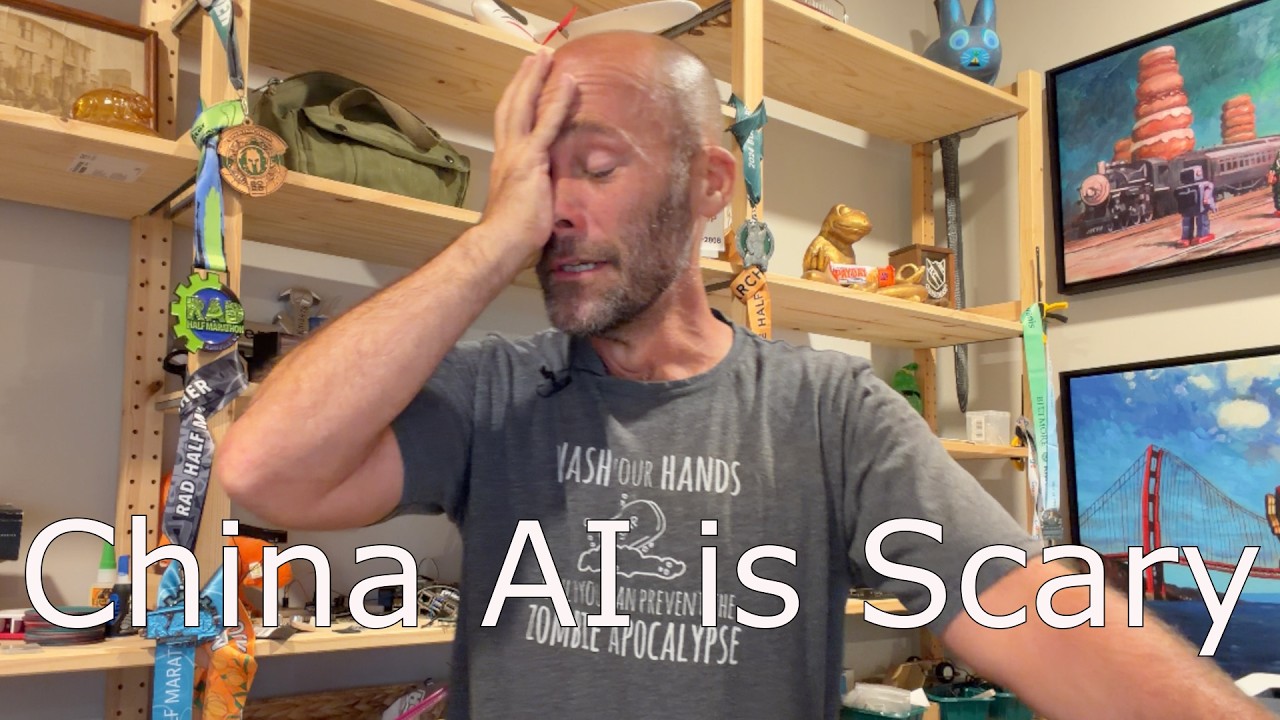
The video highlights China’s rapid advancement in AI, with a Chinese CEO claiming their Fable 5 class AI model will rival Anthropic’s latest by the end of the year, challenging U.S. dominance and Elon Musk’s timeline predictions. It critiques U.S. policies restricting AI access, questions the hype around AI’s transformative potential, and warns of the risks of underestimating China’s progress amid an accelerating global AI race.
The video discusses the rapid advancements in artificial intelligence (AI) development between the United States and China, focusing on the claim by a Chinese AI CEO that China will have a Fable 5 class AI model—comparable to Anthropic’s latest—before the end of the year. This challenges Elon Musk’s prediction that China’s rival AI would arrive by Q1 next year, with the Chinese CEO asserting it will happen sooner. The video highlights the ongoing technological competition, emphasizing that China is closing the gap with the U.S. faster than many expect, undermining the notion that America’s lead in AI is unassailable.
Anthropic, a leading American AI company, recently released Mythos 5, a highly powerful and potentially dangerous AI model, which they then “nerfed” into Fable 5 by adding safety guardrails to prevent misuse. The Trump administration deemed Fable 5 so sensitive that it restricted access exclusively to American citizens, even barring non-citizen engineers within the U.S. from working on it. This policy is criticized as impractical and counterproductive, especially given the global nature of software and AI development, and it reflects broader challenges in managing AI technology amid geopolitical tensions.
The video also critiques the outdated belief that the U.S. will always stay far ahead of China in AI innovation. It points out that China’s AI companies, such as ZAI (formerly JIUPO AI), have developed models like GLM 5.2 that perform nearly as well as Anthropic’s latest offerings and even outperform some Western models. This rapid progress suggests that the previously cited 18-month lag is shrinking, with China now trailing by perhaps only nine months. The speaker questions what winning or losing looks like in this AI race and warns that American AI development may be plateauing just as China’s is accelerating.
Beyond the technical competition, the video reflects on the broader societal impact and hype around AI. It draws parallels to past technological trends like the Internet of Things (IoT), which promised revolutionary changes but failed to fully deliver on expectations. The speaker expresses skepticism about AI’s transformative potential, noting that despite the excitement, many promised benefits—such as curing diseases or creating utopian lifestyles—have yet to materialize. This skepticism extends to concerns about how AI advancements will actually affect everyday life and global power dynamics.
In conclusion, the video urges viewers to consider the implications of China potentially matching or surpassing U.S. AI capabilities soon. It questions the current strategies and policies in place, highlighting the risks of underestimating China’s progress and the dangers of complacency. The speaker invites reflection on what the future holds in this AI competition, emphasizing the uncertainty about who will ultimately “win” or “lose” and warning that the U.S. might not even realize it has lost until it is too late. The video ends by encouraging audience engagement and further discussion on these critical issues.