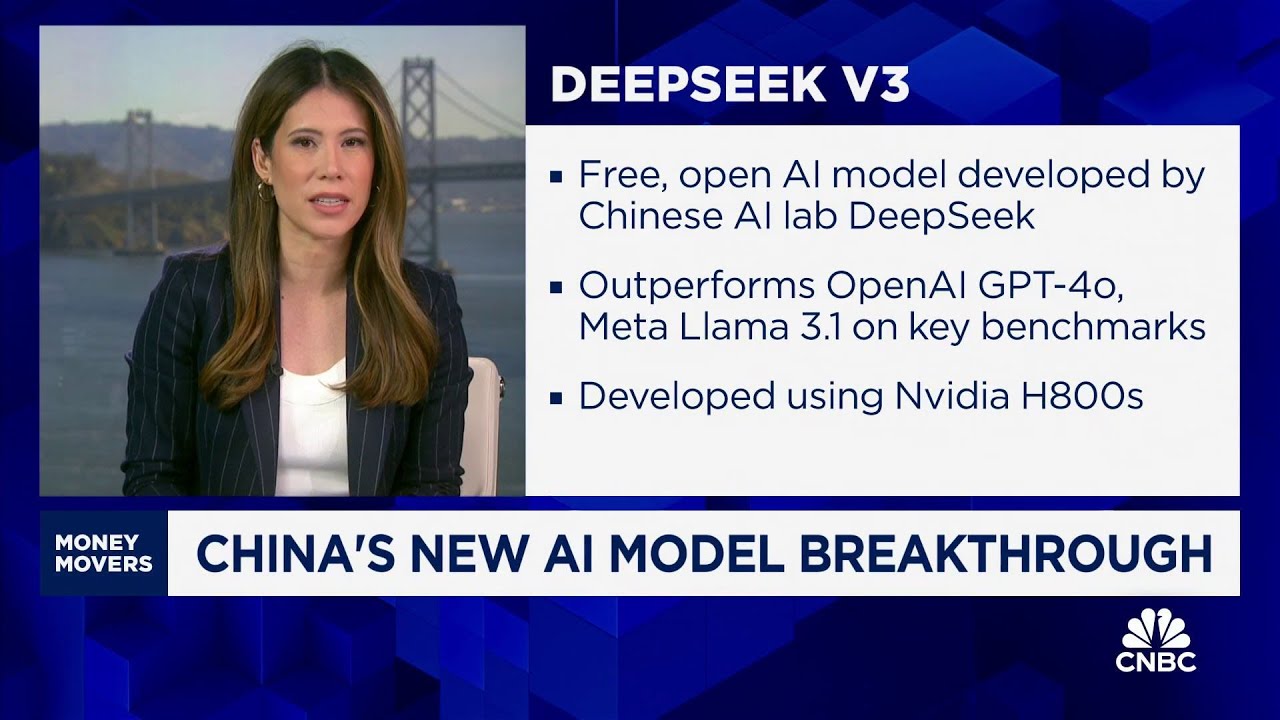
The CNBC segment discusses China’s new AI model, Deep Seek, which has outperformed leading models from OpenAI and Meta at a significantly lower cost, raising concerns for major tech companies about the future of AI development. This breakthrough highlights a trend towards commoditization in AI, suggesting that the competitive landscape may shift as countries like China leverage existing technologies to create viable alternatives.
In a recent segment on CNBC, the discussion centered around a new AI model called Deep Seek, developed by a Chinese research lab. This model has reportedly outperformed leading AI models from OpenAI and Meta on key benchmarks while being created at a fraction of the cost. Deep Seek was trained using lower-performance Nvidia H800 chips, which are more affordable and accessible in restricted markets like China. The model mimics the functionality of OpenAI’s ChatGPT and even claims to be based on the GPT-4 architecture, suggesting it may have been trained on existing outputs from ChatGPT.
The emergence of Deep Seek raises significant concerns for major players in the AI industry, such as OpenAI, Microsoft, Google, Amazon, and Meta, who have invested billions into developing advanced AI models. Deep Seek’s development cost was approximately $5.5 million, starkly contrasting with the hundreds of millions spent on Meta’s latest models and billions on OpenAI’s offerings. This disparity in costs indicates a potential shift in the AI landscape, where the barriers to entry for developing competitive AI models are diminishing.
The segment highlighted the implications of this development for investors, questioning whether the substantial investments in training frontier models by major tech companies are still worthwhile. As technological progress appears to be stalling, the ability to create competitive models with existing frameworks and lower costs could redefine the competitive landscape in AI. The rapid advancement of models like Deep Seek suggests that the traditional dominance of established companies may be challenged.
Despite lacking access to the latest high-performance chips, the Chinese research lab’s success with Deep Seek demonstrates a growing trend of commoditization in AI development. The ability to leverage existing models and outputs to create competitive alternatives signifies a shift in how AI technologies can be developed, potentially leveling the playing field between different countries and companies. This trend raises questions about the future of AI innovation and the strategies employed by leading firms.
The geopolitical ramifications of this development are also significant, as experts have noted that China’s advancements in AI pose a competitive threat to U.S. dominance in the field. The success of Deep Seek could lead to increased scrutiny and concern among U.S. tech companies and policymakers regarding the implications of open-source models and the potential for other countries to leverage existing technologies to create competitive AI solutions. As the AI landscape evolves, the story of Deep Seek is likely to gain more attention in the coming years.