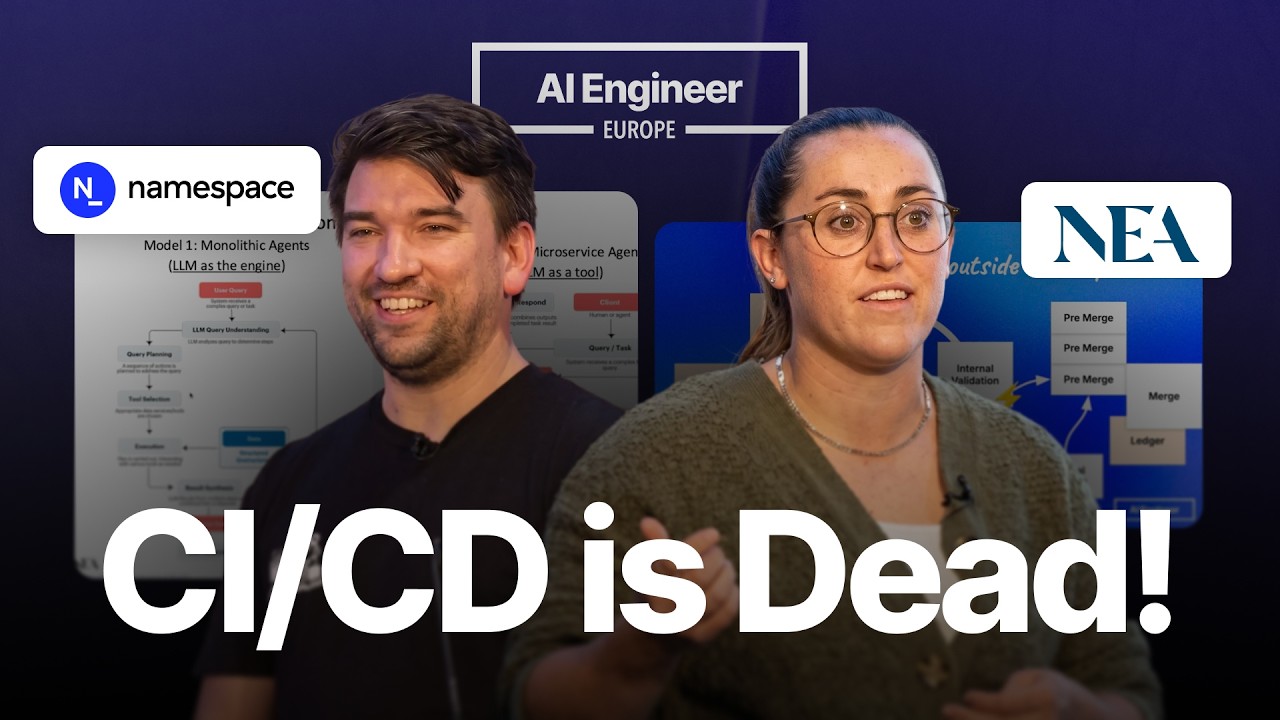
The presentation begins by challenging the traditional CI/CD (Continuous Integration/Continuous Deployment) model, arguing that it is becoming obsolete in the face of agentic software development. Madison Faulkner and Hugo Santos introduce the concept of “continuous compute” as the next evolution, driven by the increasing complexity and volume of code changes generated by autonomous agents rather than human developers. They highlight how traditional CI/CD pipelines, designed for relatively slow and human-paced code submissions, struggle to keep up with the rapid, parallel, and voluminous changes produced by these agents, leading to inefficiencies and bottlenecks.
Madison explains the current limitations of CI/CD pipelines, where human developers submit a few pull requests (PRs) that undergo review, build, test, and deployment processes. However, with agents generating thousands of short-lived branches and PRs simultaneously, the system becomes overwhelmed. The merging of multiple versions and managing caches becomes increasingly complex, making traditional CI/CD pipelines inadequate. The spike in GitHub activity and code commits underscores the urgency for a new approach that can handle this scale and velocity.
Hugo Santos expands on this by describing how the traditional PR-based workflow is inherently designed for human review and slower feedback loops. He points out that as code generation accelerates, the time to merge and validate changes becomes critical. The current model resembles a serialized database system where changes must be locked and merged sequentially, which is inefficient at scale. He proposes a new architecture where intent and plans replace PRs, and agents continuously work in loops to implement, validate, and refine code changes rapidly, with internal validations happening automatically and external validations increasingly handled by other agents rather than humans.
The future model Hugo envisions involves a stateful, high-performance environment where agents operate continuously and in parallel, managing multiple candidate changes simultaneously. This approach requires fast internal validation, minimal redundant work, and a pre-merge queue that reconciles concurrent changes to maintain codebase integrity. Human involvement shifts from reviewing individual code changes to approving aggregated results and intents, supported by AI-driven validation tools. This paradigm shift emphasizes efficiency, speed, and scalability, enabling development teams to handle the explosion of agent-generated code without being overwhelmed.
In conclusion, while CI/CD principles remain relevant, their implementation must evolve to support continuous compute driven by autonomous agents. The new development lifecycle integrates validation and governance into a seamless, continuous loop, moving away from discrete phases and human bottlenecks. Namespace and other industry leaders are actively exploring this transition, preparing for a future where software development is dominated by agentic workflows that demand radically different infrastructure and orchestration strategies. The talk closes with an invitation to embrace this change and prepare for the next era of software engineering.