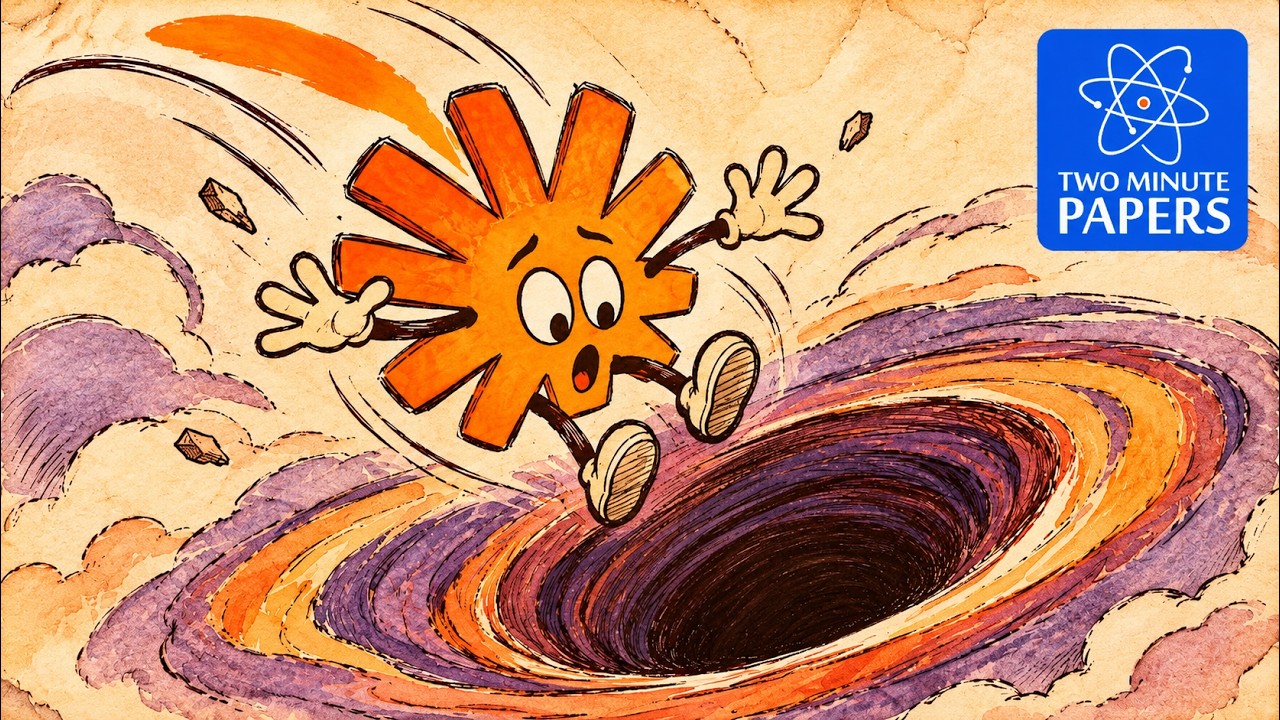
The video explores a fascinating phenomenon in physics involving black holes and the behavior of the universe as it heats up. Physicists have long known that at a certain critical temperature, a sudden and dramatic transition occurs where a black hole forms abruptly, rather than gradually. This discovery dates back to 1983 when Stephen Hawking and Don Page studied a theoretical universe shaped like a cosmic ball where energy cannot escape. At low temperatures, this universe behaves predictably, but as it heats up, it suddenly collapses into a black hole, marking a sharp phase transition.
This phenomenon highlights the clash between two fundamental theories: Einstein’s theory of relativity, which explains large-scale phenomena, and quantum mechanics, which governs the very small. Black holes sit at the intersection of these two realms, creating a puzzle about what happens to information when a black hole forms. Hawking’s work suggested that information might be lost forever, contradicting quantum mechanics, which insists that information must be preserved. This paradox has been a major challenge in theoretical physics for decades.
A key to understanding this transition lies in a variable called B, discovered in 2003. This variable determines how the universe behaves as it heats up. If B is positive, the transition is gradual, allowing the universe to “cook” slowly without collapsing immediately. If B is negative, a second, deeper energy state appears, causing a sudden switch from a normal state (likened to a bowl of goulash) to a black hole state. This analysis, known as Landau analysis, helps physicists predict the nature of the phase transition, but calculating B precisely is extremely difficult due to the complexity of quantum interactions.
The difficulty arises because the calculations involve numerous intricate Feynman diagrams, many of which yield infinite results that must be carefully combined to cancel out these infinities. For over 20 years, no one could complete this calculation. However, recently, an AI system called Claude AI, using multiple AI agents, tackled the problem by breaking it into smaller parts, writing programs to solve them, and cross-checking results. The AI found that B is negative, confirming that the transition to a black hole is indeed sudden and aligns with both Einstein’s relativity and quantum mechanics.
This breakthrough is remarkable because it unites two seemingly incompatible views of the universe, showing that they agree on this critical behavior. The cosmic “goulash” suddenly turning into a black hole is a beautiful example of nature’s underlying harmony. The video concludes by celebrating this achievement and encouraging viewers to explore AI tools like Lambda for running their own experiments, highlighting how AI is accelerating research in physics and beyond.
Useful Links