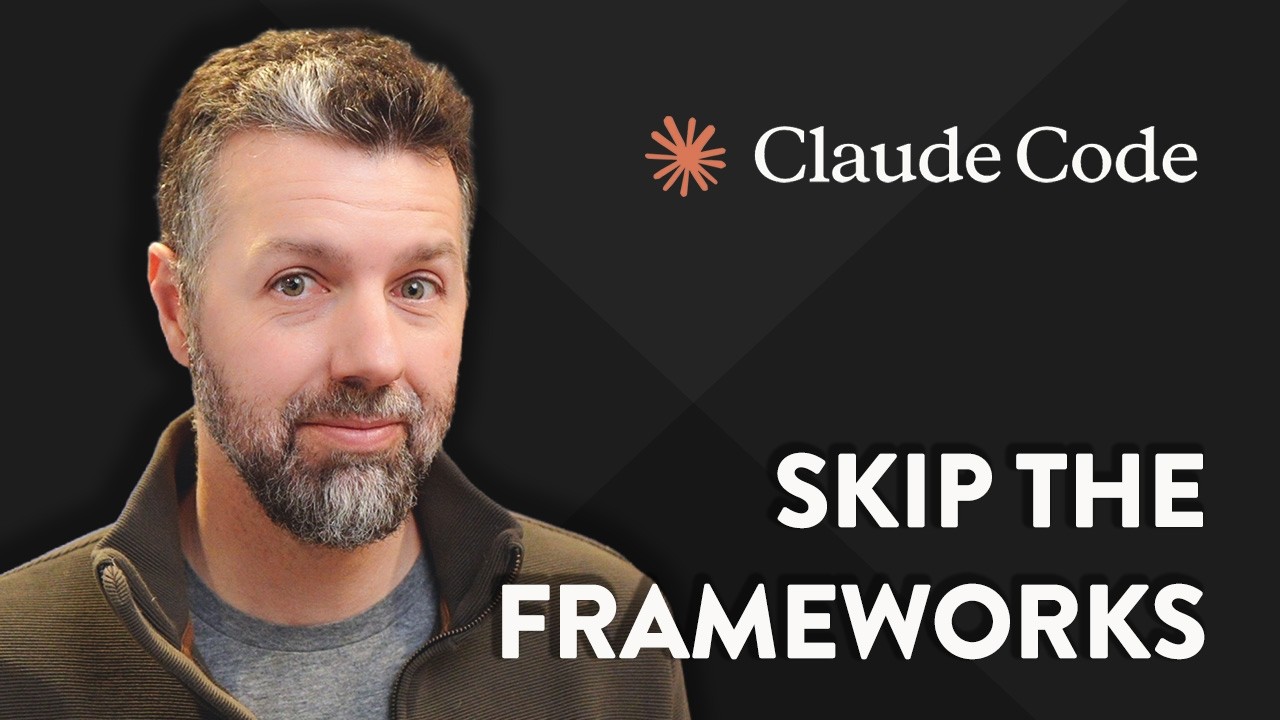
In this video, Brian Castle discusses the evolution of AI-assisted software development, specifically focusing on Claude Code in 2026. He reflects on how the landscape has changed since the tool’s launch, noting that the proliferation of frameworks, agent management systems, and custom setups over the past year has made things seem overwhelming for newcomers. Despite having created one of these frameworks himself—Agent OS—Castle now believes that most of these additional layers are unnecessary for the majority of daily development work. He emphasizes that, thanks to advancements in Claude Code and the Opus 4.5 model, the core tool is now sufficient for 90% of his professional needs.
Castle demonstrates this by building a new feature—an inbox trends view—for one of his real applications using only vanilla Claude Code. He walks through his workflow, starting with strategic planning and clarifying the scope of the feature. He highlights how Claude Code now includes built-in planning modes, sub-agents, and a Q&A interface for clarifying requirements, features that previously required external frameworks like Agent OS. The tool analyzes his codebase, asks relevant questions, and helps him refine the feature’s scope before generating a detailed implementation plan.
He points out that many of the features that once required custom frameworks are now native to Claude Code. For example, the ability to break down specs into actionable tasks, manage context across sessions, and invoke specialized skills (like front-end design) are all integrated. Castle notes that the improvements in AI models—such as Opus 4.5, Gemini 3, and GPT-5—have led to more reliable, context-aware, and efficient development workflows, reducing the need for constant reprompting and manual corrections.
Castle also stresses that while Claude Code handles most of the technical work, the developer’s experience, judgment, and product sense remain crucial. AI can implement patterns and features, but it cannot make strategic decisions or understand user needs at a deep level. He argues that the real bottleneck in software development is no longer writing code, but knowing what to build and how to structure it. The developer’s craft now lies in product thinking and decision-making, which AI tools can amplify but not replace.
Finally, Castle acknowledges that there are still scenarios—such as greenfield product design or working with legacy codebases—where additional structure or frameworks like Agent OS or Design OS can be helpful. However, he cautions against adding unnecessary complexity before mastering the native capabilities of Claude Code. His advice for 2026 is to start simple, learn the core tool, and only introduce extra layers when genuine friction arises. He teases a follow-up video on how he’s streamlining Agent OS to fit this new, simpler paradigm and encourages viewers to subscribe for more insights.